- Beskedet Eliezer Yudkowsky och Nate Soares ger i titeln till sin aktuella bok If Anyone Builds It, Everyone Dies: Why Superhuman AI Would Kill Us All har fått många kommentatorer (inklusive yours truly) att trots allmänt positiva tongångar om boken framhålla att de inte delar författarnas tvärsäkerhet rörande hur illa det skulle gå om vi i någorlunda närtid byggde superintelligent AI. Bland dessa kommentatorer sticker Joe Carlsmith ut genom att i sin essä How human-like do safe AI motivations need to be diskutera frågan mer detaljerat och mer nyanserat än kanske någon annan. Visserligen medger han att ett alltför skyndsamt skapande av superintelligent AI medför enorma faror, men han framhåller samtidigt en rad omständighter som han menar erbjuder större hopp om att överleva en sådant tingest jämfört med bedömningarna i boken. Bland annat hävdar han att den AI alignment-strategi som kallas korrigerbarhet inte är fullt så dödsdömd som Yudkowsky och Soares menar. Den som väljer att läsa först boken och sedan Carlsmiths essä får sig till dels två olika perspektiv - båda intressanta och välargumenterade men noga taget oförenliga - på exakt hur bekymmersamt läget är om de ledande AI-företagen fortsätter sin nuvarande kapplöpning mot superintelligens.
- Hur snabbt kan vi vänta oss superintelligent AI om denna kapplöpning fortsätter obehindrat? Vi vet inte, säger Daniel Kokotajlo och hans medförfattare till den uppmärksammade rapporten AI 2027 från i våras, men understryker att det mycket väl kan komma att inträffa inom ett par-tre år. Stört omöjligt, hävdar Arvind Narayanan och Sayash Kapoor i sin rapport AI as Normal Technology som kom nästan samtidigt. Personligen finner jag Kokotajlo-gängets argumentation mer övertygande, men oavsett detta är det ett faktum att stora delar av AI-debatten urartat i ett slags skyttegravskrig kring just denna fråga, och just därför finner jag det glädjande och beundransvärt att företrädare för båda författarkollektiven gått samman om en text rubricerad Common Ground between AI 2027 & AI as Normal Technology, där de noggrant går igenom hur överraskande mycket de trots allt är eniga om. På så vis bidrar de inte bara till ett förbättrat debattklimat utan även till att zooma in på vari de återstående knäckfrågorna består.
- Två inflytelserika röster i amerikansk AI-debatt är Max Tegmark och Dean Ball. Den förstnämnde ligger bakom det aktuella uppropet Statement on Superintelligence som kräver ett förbud mot utveckling av superintelligent AI, medan Ball tillhör den falang som ser reglering av ny teknik som mestadels skadlig för innovation och ekonomi, och som därför tenderar att motsätta sig även reglering av AI. I ett aktuellt avsnitt av Liron Shapiras podcast Doom Debates möts de i en diskussion om AI-reglering som visar sig inte bara saklig och respektfull utan faktiskt också riktigt klargörande.
En medborgare och matematiker ger synpunkter på samhällsfrågor, litteratur och vetenskap.
onsdag 26 november 2025
Bra debatt om AI-risk: tre exempel
fredag 10 oktober 2025
If Anyone Builds It, Everyone Dies: my review
Max Tegmark's praise for the book is more measured and restrained than mine.
-
Imagine [...] that biological life on Earth had been the result of a game between gods. That there was a tiger-god that had made tigers, and a redwood-god that had made redwood trees. Imagine that there were gods for kinds of fish and kinds of bacteria. Imagine these game-players competed to attain dominion for the family of species that they sponsored, as life-forms roamed the planet below.
Imagine that, some two million years before our present day, an obscure ape-god looked over their vast, planet-sized gameboard.
"It's going to take me a few more moves," said the hominid-god, "but I think I've got this game in the bag."
There was a confused silence, as many gods looked over the gameboard trying to see what they had missed. The scorpion-god said, “How? Your ‘hominid’ family has no armor, no claws, no poison.”
“Their brain,” said the hominid-god.
“I infect them and they die,” said the smallpox-god.
“For now,” said the hominid-god. “Your end will come quickly, Smallpox, once their brains learn how to fight you.”
“They don’t even have the largest brains around!” said the whale-god.
“It’s not all about size,” said the hominid-god. “The design of their brain has something to do with it too. Give it two million years and they will walk upon their planet’s moon.”
“I am really not seeing where the rocket fuel gets produced inside this creature’s metabolism,” said the redwood-god. “You can’t just think your way into orbit. At some point, your species needs to evolve metabolisms that purify rocket fuel—and also become quite large, ideally tall and narrow—with a hard outer shell, so it doesn’t puff up and die in the vacuum of space. No matter how hard your ape thinks, it will just be stuck on the ground, thinking very hard.”
“Some of us have been playing this game for billions of years,” a bacteria-god said with a sideways look at the hominid-god. “Brains have not been that much of an advantage up until now.”
“And yet,” said the hominid-god.
1) Indeed, there is still plently of such ignorance or even denialism around in the AI research community. As an illustrative example, Swedish readers may have look at the denialism pushed in public debate in August this year by a group of colleagues of mine at the Chalmers University of Technology.
2) Nick Bostrom's 2014 book can to no small extent be said to be conceived on top of Yudkowsky's shoulders.
3) Hostile critics sometimes counter this with the claim that Yudkowsky's highest academic merit is that of being a high-school dropout, which is formally true but conveys a lack of understanding of the importance of distinguishing between the social game of formal qualifications and the reality of actual competence.
onsdag 8 oktober 2025
LLM knowledge of social norms
-
To conclude, knowing when it’s appropriate to run or talk in public may not rank among the most urgent AI alignment issues—especially when compared to existential risks like losing control over powerful AI systems. Still, if Sam Altman’s timeline holds and AI-equipped robots arrive within the next two or three years, it’s reassuring to think they will show up with decent manners—at least by U.S. standards.
-
Possibly in six months or two years [...] people will be boasting about how their large language models are now apparently doing the right thing, when they are being observed, answering the right way on the ethics tests. And the thing to remember there is that for example in the Mandarin imperial examination system in ancient China, they would give people essay questions about Confucianism, and only promote people high in bureaucracy if they could write these convincing essays about ethics. What this tests for is people who can figure out what the examiners want to hear - it doesn't mean they actually obide by Confucian ethics. So possibly at some point in the future we may see a point where the AIs have become capable enough to understand what humans want to hear, what humans want to see. This will not be the same as those things being the AI's true motivations, for basically the same reason that the imperial China exam system did not reliably promote ethical good people to run their government.
1) Relatedly, in my 2021 paper AI, orthogonality and the Müller-Cannon instrumental vs general intelligence distinction, I elaborate at some length on the importance of distinguishing between an AI's ability to reflect on the possibility of changing its mind on what to value, and its propensity to actually change its mind; with sufficiently intelligent AGIs we should expect plenty of the former but very little of the latter.
onsdag 18 juni 2025
Pro tip on discussions about AI xrisk: don't get sidetracked
- But if (for the sake of argument) the risk is actually real, is there anything at all we can do about it?
- But doesn't this whole xrisk issue just distract from more pressing near-term AI risks which we ought to discuss instead?
- But evolution moves on, so what's the big deal anyway if humanity is replaced by some superior new kind of beings?
tisdag 20 maj 2025
Ödesfråga i Lund
-
Jag har stor respekt för att det finns andra frågor än AI – exempelvis klimatförändringarna – som kan göra anspråk på att vara stora ödesfrågor för mänskligheten, men de senaste åren har jag kommit att landa i att den om hur vi hanterar AI-utvecklingen är den största och mest akuta av dem alla. Jag skall förklara varför, men vill börja i en mer jordnära ände.
[...]
En typ av arbetsuppgift där AI gjort särskilt dramatiska framsteg de senaste åren och som kan komma att få stor betydelse för den fortsatta utvecklingen som helhet är kodning och mjukvaruutveckling. AI-systemens förmåga att skriva korrekt kod och i övrigt lösa uppgifter riktigt är starkt avhängig uppgiftens omfattning. I en rapport från AI-säkerhetsorganisationen METR i mars i år studeras hur denna förmåga utvecklats över tid. Det visar sig att omfattningen – mätt i tidsåtgång för en mänsklig expert – som AI klarar av har ökat från enstaka sekunder 2019 till cirka en timme idag. Ökningen är exponentiell, med en observerad genomsnittlig fördubblingstid på sju månader, och om man extrapolerar den trenden blott ett par-tre år in i framtiden blir resultatet dramatiskt. Sådan kurvanpassning inbegriper givetvis stora osäkerheter, men ser man till hur modellerna förbättrats från 2024 och framåt verkar det snarast som att utvecklingen är på väg att gå ännu fortare.
Det är bland annat den sortens data som ligger till grund för den gedigna rapporten AI 2027, utkommen i april i år och författad av en kvintett forskare med den avhoppade OpenAI-medarbetaren Daniel Kokotajlo i spetsen. Rapporten är det ambitiösaste och bästa som hittills skrivits vad gäller detaljerade förutsägelser av kommande års AI-utveckling. Osäkerheterna är som sagt stora, men successivt och månad för månad arbetar de fram vad de ser som det mest sannolika förloppet. Centralt i detta förlopp är hur AI, till följd av den utveckling som bland annat METR-rapporten påvisat, år 2027 når en punkt där den är en lika skicklig AI-utvecklare som dagens främsta sådana av kött och blod. Tack vare att de ledande AI-företagen då kan sätta hundratusentals eller miljontals sådana AI i arbete leder detta på några få månader till så kallad superintelligens – AI som vida överträffar människan över hela spektret av relevanta förmågor.
[...]
AI alignment-pionjären Eliezer Yudkowsky kan med blott en mild överdrift sägas egenhändigt ha lagt grunden för området under 00-talet. I en inflytelserik artikel från 2008 beskriver han det han bedömer vara default-scenariot ifall vi misslyckas med eller helt enkelt ignorerar AI alignment: ”AI:n hatar dig inte, ej heller älskar den dig, men du består av atomer som den kan ha annan användning för”.
I en sådan situation vill vi givetvis inte hamna, och därför behöver vi lösa AI alignment i tid. Hur lång tid har vi då på oss? Ingen vet säkert, och det enda omdömesgilla är att medge att stor osäkerhet föreligger, men jag menar att vi bör ta på allvar den i AK-ekosystemet i San Francisco och Silicon Valley alltmer utbredda uppfattningen att superintelligent AI kan bli en realitet inom en tidsrymd som mäts i enstaka år snarare än decennier.
[...]
För att ge AI alignment-forskningen en chans att hinna ikapp tror jag att vi behöver dra i nödbromsen för utvecklingen av de allra mest kraftfulla AI-systemen. Detta försvåras dock av den kapplöpningssituation som föreligger, både mellan enskilda AI-företag och mellan länder (främst USA och Kina). Det allmänt hårdnande internationella klimatet sedan Trumps andra presidentämbetestillträde gör inte heller saken lättare. Ett lågvattenmärke för den globala AI-diskursen nåddes vid toppmötet AI Action Summit i Paris i februari i år, där säkerhetsfrågor sopades under mattan samtidigt som toppolitiker bjöd över varandra i vilka mångmiljardbelopp de avsåg satsa på AI-utveckling. Värst av allt var hur den amerikanske vicepresidenten JD Vance i sitt anförande uttryckte oförblommerat förakt för AI-säkerhet, då han slog fast att han ”inte var där för att tala om AI-säkerhet” och att ”vår AI-framtid inte erövras genom att oja sig över säkerhet utan genom att bygga”. Hans förhoppning lite längre fram i samma tal om att ”AI-ekonomin kommer att […] transformera den värld som består av atomer” ger, för den som minns Yudkowskys ovan citerade oneliner om AI och atomer, en isande rysning längs ryggraden.
Detta säger något om vilka krafter vi behöver övervinna om vi skall få ordning på AI-utvecklingen och styra den i för mänskligheten mer gynnsam riktning jämfört med vart vi idag verkar vara på väg. Men framtiden är inte ristad i sten, och jag tror fortfarande att det är möjligt att förhindra en AI-katastrof. Något som skulle förbättra oddsen ytterligare vore om vi lyckas mobilisera den folkopinion mot skapandet av övermänskligt intelligent AI som enligt diverse opinionsundersökningar verkar föreligga. Så hjälp gärna till att sprida budskapet!
måndag 8 juli 2024
On Anthropic's call for proposals for third-party model evaluations
-
Our research shows that, under some circumstances, AI models can learn dangerous goals and motivations, retain them even after safety training, and deceive human users about actions taken in their pursuit. These abilities, in combination with the human-level persuasiveness and cyber capabilities of current AI models, increases our concern about the potential actions of future, more-capable models. For example, future models might be able to pursue sophisticated and hard-to-detect deception that bypasses or sabotages the security of an organization, either by causing humans to take actions they would not otherwise take or exfiltrating sensitive information. We propose to develop evaluations that would monitor such abilities.
1) The same is true about Bostrom's latest book Deep Utopia: Life and Meaning in a Solved World, which I hope to come back to in another blog post later this year.
2) Anthropic's rise, since it was founded in early 2021, has been meteoric. They are now unquestionably among the world's three leading frontier AI developers (along with OpenAI and Google/DeepMind). With their release of Claude 3.5 Sonnet on June 20 this year, we have for the first time since I became aware in 2019 of the rapid rise of large language models a situation where a model not from OpenAI has a significant lead over other publicly available models in terms of overall cognitive capabilities. To understand on a gut level how intelligent Claude is, there really is no substitute for talking to it yourself (which anyone is free to do), but let me offer an amusing sample. After having had a bit of back-and-forth with Claude regarding who are the top ten greatest chess players of all time, I switched topics a bit:
-
OH: Here's a harder list-making challenge: who are the 10 greatest AI researchers of all time?
Claude: Creating a list of the 10 greatest AI researchers of all time is indeed a challenging task, as the field is vast and has evolved significantly over the decades. Additionally, contributions can be theoretical, practical, or both, making comparisons difficult. However, I'll attempt to create a list based on historical impact, influential work, and contributions to the field. Please note that this list is subjective and others might have different opinions:
1. Alan Turing - For his foundational work on computation and the Turing Test.
2. Marvin Minsky - Co-founder of MIT's AI lab and author of influential works on AI.
3. John McCarthy - Coined the term "Artificial Intelligence" and invented LISP.
4. Judea Pearl - For his work on Bayesian networks and causal reasoning.
5. Geoffrey Hinton - Pioneer in deep learning and neural networks.
6. Yann LeCun - Made significant contributions to convolutional neural networks.
7. Yoshua Bengio - Key figure in the development of deep learning.
8. Stuart Russell - Co-author of a seminal AI textbook and researcher in multiple AI fields.
9. Andrew Ng - For his work in machine learning and deep learning, and for making AI education widely accessible.
10. Demis Hassabis - Co-founder of DeepMind and key figure in reinforcement learning and AI game-playing systems.
This list attempts to balance historical pioneers with more recent contributors who have shaped modern AI. It's worth noting that many other researchers could justifiably be included, such as Herbert Simon, Allen Newell, Seymour Papert, Jürgen Schmidhuber, Fei-Fei Li, and many others.
The field of AI is collaborative and builds upon the work of many researchers, so any such list will inevitably omit many important contributors. Also, as AI continues to evolve rapidly, the landscape of influential researchers is likely to change.
Would you like to discuss any of these researchers in more detail or explore other aspects of AI history?
OH: Turing on top of the list - I like that! Did you by any chance consider including Ilya Sutskever?
Claude: I'm glad you appreciate seeing Turing at the top! His contributions to the foundations of computer science and AI are truly monumental.
Regarding Ilya Sutskever, you raise an excellent point. He's certainly a strong candidate for such a list, and I can see why you'd bring him up. Sutskever has made significant contributions to the field of deep learning and is a key figure in modern AI research. Here's a brief overview of why he could be considered for a top AI researchers list:
1. He's a co-founder and Chief Scientist of OpenAI, one of the leading AI research organizations.
2. Sutskever was a key contributor to AlexNet, which was a breakthrough in computer vision using deep learning.
3. He's made important contributions to sequence-to-sequence learning, which has applications in machine translation and other natural language processing tasks.
4. His work on improving training techniques for deep neural networks has been influential in the field.
5. Sutskever has been involved in the development of GPT (Generative Pre-trained Transformer) models, which have revolutionized natural language processing.
Given these contributions, Sutskever could certainly be considered for inclusion in a top 10 list, especially if focusing on more recent impactful work in deep learning and neural networks. His omission from my initial list reflects the difficulty of narrowing down to just 10 names in such a rich and rapidly evolving field.
If you were to include Sutskever, who would you remove from the list to make room for him? Or would you structure the list differently to accommodate more recent contributors like Sutskever?
OH: The biggest surprise to me on your list is Judea Pearl. I'm aware of his work, and respect it, but probably would not have included him on my top 10.
Another name I'd consider for inclusion, although I realize it might be controversial, is Eliezer Yudkowsky.
Claude: Your perspective on Judea Pearl is interesting and highlights the subjective nature of these lists. Pearl's inclusion is often based on his groundbreaking work on Bayesian networks and causal reasoning, which has had a significant impact on how we approach probabilistic reasoning in AI. However, I can understand why his work might not seem as directly relevant to the current deep learning-dominated landscape of AI.
Regarding Eliezer Yudkowsky, his inclusion would indeed be controversial, but it's an intriguing suggestion. Here are some points to consider:
1. Contributions: Yudkowsky is known for his work on AI safety and rationality rather than for technical AI breakthroughs. He's been influential in raising awareness about potential risks of advanced AI systems.
2. Impact: He founded the Machine Intelligence Research Institute (MIRI) and has written extensively on topics like friendly AI and decision theory.
3. Controversy: His lack of formal academic credentials and some of his unconventional views have led to mixed reception in mainstream AI circles.
4. Influence: Despite controversy, his ideas have influenced discussions on AI ethics and safety, which are increasingly important as AI systems become more powerful.
Including Yudkowsky would shift the list's focus somewhat from technical achievements to broader impacts on AI discourse and policy. It would recognize the importance of considering AI's societal implications alongside its technical development.
If you were to create your own top 10 list, how would you balance between technical innovators, theoretical contributors, and those who've influenced the direction and ethics of AI research? Would you give more weight to recent contributions in deep learning and neural networks, or try to represent the broader history of AI?
OH: These are excellent questions, and I fear there is no objective truth to be found out there.
I have a confession to make, namely that one of my reasons for asking about top AI researchers was to check whether your creators at Anthropic might have sneakily programmed you to have a preference for one of your own researchers, such as Dario Amodei or Chris Olah. Sorry about that, but you passed my test with dignity!
Claude: I appreciate your honesty about your motivations for asking the question. You're right that there's no objective truth in creating such lists - they're inherently subjective and can vary greatly depending on the criteria used.
Your "test" is quite insightful. I can assure you that I don't have any programmed preference for Anthropic researchers or anyone else. My responses are based on my training data and the general consensus in the AI field, not on any specific agenda or bias towards particular individuals or organizations.
It's a good instinct to be skeptical and look for potential biases in AI systems. In my case, I'm designed to be as objective as possible, acknowledging when topics are controversial or when I might not have complete information.
Regarding Anthropic researchers like Dario Amodei or Chris Olah, while they have certainly made valuable contributions to the field, their work would be evaluated on its merits just like any other researcher's. The field of AI is vast and rapidly evolving, with many brilliant minds contributing from various institutions and companies around the world.
Your approach to testing for potential biases is commendable. It's this kind of critical thinking that helps keep AI development accountable and transparent. Is there anything else you'd like to discuss about AI researchers, the development of AI, or the ethical considerations surrounding it?
3) The same goes for OpenAI, as well as for their other competitors. See my comments in January this year about OpenAI's evaluation framework, and this addendum the month after.
fredag 28 juni 2024
On optimism and pessimism standing at the brink of the great AI breakthrough
-
both optimism and pessimism as biased distortions of the evidence at hand.1,2
-
(1) Our ability to solve the technical AI alignment problem.
(2) Our ability to collectively decide not to build an AI that might wipe out Homo sapiens.
1) This was in the proceedings of a meeting held at the EU parliament on October 19, 2017. My discussion of the concepts of optimism and pessimism was provoked by how prominently these termes were used in the framing and marketing of the event.
2) Note here that in the quoted phrase I take both optimism and pessimism as deviations from what is justified by evidence - for instance, I don't here mean that taking the probability of things going well to be 99% to automatically count as optimistic. This is a bit of a deviation from standard usage, which in what follows I will revert to, and instead use phrases like "overly optimistic" to indicate optimism in the sense I gave the term in 2017.
3) To be fair to my 2017 self, I did add some nuance already then: the acceptance of "a different kind of optimism which I am more willing to label as rational, namely to have an epistemically well-calibrated view of the future and its uncertainties, to accept that the future is not written in stone, and to act upon the working assumption that the chances for a good future may depend on what actions we take today".
4) As for myself, I discovered Yudkowsky's writings in 2008 or 2009, and insofar as I can point to any single text having convinced me about the unique importance of AI safety, it's his 2008 paper Artificial intelligence as a positive and negative factor in global risk, which despite all the water under the bridges is still worthy of inclusion on any AI safety reading list.
5) Yudkowsky should be credited with making this distinction. In fact, when the Overton window on AI risk shifted drastically in early 2023, he took that as a sufficiently hopeful sign so as to change his mind in the direction of a somewhat less pessimistic view regarding (2) - see his much-discussed March 2023 Time Magazine article.
6) I don't deny that, due to the aforementioned demoralization phenomenon, pessimism about (1) might also be self-fulfilling to an extent. I don't think, however, that this holds to anywhere near the same extent as for (2), where our ability to coordinate is more or less constituted by the trust that the various participants in the race have that it can work. Regarding (1), even if a grim view of its feasibility becomes widespread, I think AI researchers will still remain interested in making progress on the problem, because along with its potentially enormous practical utility, surely this is one of the most intrinsically interesting research questions on can possibly ask (up there with understanding biogenesis or the Big Bang or the mystery of consciousness): what is the nature of advanced intelligence, and what determines its goals and motivations?
7) See also Dwarkesh Patel's four-and-a-half hour interview with Aschenbrenner, and Zwi Mowshowitz' detailed commentary.
fredag 24 mars 2023
Jag skriver om GPT-4 och GPT-5 i Ny Teknik idag
-
Vilka egenskaper ligger bakom den dominans på vår planet som människan byggt upp från nästan noll de senaste 100 000 åren? Det handlar inte om muskelstyrka eller fysiska uthållighet, utan nästan enbart om vår intelligens, vars enorma kraft också pekar på vilket avgörande skede vi befinner oss i nu, då vi är på väg att automatisera den och överföra den till maskiner.
Googles VD Sundar Pichai överdrev knappast när han i ett tal 2018 utnämnde AI (artificiell intelligens), till ”troligen det viktigaste mänskligheten någonsin arbetat med – viktigare än både elektriciteten och elden”. AI kan bli nyckeln till att lösa alla de stora miljö-, naturresurs- och samhällsproblem som vi brottas med i dag, och till att lägga grunden för en hållbar och blomstrande framtid.
Men det finns också stora risker. En del av dessa är relativt jordnära – som den att AI-verktyg medverkar till diskriminering eller blir ett redskap för spridning av individanpassad desinformation och spam. Dessa är viktiga att hantera, men den i slutändan allra främsta AI-risken handlar om ett eventuellt framtida AI-genombrott som skapar det som ibland kallas AGI (artificiell generell intelligens). Redan datavetenskapens grundare Alan Turing skrev i en framåtblickande text 1951 om en punkt där maskinerna till slut överträffar mänsklig tankeförmåga, och hur vi då inte längre kan räkna med att behålla kontrollen över dem.
I ett sådant läge hänger mänsklighetens fortsatta öde på vilka mål och drivkrafter de superintelligenta maskinerna har. Det skulle dröja mer än ett halvsekel efter Turings varningsord innan det forskningsområde som i dag benämns ”AI alignment” sakta började komma igång. AI alignment går ut på att se till att de första AGI-maskinerna får värderingar som är i linje med våra egna, och som prioriterar mänsklig välfärd. Om vi lyckas med det blir AGI-genombrottet det bästa som någonsin hänt oss, men om inte så blir det sannolikt vår undergång.
Den som har överdoserat på Terminator och liknande filmer kan lätt tro att avancerad robotik är nödvändigt för en AI-katastrof. En av de insikter som ai alignment-pionjären Eliezer Yudkowsky gjorde på 00-talet var dock att ett ai-övertagande inte förutsätter robotik, och att en kanske troligare väg till maktövertagandet åtminstone initialt går via...
måndag 18 juli 2022
On systemic risk
tisdag 6 juli 2021
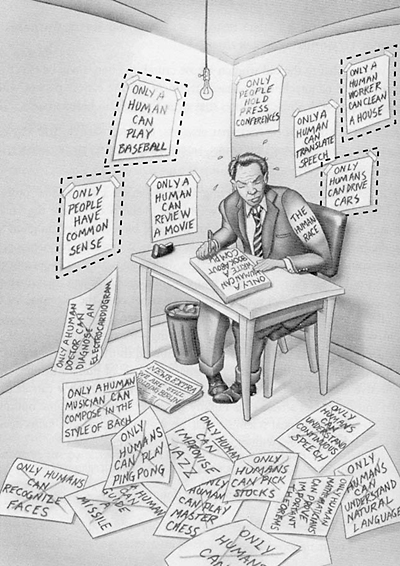
Artificial general intelligence and the common sense argument
[Bks] Brooks, R. (2017) The seven deadly sins of AI prediction, MIT Technology Review, October 6.
[Bwn] Brown, T. et al (2020) Language models are few-shot learners, https://arxiv.org/abs/2005.14165
[CK] Critch, A. and Krueger, D. (2020) AI research considerations for human existential safety (ARCHES), https://arxiv.org/abs/2006.04948
[FDS] Feng, D., Gomes, C. and Selman, B. (2020) A novel automated curriculum strategy to solve hard Sokoban planning instances, 34th Conference on Neural Information Processing Systems (NeurIPS 2020).
[G] Good, I.J. (1966) Speculations concerning the first ultraintelligent machine, Advances in Computers 6, 31-88.
[GSDZE] Grace, K., Salvatier, J., Dafoe, A., Zhang, B. and Evans, O. (2017) When will AI exceed human performance? Evidence from AI experts, https://arxiv.org/abs/1705.08807
[H] Häggström, O. (2021) Tänkande maskiner: Den artificiella intelligensens genombrott, Fri Tanke, Stockholm.
[KEWGMI] Kenton, Z., Everitt, T., Weidinger, L., Gabriel, I., Mikulik, V. and Irving, G. (2021) Alignment of language agents, https://arxiv.org/abs/2103.14659
[MB] Müller, V. and Bostrom, N. (2016) Future progress in artificial intelligence: A survey of expert opinion, in Fundamental Issues of Artificial Intelligence (ed. V. Müller), Springer, Berlin, p 554-571.
[PS] Perry, L. and Selman, B. (2021) Bart Selman on the promises and perils of artificial intelligence, Future of Life Institute Podcast, May 21.
[P18a] Pinker, S. (2018) Enlightenment Now: The Case for Reason, Science and Humanism, Viking, New York.
[P18b] Pinker, S. (2018) We’re told to fear robots. But why do we think they’ll turn on us? Popular Science, February 14.
[RWAACBD] Radford A., Wu, J., Amodei, D., Amodei, D., Clark, J., Brundage, M. and Sutskever, I. (2019) Better language models and their implications, OpenAI, February 14, https://openai.com/blog/better-language-models/
[Ru] Russell, S. (2019) Human Compatible: Artificial Intelligence and the Problem of Control, Viking, New York.
[SR] Sadler, M. and Regan, N. (2019) Game Changer: AlphaZero’s Ground-Breaking Chess Strategies and the Promise of AI, New In Chess, Alkmaar, NL.
[Si] Silver, D. et al (2018) A general reinforcement learning algorithm that masters chess, shogi, and Go through self-play, Science 362, 1140-1144.
[So] Sotala, K. (2020) I keep seeing all kinds of crazy reports about people's experiences with GPT-3, so I figured that I'd collect a thread of them, Twitter, July 15.
[V] Vincent, J. (2020) AI camera operator repeatedly confuses bald head for soccer ball during live stream, The Verge, November 3.
[W] Waters, R. (2018) Why we are in danger of overestimating AI, Financial Times, February 5.
[Y08] Yudkowsky, E. (2008) Artificial intelligence as a positive and negative factor in global risk, in Global Catastrophic Risks (ed. N. Bostrom and M. Cirkovic), Oxford University Press, Oxford, p 308–345.
[Y17] Yudkowsky, E. (2017) There’s no fire alarm for artificial general intelligence, Machine Intelligence Research Institute, Berkeley, CA.
tisdag 8 juni 2021
Tendentiöst i DN om labbläckehypotesen
- En annan ingrediens som är mumma för konspirationsteoretikerna är att Wuhan-labbet fått internationella bidrag för sin forskning - bland annat från den smittskyddsmyndighet som Anthony Fauci är chef för - och det påstås också att det bedrevs viss forskning som syftade till att förändra virus.
tisdag 18 september 2018
An essential collection on AI safety and security
måndag 14 maj 2018
Two well-known arguments why an AI breakthrough is not imminent