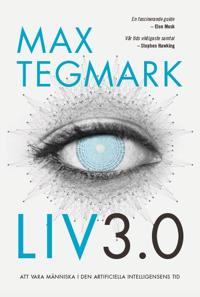
- Igår besökte jag Förmiddag i P4 Göteborg med Stefan Livh (som jag nästan blivit stamgäst hos), och vi pratade om hur framtiden med artificiell intelligens kan komma att te sig, med start cirka 1:34 in i ljudfilen fram till och med 1:54.
- I ett inslag i Aftonbladet/TV3 Morgon vid halv nio-tiden i morse gick jag (lite motvilligt) med på att rangdordna de fem största hoten mot mänskligheten.
En medborgare och matematiker ger synpunkter på samhällsfrågor, litteratur och vetenskap.
tisdag 14 november 2017
Nya framträdanden i radio och TV
fredag 3 november 2017
Lidande - en filosofisk läslista
- Först har vi som sagt Thomas Metzingers uppsats Suffering.
- En annan filosof, David Benatar, är känd för sin bok Better Never to Have Been: The Harm of Coming into Existence. Jag har (ännu) inte läst boken, men rekommenderar hans färska uppsats Having children is not life-affirming: it's immoral i vilken han argumenterar för den ytterst kontroversiella ståndpunkten att ett människoliv tenderar att föra med sig så mycket lidande att det helt enkelt är omoraliskt att skaffa barn. Följande passage i uppsatsen ansluter till ovan nämnda taxidiskussion:
- The suggestion that life is worse than most people think is often met with indignation. How dare I tell you how poor the quality of your life is! Surely the quality of your life is as good as it seems to you? Put another way, if your life feels as though it has more good than bad, how could you possibly be mistaken?
It is curious that the same logic is rarely applied to those who are depressed or suicidal. In these cases, most optimists are inclined to think that subjective assessments can be mistaken. However, if the quality of life can be underestimated it can also be overestimated. Indeed, unless one collapses the distinction between how much good and bad one’s life actually contains and how much of each a person thinks it contains, it becomes clear that people can be mistaken about the former. Both overestimation and underestimation of life’s quality are possible, but empirical evidence of various cognitive biases, most importantly an optimism bias, suggests that overestimation is the more common error.
- En klassiker på Scott Alexanders formidabelt läsvärda blogg Slate Star Codex är bloggposten Meditations on Moloch, som bättre än något annat jag läst visar hur ofantligt svårt det är att skapa och i det långa loppet bevara ett gott samhälle (i betydelsen ett samhälle där invånarna upplever lycka och välbefinnande), och hur starka de evolutionära, ekonomiska och spelteoretiska krafter är som driver på i motsatt riktning. Detta understryker relevansen i framtidsscenarier med astronomiska mängder lidande.
- Negativ utilitarism (NU) är en moralfilosofisk inriktning som fokuserar på minimering av lidande (och mindre eller inte alls på förbättringar i den andra änden av den hedoniska skalan, ökandet av välbefinnande). Påverkad av Toby Ords eminenta uppsats Why I'm Not a Negative Utilitarian har jag tenderat att avfärda NU, men saken är möjligen inte fullt så enkel som jag tidigare tänkt, och Simon Knutssons kritik av Ord är värd att ta del av (se även Knutssons The World Destruction Argument).
- Relaterad till NU, men inte samma sak (genom att vara inte ett moralsystem utan snarare en teori om hur vi är funtade) är så kallad tranquilism; se Lukas Gloors uppsats om saken.
fredag 27 oktober 2017
On Tegmark's Life 3.0
- Why do we know that AGI is decades away? In popular articles penned by heads of AI research labs and the like, there are typically three prominent reasons given:
(A) The author does not know how to build AGI using present technology. The author does not know where to start.
(B) The author thinks it is really very hard to do the impressive things that modern AI technology does, they have to slave long hours over a hot GPU farm tweaking hyperparameters to get it done. They think that the public does not appreciate how hard it is to get anything done right now, and is panicking prematurely because the public thinks anyone can just fire up Tensorflow and build a robotic car.
(C) The author spends a lot of time interacting with AI systems and therefore is able to personally appreciate all the ways in which they are still stupid and lack common sense.
måndag 23 oktober 2017
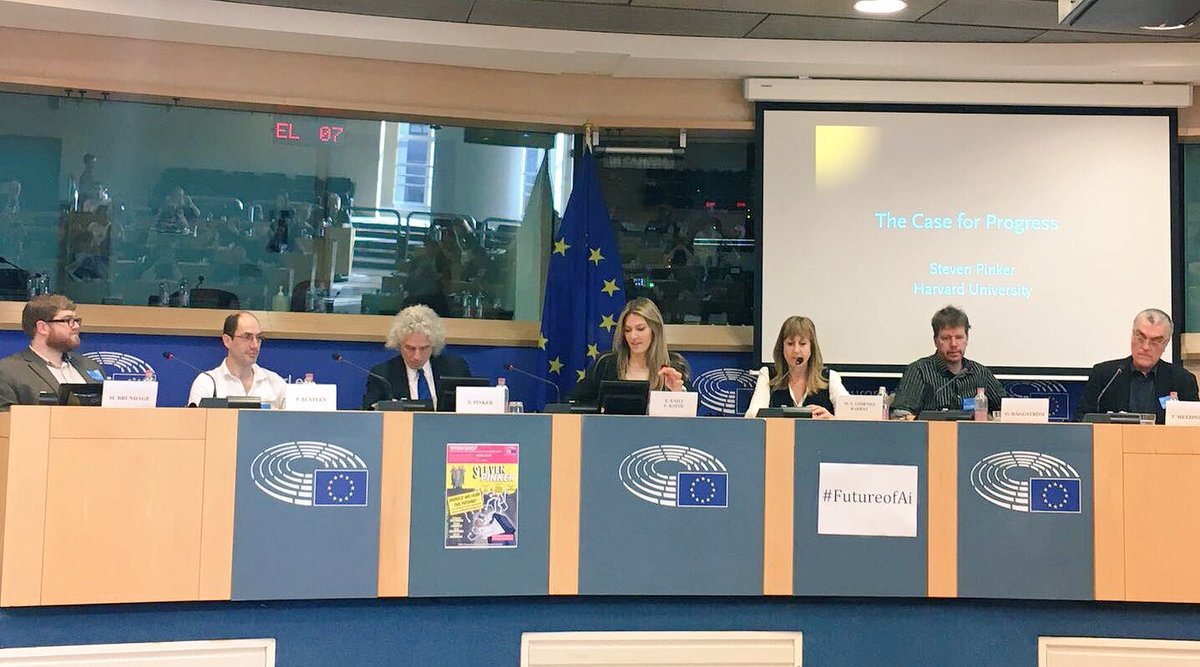
The AI meeting in Brussels last week
-
1. The general public already has the nuclear threat and the climate threat to worry about, and bringing up yet another global risk may overwhelm people and cause them to simply give up on the future. There may be something to this speculation, but to evaluate the argument's merit we need to consider separately the two possibilities of
-
(a) apocalyptic AI risk being real, and
(b) apocalyptic AI risk being spurious.
2. Pinker held forth a bunch of concerns that seemed more or less copy-and-pasted from the standard climate denialism discourse. These included the observation that the Millennium bug did not cause global catastrophe, whence (or so the argument goes) a global catastrophe cannot be expected from a superintelligent AGI (analogously to the oft-repeated claim that the old Greek's fear that the skies would fall down turing out to be unfounded shows that greenhouse gas emissions cannot accelerate global warming in any dangerous way), and speculations about the hidden motives of those who discuss AI risk - they are probably just competing for status and research grants. This is not impressive. See also yesterday's blog post by my friend Björn Bengtsson for more on this; it is to him that I owe the (in retrospect obvious) parallel to climate denialism.
-
3. All the apocalyptic AI scenarios involve the AI having bad goals, which leads Pinker to reflect on why in the world would anyone program the machine with bad goals - let's just not do that! This is essentially the idea of the so-called Friendly AI project (see Yudkowsky, 2008, or Bostrom, 2014), but what Pinker does not seem to appreciate is that the project is extremely difficult. He went on to ask why in the world anyone would be so stupid as to program self-preservation at all costs into the machine, and this in fact annoyed me slightly, because it happened just 20 or so minutes after I had sketched the Omohundro-Bostrom theory for how self-preservation and various other instrumental goals are likely to emerge spontaneously (i.e., without having them explicitly put into it by human programmers) in any sufficiently intelligent AGI.
4. In the debate, Pinker described (as he had done several times before) the superintelligent AGI in apocalyptic scenarios as having a typically male psychology, but pointed out that it can equally well turn out to have more female characteristics (things like compassion and motherhood), in which case everything will be all right. This is just another indication of how utterly unfamiliar he is with the literature on possible superintelligent psychologies. His male-female distinction in the general context of AGIs is just barely more relevant than the question of whether the next exoplanet we discover will turn out to be male or female.
- Why do we know that AGI is decades away? In popular articles penned by heads of AI research labs and the like, there are typically three prominent reasons given:
(A) The author does not know how to build AGI using present technology. The author does not know where to start.
(B) The author thinks it is really very hard to do the impressive things that modern AI technology does, they have to slave long hours over a hot GPU farm tweaking hyperparameters to get it done. They think that the public does not appreciate how hard it is to get anything done right now, and is panicking prematurely because the public thinks anyone can just fire up Tensorflow and build a robotic car.
(C) The author spends a lot of time interacting with AI systems and therefore is able to personally appreciate all the ways in which they are still stupid and lack common sense.
fredag 13 oktober 2017
Fler ställen att läsa om vårt existentiell risk-program
- forskning.se, 13 september 2017.
- ETC, 23 september 2017.
- GU-Journalen 4/2017 (s 25-26).
torsdag 5 oktober 2017
Videos from the existential risk workshop
- Anders Sandberg: Tipping points, uncertainty and systemic risks: what to do when the whole is worse than its parts?
- Karin Kuhlemann: Complexity, creeping normalcy, and conceit: Why certain catastrophic risks are sexier than others
- Phil Torres: Agential risks: Implications for existential risk reduction
- Karim Jebari: Resetting the tape of history
- Due to a technical mishap, we have no video for David Denkenberger's talk on Cost of non-sunlight dependent food for agricultural catastrophes. Try instead watching his talk Feeding everyone no matter what given at CSER in Cambridge last year, which covers much of the same ground.
- Thore Husfeldt: Plausibility and utility of apocalyptic AI scenarios
- Roman Yampolskiy: Artificial intelligence as an existential risk to humanity
- Stuart Armstrong: Practical methods to make safe AI
- Robin Hanson: Disasters in the Age of Em and after
- Katja Grace: Empirical evidence on the future of AI
- James Miller: Hints from the Fermi paradox for surviving existential risks
- Catherine Rhodes: International governance of existential risk
- Seth Baum: In search of the biggest risk reduction opportunities
måndag 2 oktober 2017
Några datum att hålla ordning på i oktober
- Onsdag 4 oktober: Jag fyller 50.
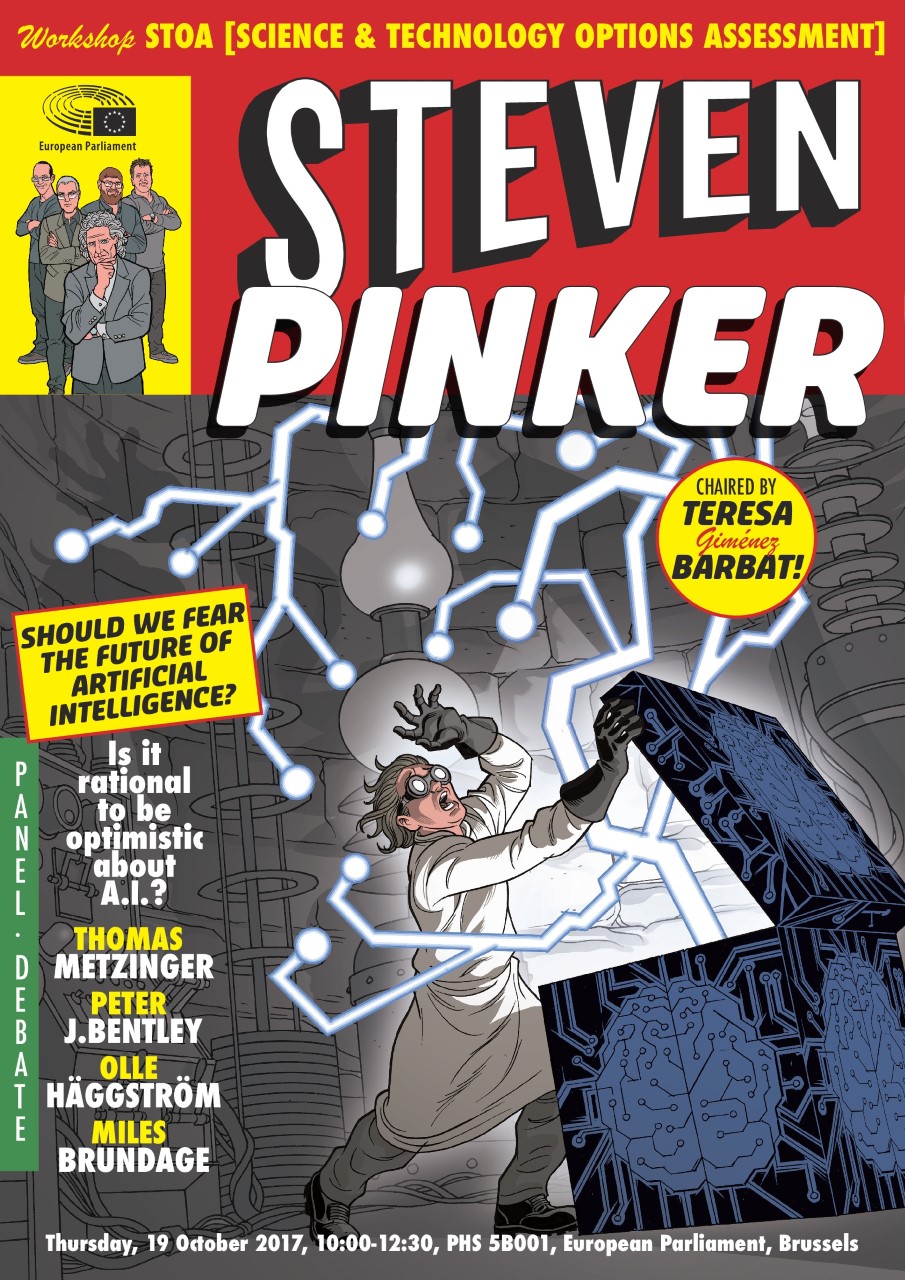
- Torsdag 19 oktober: Jag besöker EU-parlamentet i Bryssel för att debattera med bland andra Steven Pinker om framtiden med artificiell intelligens och så kallad rationell optimism. Se bilden ovan (som är en detalj från mötets officiella poster) för en illustration av diskussionspanelens brist på mångfald.
- Tisdag 24 oktober: Dorna Behdadi och jag besöker Borås Kulturhus för att diskutera ungefär samma ämne - framtiden med artificiell intelligens - fast denna gång klokt nog utan någon på förhand stipulerad slogan om var på skalan optimism/pessimism man bör lägga sig.