Visar inlägg med etikett Timothy Snyder. Visa alla inlägg

onsdag 11 november 2020

20 Lessons for November-December 2020

I have called your attention to the important writings of historian Timothy Snyder before (such as here, here, here). Now he is back, with a message more urgent than ever:

söndag 2 september 2018

Snyder on Putin and the threats to freedom and democracy

Earlier this year, I enthusiastically reviewed (in Swedish) Daniel Ellsberg's important book The Doomsday Machine: Confessions of a Nuclear War Planner. Based on unique inside information, Ellsberg makes such an overwhelming case that the nuclear balance of terror between the United States and the USSR/Russia has been (and still is) even more dangerous than most of us have realized, and that disarmament is the only sensible way forward, that one begins to wonder how anyone could possibly oppose disarmament. Well, for the sake of balance (no pun intended!), let me offer the best counterpoint I've seen, given to the world through the actions of Vladimir Putin, and reluctantly put into words by Timothy Snyder in his most recent book The Road to Unfreedom: Russia, Europe, America as follows:
    [The Russian invasion of Crimea in 2014] violates basic consensual principles of international law, the United Nations Charter, every treaty signed between independent Ukraine and independent Russia, as well as a number of assurances that Russia has offered Ukraine about the protection of its frontiers. One of these was the Budapest Memorandum of 1994, in which the Russian Federation (along with the United Kingdom and the United States) had guaranteed Ukranian borders when Ukraine agreed to give up all nuclear weapons. In what was perhaps the greatest act of nuclear disarmament in history, Ukraine handed over some 1,300 intercontinental ballistic missiles. By invading a country that had engaged in complete nuclear disarmament, Russia offered the world the lesson that nuclear arms should be pursued. [p 142]
The Road to Unfreedom is Snyder's follow-up to his marvelous little book On Tyranny from 2017. His new book is very different but just as important. It offers a detailed history of Vladimir Putin's misdeeds in the 2010's, his multifaceted fight against democracy at home, in Europe and in the United States, his war on Ukraine, and his successful effort to install in the White House a person who for all practical purposes can be regarded as his puppet.1 Solid sources are provided throughout, and the events are skillfully integrated into a highly readable narrative, including the necessary background on Stalin's, Brezhnev's and Gorbachev's Soviet Union and on Yeltsin's Russia, as well as on the fascist thinkers (mainly Ivan Ilyin) whom Putin has chosen as his and his country's pet philosophers to support his aggressive geopolitical views. The Road to Unfreedom is essential reading for anyone who wants to understand current events in Russia and in the West.

Let me add something to my Swedish compatriots who will go to the election polls on Sunday (September 9). One of the main lessons from Snyder's book is that Putin aspires to destabilize Europe and ultimately to dissolve the European Union, so as to make it easier for him to attain dominance over Eurasia. There is no end to the cynical things he will do to this end, including bombing Syria to fuel the refugee crisis. His other main tool to the same end is to support right-wing and EU-skeptical populist parties across Europe, for instance using his troll factories. If you vote for Sverigedemokraterna on Sunday, you play right into Putin's hands.

Footnote

1) This is convincingly argued in the book despite it being published several months prior to Putin's and Trump's July 2018 press conference in Helsinki, where Trump's puppet status was made overwhelmingly clear to anyone who cared to look.

lördag 23 december 2017

Do not obey in advance

About the recent public outcry about a 1984-style ban on the terms vulnerable, entitlement, diversity, transgender, fetus, evidence-based, and science-based at the United States Centers for Disease Control and Prevention (CDC). It turns out, according to a Slate article a couple of days ago, that the ban came not from the Trump administration, but from within. From the Slate article:
    Anonymous sources at the Department of Health and Human Services told the National Review’s Yuval Levin this week that any language changes did not originate with political appointees, but instead came from career CDC officials who were strategizing how best to frame their upcoming budget request to Congress. What we’re seeing, his interviews suggest, is not a top-down effort to stamp out certain public-health initiatives, like those that aim to help the LGTBQ community, but, in fact, the opposite: a bottom-up attempt by lifers in the agency to reframe (and thus preserve) the very work they suspect may be in the greatest danger.
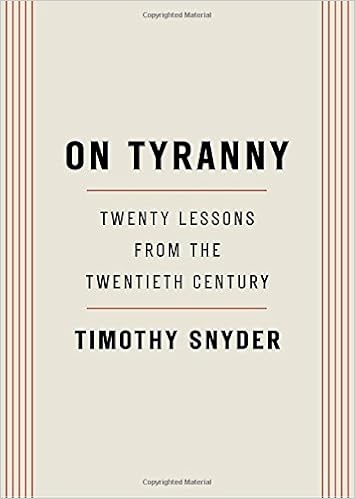
This does not make the case any less worrisome. It is a good example of what Timothy Snyder calls obedience in advance. The Trump administration didn't have to tell the CDC to suppress talk about diversity and transgender, because managers at the CDC are sufficiently sensitive to figure out for themselves what the politicians in Washington want. Their reasons, as explained in the Slate quote above, may be respectable, but still, obeying an authoritarian-leraning regime in advance in this way is a dangerous step. The first lesson in Snyder's important book On Tyranny: Twenty Lessons from the Twentieth Century is entitled "Do not obey in advance", and here is his three-sentence summary of that lesson:
    Most of the power of authoritarianism is freely given. In times like these, individuals think ahead about what a more repressive government will want, and then offer themselves without being asked. A citizen who adapts in this way is teaching power what it can do.
Other lessons in Snyder's book with direct relevance to the CDC case are Lesson 5 ("Remember professional ethics") and Lesson 9 ("Be kind to our language").

I do not often reread books, but I've read Snyder's On Tyranny three times in 2017. My goal is to learn his lessons so well that when the time comes, my default reactions will be in line with his lessons.

(Note to my Swedish readers: Snyder's book is explicitly about present-day United States, but his lessons are important here too. We are not immune to authoritarianism. Do not let yourselves be fooled for a second into thinking that Grotesco's satirical account of the evening of our parliamentary election day in 2022 is the slightest bit implausible.)

lördag 22 juli 2017

Om synen på universitet

Väldigt mycket blir bättre här i världen, och min grundinställning är att om vi (mänskligheten) sköter våra kort rätt så väntar oss en blomstrande framtid. Likväl drabbas jag ibland av stunder då bekymren ter sig svårövervinnerliga. Det kan t.ex. handla om vissa av de katastrofscenarier jag diskuterar i min senaste bok Here Be Dragons, eller (allt oftare de senaste två åren) om vad som händer i politiken (Putin, Trump, Berxit etc). Men det är inte ofta en nyhet så till den grad fyller mig med pessimism som den nyligen rapporterade opinionsundersökning som anger att...

Hur påverkar man ett sådant opinionsläge? Hjälper det överhuvudtaget att tala förstånd med en folkopinion som verkar ha kastat allt vad förstånd och rationalitet vill heta överbord?1 Och vad skall vi annars göra?

Fotnot

1) Timothy Snyder skriver i sin bok On Tyranny: Twenty Lessons from the Twentieth Century (som jag nyligen utnämnde till obligatorisk läsning) om Victor Klemperers beskrivning av auktoritarianismens nedmontering av sanning och rationalitet i fyra moder. Efter att ha gått igenom de två första (det oförblommerade förnekandet av verifierbar verklighet, respektive det hypnotiska upprepandet av fraser som "Crooked Hillary" och "Build that wall") redogör han på s 67-69 för de två sista:
    The next mode is magical thinking, or the open embrace of contradiction. The president's campaign involved the promises of cutting taxes for everyone, eliminating the national debt, and increasing spending on both social policy and national defense. These promises mutually contradict. It is as if a farmer said he was taking an egg from the henhouse, boiling it whole and serving it to his wife, and also poaching it and serving it to his children, and then returning it to the hen unbroken, and then watching as the chick hatches.

    Accepting untruth of this radical kind requires a blatant abandonment of reason. Klemperer's descriptions of losing friends in Germany in 1933 over the issue of magical thinking ring eerily true today. One of his former students implored him to "abandon yourself to your feelings, and you must always focus on the Führer's greatness, rather than on the discomfort you are feeling at present". Twelve years later, after all the atrocities, and at the end of a war that Germany had clearly lost, an amputated soldier told Klemperer that Hitler "has never lied yet. I believe in Hitler".

    The final mode is misplaced faith. It involves the sort of self-deifying claims the president made when he said that "I alone can solve it" and "I am your voice". When faith decends from heaven to earth in this way, no room remains for the small truths of our individual discernment and experience. What terrified Klemperer was the way that this transition seemed permanent. Once truth had become oracular rather than factual, evidence was irrelevant. At the end of the war a worker told Klemperer that "understanding is useless, you have to have faith. I believe in the Führer".
Väldigt dystert alltsammans, men Snyder påminner oss om att framtiden inte är ristad i sten, och att vi genom att göra motstånd kan hejda tyranniets framväxt.

söndag 9 juli 2017

Required reading: Timothy Snyder

President Trump's encouragement of violence against media he perceives as oppositional, which took place on Twitter last week, is just one of his many many steps on the slippery slope towards authoritarianism and fascism. These steps by him and his administration urgently need to be resisted. I know of no better guide to such resistance than the American historian Timothy Snyder's marvelous little book On Tyranny: Twenty Lessons from the Twentieth Century.1 The book contains exactly what the title says, thus drawing heavily on experiences from the twentieth century. It is generally considered bad manners to compare contemporary phenomena to counterparts in Nazi Germany, but I dont't think this particular code of polite behavior should be carried too far, as there are important parallels to be drawn between, e.g., Donald Trump and Adolf Hitler - parallels that we need to understand. Snyder does not shy away from this. His book is organized in the following twenty concrete lessons.
    1. Do not obey in advance.
    2. Defend institutions.
    3. Beware the one-party state.
    4. Take responsibility for the face of the world.
    5. Remember professional ethics.
    6. Be wary of paramilitaries.
    7. Be reflective if you must be armed.
    8. Stand out.
    9. Be kind to our language.
    10. Believe in truth.
    11. Investigate.
    12. Make eye contact and small talk.
    13. Practice corporeal politics.
    14. Establish a private life.
    15. Contribute to good causes.
    16. Learn from peers in other countries.
    17. Listen for dangerous words.
    18. Be calm when the unthinkable arrives.
    19. Be a patriot.
    20. Be as corageous as you can.
Each lesson begins with three to five sentences summarizing its take-home message, such as the following in Lesson 1:
    Most of the power of authoritarianism is freely given. In times like these, individuals think ahead about what a more repressive government will want, and then offer themselves without being asked. A citizen who adapts in this way is teaching power what it can do.
Then follows just a few pages elaborating and giving historical examples, and then on to the next lesson. The entire book is just 126 sparsely typeset pages, and can easily be read in an hour or two, but deserves to be read again and - for someone who's a slow learner like myself - yet again. I warmly recommend it - no, I insist you should read it. Doing so and learning Snyder's lessons is, at the current moment, most urgent for Americans, but Europeans (and others) should do the same, because we are not immune to the development that is currently most visible in the United States. One day in the not-so-distant future, we may plausibly see a Marine Le Pen as president of France, and a Geert Wilders and a Jimmie Åkesson as prime ministers of the Netherlands and Sweden, respectively. Hungary is already there, and Poland is well on its way. When a government with an authoritarian inclination comes into power, we are in a better position to resist it the more prepared we are, and reading Snyder is one of the best ways to prepare.

I also recommend the May 29 episode of Sam Harris' podcast, where Harris interviews Snyder about the book. Some 26 minutes into the episode, Snyder emphasizes the pivotal role of Lesson 1:
    [This lesson] is number 1 for a bunch of reasons. [...] It is at the core of what historians understand about authoritarian regime changes: Nazi Germany in particular but also in general. Namely, that at the very beginning, whether it's the takeover in Germany itself or it's the Anschluss in Austria, [...] authoritarian leaders require consent. This is a really important thought, because when we think of authoritarians, we then think of villains and then we think of super-villains, then we think of super-powers, we imagine these guys in uniforms who can stride across the stage of history and do whatever they want. And maybe towards the end, something like that is true, but at the beginning it's not. At the beginning, interestingly, people will in a sense have more power than they do normally, because they have the power to resist. The problem is that we don't usually realize that. [...] We tend to [...] look for the new true north and align [our compasses] with that. We follow along; we drift. Most of the time that's appropriate, but sometimes it's an absolute disaster.
See Lesson 1 in Snyder's book for a scholarly historical perspective on this, and for the remaining 19 lessons. If you are at all literate, if you care at all for liberal democracy, and if you can spare just a few bucks, then you have no excuse for not getting the book. Order it now. And then read it. Just do it.

Footnote

1) Also very much reading is Snyder's 2012 book with Tony Judt: Thinking the Twentieth Century. More than once in the last couple of years, I've found myself wishing that Tony Judt were still around to help us navigate these difficult times. Alas, he isn't, but Timothy Snyder is among his best replacements.

onsdag 26 november 2014

Varför vill Putin rehabilitera minnet av Molotov-Ribbentrop-pakten?

När Magnus Carlsen i söndagens dramatiska parti avgjorde VM-matchen mot Viswanathan Anand, fastställde segersiffrorna till prydliga 6,5-4,5, och därmed försäkrade sig om att få fortsätta kalla sig schackvärldsmästare fram till 2016, så kunde ett fan som jag tillfälligt förtränga betydelsen av att matchen ägde rum i Sotji, för att istället känna odelad glädje över vilken fantastisk schackspelare Carlsen är. Denna ogrumlade glädje gick dock inte att upprätthålla fullt ut igår, då en av vår tids värsta brottslingar, Vladimir Putin, dök upp som prisutdelare, och därmed snodde åt sig en god portion av Carlsens stjärnglans.

För att (likt jag gjorde i matchens inledning för några veckor sedan) dra ett litet litet strå till stacken i neutraliserandet av denna Putins propagandaseger, låt mig uppmärksamma läsekretsen på en aktuell text av den amerikanske historikern och Östeuropaexperten Timothy Snyder (som jag tidigare lyft fram här på bloggen), publicerad på New York Review of Books-bloggen och därefter, denna morgon, i svensk översättning i Dagens Nyheter. Snyder diskuterar betydelsen av att Putin nu tagit Molotov-Ribbentrop-pakten (1939 års allians mellan Stalin och Hitler) till sitt hjärta:
    As Russian military convoys continue the Russian invasion of Ukraine, Vladimir Putin has chosen to rehabilitate the alliance between Hitler and Stalin that began World War II. Speaking before an audience of Russian historians at the Museum of Modern Russian History, Putin said: “The Soviet Union signed a non-aggression agreement with Germany. They say, ‘Oh, how bad.’ But what is so bad about it, if the Soviet Union did not want to fight? What is so bad?”

    In fact, Stalin did want to fight. The August 1939 Molotov-Ribbentrop pact had a secret protocol that divided Eastern Europe between Hitler and Stalin. It led directly to the German-Soviet invasion of Poland the following month that began World War II. In speaking of this agreement, known as the Molotov-Ribbentrop pact, as good foreign policy, Putin has violated both a long Soviet taboo and revised his own prior position that the agreement was “immoral.” What might he have in mind? What it is about rapprochement with Nazi Germany that is so appealing just at the present moment?

    [...]

    Today, the positive emphasis on a war of aggression goes well with tendencies in the Russian media, where defiant declarations of Russian anti-fascism are increasingly submerged in rhetoric that may seem rather fascist. Jews are blamed for the Holocaust on national television; an intellectual close to the Kremlin praises Hitler as a statesman; Russian Nazis march on May Day; Nuremberg-style rallies where torches are carried in swastika formations are presented as anti-fascist; and a campaign against homosexuals is presented as a defense of true European civilization. In its invasion of Ukraine, the Russian government has called upon the members of local and European far right groups to support its actions and spread Moscow’s version of events.

    In the recent “elections” staged in the Russian-backed eastern Ukrainian regions of Donetsk and Luhansk, as in the earlier faked referendum in occupied Crimea, European far-right politicians have come as “observers” to endorse the gains of Russia’s war. Far from being an eccentric stunt, the invitation of these “observers” reveals why the Molotov-Ribbentrop pact is meaningful to Moscow today. Although Putin would certainly have been pleased if actual German or Polish political leaders were foolish enough to take the bait of agreeing to a new division of Europe, he seems satisfied for the moment with the people who have actually responded, in one way or another, to his appeal to destroy the existing European order: separatists across Europe (including the UK Independence Party, whose leader, Nigel Farage, calls Putin the world leader he most admires); anti-European right-wing populist parties (of which the most important is France’s National Front); as well as the far-right fringe, including neo-Nazis.

    The Molotov-Ribbentrop pact was not only about territory in Eastern Europe but also about the entire European legal order. In making his alliance with Hitler, Stalin had a political logic. He imagined that in supporting the Nazi state as it began its total war he would turn the German armed forces to the west, away from the Soviet Union. In this way, the inherent contradictions of the capitalist world would be exposed, and Germany, France, and Britain would collapse simultaneously. In his own way, Putin is now attempting much the same thing. Just as Stalin sought to turn the most radical of European forces, Adolf Hitler, against Europe itself, so Putin is allying with his grab bag of anti-European populists, fascists, and separatists. His allies on the far right are precisely the political forces that wish to bring an end to the current European order: the European Union.

    It should go without saying that a return to the nation-state in Europe would be a catastrophe for all concerned, including, in the end, for Russia. But there is an important difference between Stalin in 1939 and Putin in 2014. One can at least credit Stalin for attempting to resolve a real problem: Hitler did indeed intend to destroy the Soviet Union. In allying with Hitler he compromised his ideology and made a strategic mistake, but he was certainly responding to a real threat. Putin, on the other hand, had no European enemy. Without any apparent cause, in 2013, for the first time, the Russia government designated the European Union as an adversary. In its media and indeed in official foreign policy pronouncements it has characterized the European Union as “decadent,” in the sense of about to disintegrate.

Läs hela Snyders text, antingen här (på originalspråk) eller här (i svensk översättning).

lördag 15 mars 2014

Om Vladimir Putin

Även om jag ibland gör ansatser här på bloggen att lyfta frågor som jag finner ohyggligt viktiga men som i stort sett ignoreras i det offentliga samtalet, så gör jag inga som helst anspråk på att prioritera vilka aktuella världshändelser som är viktigast och som starkast påkallar vår uppmärksamhet. Jag skriver glatt om oviktiga saker som schack-VM, du-reformens efterdyningar och en gammal Pepsodentreklam, samtidigt som jag inte med ett ord nämner vare sig kriget i Syrien eller tyfonen Haiyans katastrofala framfart över Filippinerna i november förra året. Jag har helt enkelt inte ambitionen att erbjuda den sortens välbalanserad nyhetsbevakning.

Ändå - i största korthet - här är något jag inte tycker att jag kan tiga om hur länge som helst: Rysslands president Vladimir Putin utgör personligen, med sin maktfullkomlighet och sina geopolitiska ambitioner, ett av de största hoten mot världsfreden på mycket länge. Det är inte fel att (som mer framstående debattörer än jag gjort) jämföra dagens Putin med 1930-talets Adolf Hitler.

Timothy Snyders text Fascism, Russia and Ukraine i senaste New York Review of Books är visserligen författad den 19 februari, någon vecka före det ryska militära intåget på Krimhalvön, men ger en mycket läsvärd, intressant och förfärande inblick i Putins och hans nära rådgivare den fascist-stalinist-eurasianistiske statsvetaren Aleksandr Dugins tankevärld. Lika förfärande läsning är det referat från en putinsk presskonferens häromveckan som den rysk-amerikanska journalisten Julia Ioffe publicerade i New Republic och som pekar mot att Putin är på väg att alldeles förlora förståndet.

Putin är verkligen en fasansfull politiker och en vedervärdig person. Det enda positiva om honom jag kan komma på att - för balansens skull - lyfta fram skall väl i så fall vara hans framträdande roll som gay-ikon (vilken dock står i bisarr kontrast mot hans syn på homosexuellas rättigheter).

Vi bör emellertid vara noga med att inte låta våra berättigade antipatier mot Vladimir Putin spilla över i något slags generell antipati mot ryssar i allmänhet. Se t.ex. dagens hoppingivande rapportering om protester i Moskva mot Rysslands kränkningar av ukrainskt territorium. Den ryske förre schackvärldsmästaren Garri Kasparovs twitterflöde om rysk politik och oppositionen mot Putin är också värt att följa.

fredag 27 juli 2012

Tankar om ett århundrade

För snart två år sedan gick en av vår tids stora intellektuella, historikern Tony Judt, bort i den fruktansvärda sjukdomen ALS. I ett av mina första inlägg på denna blogg hyllande jag honom för hans
    ofta kontroversiella men alltid välargumenterade texter i New York Review of Books, [för hans] monumentala Postwar: A History of Europe since 1945, [och för hans] skarpsinniga och koncisa Ill Fares the Land som [...] jag skulle [vilja utnämna] till obligatorisk läsning åt var och en som intellektuellt och på allvar intresserar sig för politik och samhällsutveckling.
De sista åren av hans liv blev, trots omständigheterna, mycket produktiva. Man hade lätt kunnat tro att Ill Fares the Land skulle bli hans sista bok, men jag har nu läst hans mer nyligen utkomna Thinking the Twentieth Century. Boken kom till i nära samverkan med historikerkollegan Timothy Snyder, och utgör en redigerad transkribering av en serie samtal de båda herrarna emellan, förda vid en tidpunkt då Judt var fysiskt allt för svag för att kunna skriva själv. De samtalar om 1900-talet och om dess stora idéströmningar och historiska skeenden. Stort (men långt ifrån exklusivt) fokus hamnar på Marxismens uppgång och fall, på Förintelsen och på Israel. Framställningen lättas upp av att de diskussionerna interfolieras med samtal om Judts eget, klart intressanta och kosmopolitiska, liv - vilket kan behövas, då tyngden i de historiska diskussionerna är stor och man som läsare närmast kippar efter andan inför vilka nivåer på belästhet och historiska kunskaper som en människa kan besitta.

För mig går läsningen de första 100 sidorna lite trögt, då jag saknar väl mycket av de referensramar som för Judt och Snyder är självklara. De rör sig lätt och ledigt i de nationella intellektuella kontexter som rådde i början av seklet och under mellankrigstiden - inte bara i England och Frankrike utan även i t.ex. Polen, Österrike och Rumänien.1 Men allteftersom diskussionen så sakteliga rör sig framåt i tiden går det lättare att hänga med. Boken är så fullspäckad med kunskaper och insikter att jag omöjligt kan erbjuda vare sig någon sammanfattning eller något representativt urval, utan måste nöja mig med att rätt och slätt ge den mina varmaste rekommendationer.

Låt mig ändå, utan minsta anspråk på representativitet, bjuda på några små klipp ur boken.2 Här är en faktauppgift som, för den läsare som i alltför hög grad fått sin bild av krig färgad av TV-serier som M*A*S*H och filmer som Plutonen och Saving Private Ryan, blir till något av en ögonöppnare:
    At the Battle of Stalingrad, the Red Army lost more solidiers than America has lost - soldiers and civilians combined - in all the American wars of the twentieth century.
En del diskussion om historieämnet som sådant bjuds vi också på, som t.ex. följande passage.
    I don't think neglecting the past is our greatest risk; the characteristic mistake of the present is to cite it in ignorance. Condoleeza Rice, who holds a PhD in political science and was the provost of Stanford University, invoked the American occupation of postwar Germany to justify the Iraq War. How much historical illiteracy can you identify in that one analogy? Given that we are bound to exploit the past in order to justify present public behavior, the case for actually knowing history is unanswerable. A better-informed citizenry is less likely to be bamboozled into abusive exploitations of the past for present errors.

    It's terribly important for an open society to be familiar with its past. It was a common feature of the closed societies of the twentieth century, whether Left or Right, that they manipulated history. Rigging the past is the oldest form of knowledge control: if you have power over the interpretation of what went before (or can simply lie about it), the present and the future are at your disposal. So it is simple democratic prudence to ensure that the citizenry are historically informed.

    Here, I worry about "progressive" history teaching. In our childhood, certainly in mine and I imagine in yours, history was a bunch of information. You learned it in an organized, serial way - usually along a chronological timeline. The purpose of this exercise was to provide children with a mental map - stretching back across time - of the world they inhabited. Those who insisted that this approach was uncritical were not wrong. But it has proven a grave error to replace data-laden history with the intuition that the past was a set of lies and prejudices in need of correction: prejudices in favor of white people and men, lies about capitalism or colonialism or whatever it might be.

    You cannot teach children American history by saying: it is widely believed that the Civil War was about the abolition of slavery, but ha! - I can assure you that it was really about something else altogether. For the poor little things in the front row are turning to one another and asking: "Wait a minute, what's he talking about? What is the Civil War? When did it happen? Who won?"

    These supposedly critical approaches, intended - let's be generous - to help children and students form their own judgement, are self-defeating. They sow confusion rather than insight, and confusion is the enemy of knowledge. Before anyone - whether child or graduate student - can engage the past, they have to know what happened, in what order and with what outcome. Instead, we have raised two generations of citizens completely bereft of common references.3

Judts tidigare bok Ill Fares the Land är ett briljant vältaligt försvar för välfärdsstat och socialdemokrati, och han finner mycket att invända mot i rådande tidsanda. Mot slutet av Thinking the Twentieth Century glider han in på samma ämne:
    More recently, I think we really are the victims of a discursive shift, since the late 1970s, towards economics. Intellectuals don't ask if something is right or wrong, but whether a policy is efficient or inefficient. They don't ask if a measure is good or bad, but whether or not it improves productivity. The reason they do this is not necessarily because they are uninterested in society, but because they have come to assume, rather uncritically, that the point of economic policy is to generate resources. Until you've generated resources, goes the refrain, there's no point in having a conversation about distributing them.

    This, it seems to me, comes close to a sort of soft blackmail: surely you are not going to be so unrealistic or unworldly or idealistic as to place goals before means? We are accordingly advised that everything begins with economics. But this reduces intellectuals - no less than the workers they are discussing - to rodents on a treadmill. When we talk of increasing productivity or resources, how do we know when to stop? At what point are we sufficiently well-resourced to turn our attention to the distribution of goods? How would we ever know when the time has come to talk about deserts and needs rather than outputs and efficiencies?

Fotnoter

1) Om läsaren här tycker sig se en antydan om att boken är en smula eurocentrisk, så är det rätt uppfattat. USA och Israel räknas i detta avseende som ett slags "hedersmedlemmar" i Europa, men resten av världen lyser i stort sett med sin frånvaro; så t.ex. omnämns Kina blott en handfull gånger i boken.

2) De tre citat som följer är av Judt. (Genom hela boken framgår tydligt vad som sägs av Judt och vad som sägs av Snyder.)