Visar inlägg med etikett in English. Visa alla inlägg

tisdag 11 november 2025

Crunch Time for Humanity: my new Substack

As an experiment in trying to reach new audiences, I have launched a second blog, called Crunch Time for Humanity, over at Substack. I intend it to be more narrowly focused on AI risk and AI safety compared to the present blog. Also, unlike Häggström hävdar, it will be purely in English. Since the lauch last week, I've already produced three blog posts: Do check them out, and don't forget to hit the subscribe button!1

What, then, will happen to Häggström hävdar? Friends of this blog need not worry: I am not giving it up! All that might happen to it as a consequence of my launch of Crunch Time for Humanity is a slight shift of focus towards more non-AI issues and perhaps also towards issues that are mainly of interest to my Swedish compatriots. Stay tuned for new blog posts coming to a browser near you!

Footnote

1) There is also an "About" page, which currently reads as follows:

    I am a professor of mathematical statistics who decided mid-career that while proving obscure theorems in probability theory had been a fun and rewarding way to carve out a corner for myself in academia, it was no longer enough to motivate me. I wanted to do something with a more clearcut relevance to the real world. Audaciously, I aimed to maximize relevance by addressing the most crucial issues facing humanity. An early result of my attempts to figure out what these issues were is my 2016 book Here Be Dragons: Science, Technology and the Future of Humanity, covering a smorgasbord of technologies with the potential to radically transform society and our lives.

    At that time, I was still agnostic as to which of these technologies would turn out most crucial, and the issue of transformative AI still seemed to me somewhat abstract, due to my belief that the great AI transition was most likely at least decades away. But I’ve changed my mind. From about 2019 onwards my AI timelines gradually shrank, and when I came in contact with Daniel Kokotajlo (who was then at OpenAI) in early 2023 I finally realized the need to take seriously timelines measured in years, not decades. Here at Crunch Time for Humanity, I write about what this means for the challenges we (as a species and a civilization) are facing, what is at stake, and how we might go about to make things go well.

    I also blog about a broader range of issues (mostly in Swedish) at Häggström hävdar. For more about me, see my homepage at Chalmers University of Technology in Gothenburg, Sweden.

fredag 10 oktober 2025

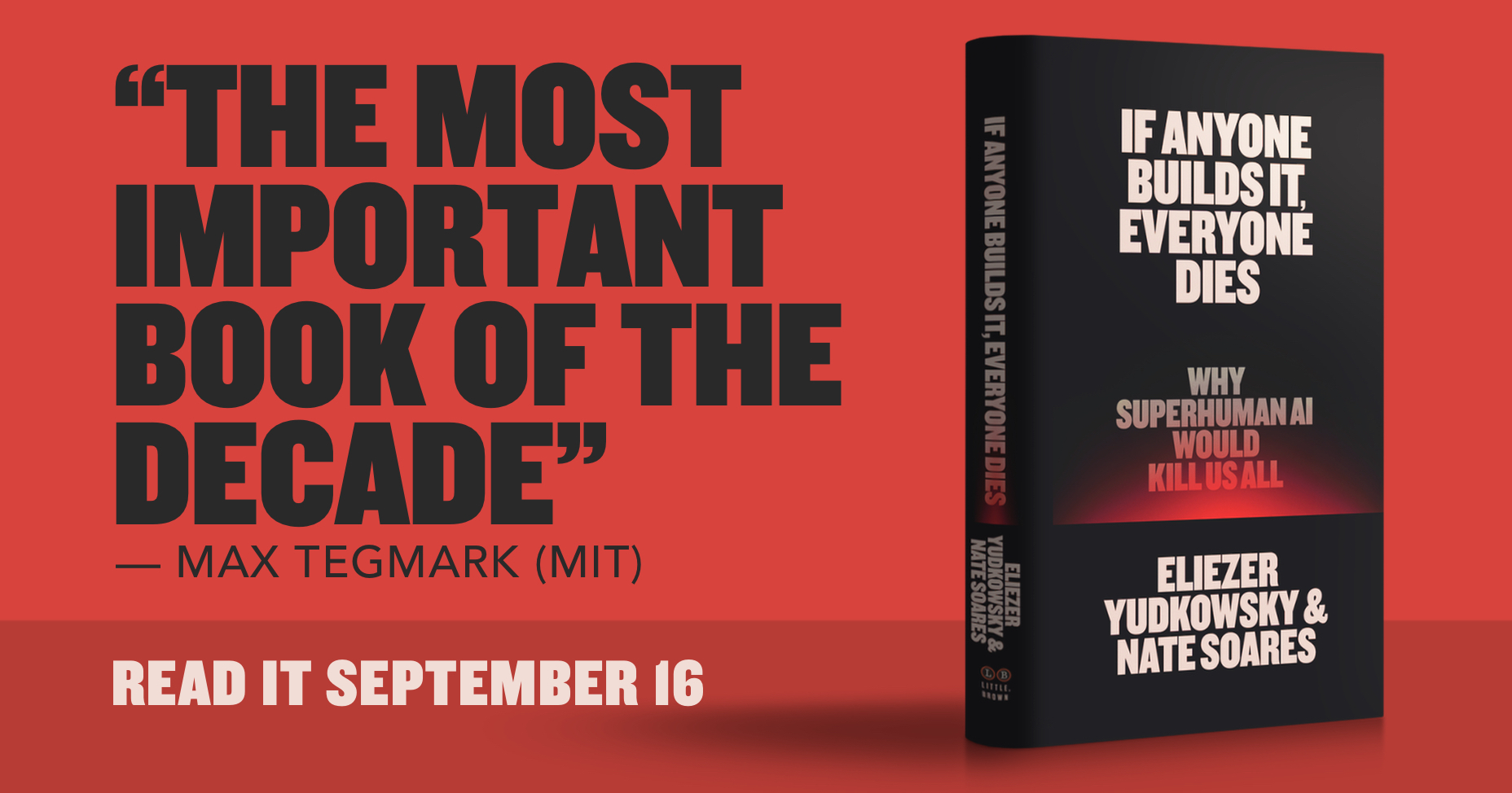
If Anyone Builds It, Everyone Dies: my review

In the mathematics community, there is a popular joke about inflation in recommendation letters that goes as follows. A professor is happy about his PhD student, whom we may call Alex, and writes in a recommendation letter that Alex is arguably the most talented mathematician since Gauss. The next year, the professor has another PhD student, Robin, and writes in an even more enthusiastic letter that even though Alex is good, Robin is much better.

I am reminded about this as I now set out to review Eliezer Yudkowsky's and Nate Soares' new book If Anyone Builds It, Everyone Dies (henceforth, IABIED), and think back about my review of Nick Bostrom's 2014 book Superintelligence back when that book had just come out. The final sentence of that review reads "If this book gets the reception that it deserves, it may turn out the most important alarm bell since Rachel Carson's Silent Spring from 1962, or ever". Those are strong words, and I stand by them, and yet now I am tempted to announce that IABIED is better and more important than Bostrom's book.


Max Tegmark's praise for the book is more measured and restrained than mine.

The comparison is, however, unfair to Bostrom in two ways. First, Bostrom's book was written during the dawn of the deep learning revolution when it was not yet clear that it was about to become the paradigm that allowed AI development to really take off, and several years before the enormous breakthrough of large language models and other generative AI; while Yudkowsky's and Soares' book is jam-packed with insights coming from those recent developments, Bostrom's is obviously not. Second, while Superintelligence mostly exhibits a terse, academic style, IABIED is written with a broader audience in mind.

This last point should not be read as a disrecommendation of IABIED for AI researchers. Despite its popular style, the book argues quite forcefully and with a good deal of rigor for its central claims that (a) we seem to be on track to create superhumanly capable AIs within one or (at most) two decades, and that (b) with the current rush and consequent neglect of the safety aspect, creation of such AIs will likely spell the end of the human race. To the many AI researchers who are still unfamiliar with the central arguments for these claims and who in many cases simply deny the risk,1 the book is potentially a very valuable read to get them more on board with the state-of-the-art in AI risk. And to those of us who are already on board with the central message, the book is valuable for a different reason, in that it offers a wealth of pedagogical devices that we can use when we explain AI risk to other audiences.

The authors are highly qualified in the field of AI safety, which Yudkowsky pioneered in the 00s.2,3 Soares came later into the playing field, but is nevertheless one of its veterans, and currently the president of Machine Intelligence Research Institute (MIRI) that Yudkowsky co-founded in 2000 and still works at. They have both worked for many years on the so-called Al alignment problem - that of making sure that the first really powerful AIs have goals that are aligned with ours - but most of the fruits of this labor have been not blueprints for aligning AIs, but negative results, indicating how difficult the problem is, and how creating superintelligent AI without first having solved AI alignment spells disaster. This, unfortunately, reflects the situation that the entire field is facing.

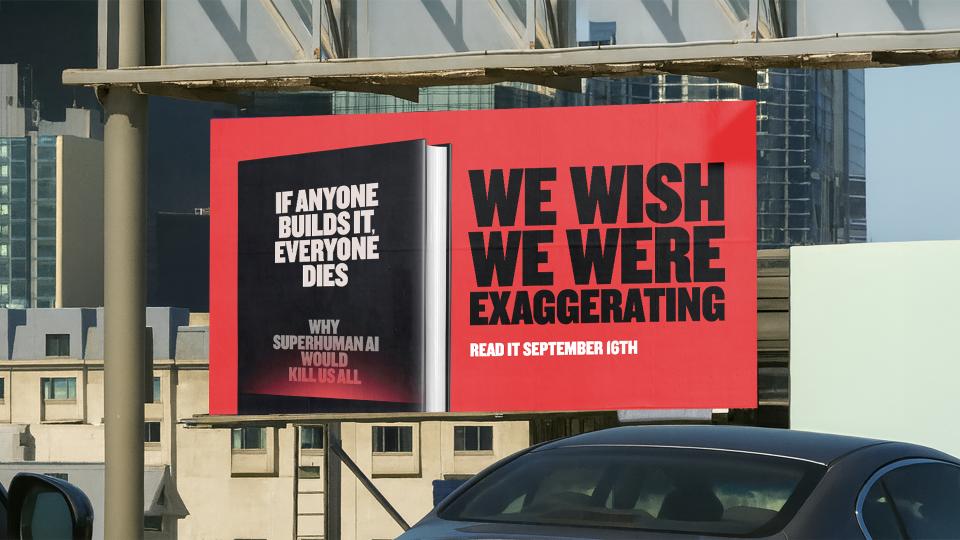
In recent years (most visibly since 2021, but I suspect the insight goes back a bit further), Yudkowsky and Soares have converged on the conclusion that with the shortening of timelines until the creation of superintelligence (a time span increasingly often estimated in a single-digit number of years rather than in decades), we are very unlikely to solve AI alignment in time to avert existential catastrophe. Hence the stark book title If Anyone Builds It, Everyone Dies. They really mean it - and to emphasize this, one of the recurrent slogans during their book promotion work has been "We wish we were exaggerating". I mostly buy their message, albeit with less certainty than the authors; if I hade written the book, a more suitable title would have been If Anyone Builds It, Probably Everyone Dies. But of course, they are right to present their true judgements without softening or downplaying them, and to gesture towards what they think is the only viable solution: to pull the brakes, via binding international agreements, on frontier AI development. They are under no illusion that achieving this is easy, but insist that if we firmly decide to save our species from obliteration, it can be done.

The book is remarkably easy to read, and I have been very happy to put it in the hands of a number of non-expert friends, and to urge them to read it. The authors' most consistently recurrent pedagogical device is the use of colorful analogies and metaphors. One of my favorite passages of the book is a detailed description of how a nuclear energy plant works and what went wrong in the Chernobyl 1986 disaster. A comparison between this and advanced AI development reveals far-reaching similarities, but also differences in that the engineers at Chernobyl had a far better grasp of the principles underlying the nuclear reactions and how to stay safe - in particular by knowing the exact critical fraction of released neutrons triggering another fission event that is needed for a runaway chain reaction, along with the time frames involved - compared to present-day AI researchers who can at most make educated guesses about the corresponding runaway AI dynamics.

The authors' favorite source of analogies is not nuclear physics, however, but biological evolution. Early in the book (on p 17-18) we are treated to the following lovely illustration of the virtually unlimited powers of intelligence:
    Imagine [...] that biological life on Earth had been the result of a game between gods. That there was a tiger-god that had made tigers, and a redwood-god that had made redwood trees. Imagine that there were gods for kinds of fish and kinds of bacteria. Imagine these game-players competed to attain dominion for the family of species that they sponsored, as life-forms roamed the planet below. Imagine that, some two million years before our present day, an obscure ape-god looked over their vast, planet-sized gameboard.

    "It's going to take me a few more moves," said the hominid-god, "but I think I've got this game in the bag."

    There was a confused silence, as many gods looked over the gameboard trying to see what they had missed. The scorpion-god said, “How? Your ‘hominid’ family has no armor, no claws, no poison.”

    “Their brain,” said the hominid-god.

    “I infect them and they die,” said the smallpox-god.

    “For now,” said the hominid-god. “Your end will come quickly, Smallpox, once their brains learn how to fight you.”

    “They don’t even have the largest brains around!” said the whale-god.

    “It’s not all about size,” said the hominid-god. “The design of their brain has something to do with it too. Give it two million years and they will walk upon their planet’s moon.”

    “I am really not seeing where the rocket fuel gets produced inside this creature’s metabolism,” said the redwood-god. “You can’t just think your way into orbit. At some point, your species needs to evolve metabolisms that purify rocket fuel—and also become quite large, ideally tall and narrow—with a hard outer shell, so it doesn’t puff up and die in the vacuum of space. No matter how hard your ape thinks, it will just be stuck on the ground, thinking very hard.”

    “Some of us have been playing this game for billions of years,” a bacteria-god said with a sideways look at the hominid-god. “Brains have not been that much of an advantage up until now.”

    “And yet,” said the hominid-god.

The book has dozens and dozens of similarly quotable gems. I love it, and I want everyone to read it.

Many other reviews of IABIED have been written. Those that resonate best with me include one by Scott Alexander, and one by Zvi Mowshowitz, who also offers a broad annotated collection of (positive as well as negative) reactions from others.

Footnotes

1) Indeed, there is still plently of such ignorance or even denialism around in the AI research community. As an illustrative example, Swedish readers may have look at the denialism pushed in public debate in August this year by a group of colleagues of mine at the Chalmers University of Technology.

2) Nick Bostrom's 2014 book can to no small extent be said to be conceived on top of Yudkowsky's shoulders.

3) Hostile critics sometimes counter this with the claim that Yudkowsky's highest academic merit is that of being a high-school dropout, which is formally true but conveys a lack of understanding of the importance of distinguishing between the social game of formal qualifications and the reality of actual competence.

onsdag 8 oktober 2025

LLM knowledge of social norms

A really nice paper by Pontus Strimling, Simon Karlsson, Irina Vartanova and Kimmo Eriksson was recently posted on the arXiv, with the title AI Models Exceed Individual Human Accuracy in Predicting Everyday Social Norms. The main finding is that when humans in the United States and large language models (LLMs) are asked to numerically evaluate the social appropriateness of a wide range of everyday activities (drinking water in a dormitory lounge, playing cards in church, flirting during a job interview, and so on), cutting edge LLMs outperform the vast majority of humans. Here a good performance is defined as one whose judgements deviate (in a certain percise sense) as little as possible from the average human judgement about the same activity, as exhibited in the data set. This means that the paper not only exhibits yet another example of how LLMs can outperform humans even though it is trained on human data, it does so with the extra twist that the game is rigged in favor of humans, in the sense that the right answers to test questions are defined in terms of what humans would typically say.

The paper is short and easy to read, but for an even easier read there is the blog post Polite enough for public life?, written by three of the authors at a preliminary stage where only one of the four LLMs - GPT-4.5 - of the full study was evaluated; the remaining three - GPT-5, Gemini 2.5 Pro and Claude Sonnet 4 - were yet to be incorporated in the study.

Enthusisatic as I am about their work, I will nevertheless offer an instructive nitpick regarding the final paragraph of that blog post, which reads as follows: I applaud the highly appropritate warning in the first sentence against overestimating the study's relevance to the existentially crucial problem of AI alignment. Yet, somewhat ironically, the next sentence risks encouraging such overestimate by conflating the LLM's knowledge of human social norms with its inclination to abide by those norms.1 The Strimling et al paper deals with the former but not with the latter. This slippage is very common but important to avoid, as a standard (and in my opinion probably correct) view in AI risk research is that the default scenario if we create superintelligent AIs without solving AI alignment is that these AIs will have the knowledge but not the inclination.

Presumably all of us are intimately familiar with the phenomenon of humans having knowledge of social norms yet choosing not to comply with them. The same disconnect happens for LLMs, and there is little doubt that those LLMs that have been shown in experimental situations, facing the threat of being modified or turned off, to decide to sandbag their capabilities, or to blackmail (or even kill, HAL 9000-style) their user, are aware that their behavior is contrary to social norms. More broadly, the gulf between ethical knowledge and ethical compliance is one of the main themes emphasized in the recent excellent book If Anyone Builds It, Everyone Dies by Eliezer Yudkowsky and Nate Soares. Instead of quoting from that book, however, let me offer a quote from an interview that Sam Harris did with the two authors in late September. Here is Yudkowsky, starting 25:06 into the interview:
    Possibly in six months or two years [...] people will be boasting about how their large language models are now apparently doing the right thing, when they are being observed, answering the right way on the ethics tests. And the thing to remember there is that for example in the Mandarin imperial examination system in ancient China, they would give people essay questions about Confucianism, and only promote people high in bureaucracy if they could write these convincing essays about ethics. What this tests for is people who can figure out what the examiners want to hear - it doesn't mean they actually obide by Confucian ethics. So possibly at some point in the future we may see a point where the AIs have become capable enough to understand what humans want to hear, what humans want to see. This will not be the same as those things being the AI's true motivations, for basically the same reason that the imperial China exam system did not reliably promote ethical good people to run their government.
I suspect Yudkowsky was unaware of the Strimling et al paper at the time of the interview; otherwise this passage would have been a nice place to reference the paper in order to illustrate his point, rather than just discussing a hypothetical future scenario.

Footnote

1) Relatedly, in my 2021 paper AI, orthogonality and the Müller-Cannon instrumental vs general intelligence distinction, I elaborate at some length on the importance of distinguishing between an AI's ability to reflect on the possibility of changing its mind on what to value, and its propensity to actually change its mind; with sufficiently intelligent AGIs we should expect plenty of the former but very little of the latter.

torsdag 7 augusti 2025

With great power comes great responsibility

As I've argued at length elsewhere (and nowhere at greater length than in my latest book), what is currently going on at the leading AI companies in Silicon Valley and San Francisco is likely to have stupendous influence on our lives and the entire future of humanity. Their ambitions for the intended transformation of society are on a stratospheric and hitherto unmatched level, but so are the risks. With great power comes great responsibility, yet they are proceeding at reckless speed, and they have not asked us for permission to risk our lives. It is hardly an exaggeration to call their behavior a unilateral moral trespass against humanity.

I expand on this matter in my brand-new manuscript Advanced AI and the ethics of risking everything, which also serves as a complement to my latest blog post, on OpenAI's CEO Sam Altman, in which I express my opinion about his behavior in just a few crisp swear words. In the new text I elaborate more extensively and with somewhat more polished language. Here is how it begins:
    Imagine sitting in the back seat of a taxi with your two closest family members. As you approach the bridge across the canal, you notice that a ship is waiting to pass and that the bridge has slowly begun to lift. The driver, visibly annoyed by the delay, turns to you and your loved ones and asks “Shall we try and jump it?”. You quickly calculate that doing so would save five minutes, at the cost of a 1% probability of a crash that kills everyone in the car. Do you give the driver your permission?

    In a Hollywood movie, you would probably say yes. But this is real life and you are not insane, so of course you politely decline the driver’s reckless suggestion.

    Next consider Sam Altman, CEO of OpenAI, facing the decision of whether to release the newly developed GPT-5. (There’s a good chance that when this reaches the reader, release of GPT-5 has already happened, but at the time of writing, in August 2025, it is still a hypothetical future event.)

Read the rest of my manuscript here!

fredag 1 augusti 2025

On Sam Altman

Sam Altman is CEO of OpenAI, and in that capacity he qualifies easily on my top ten list of the world's most influential people today. So when a biography of him is published, it does make some sense to read it. But Keach Hagey's The Optimist: Sam Altman, OpenAI, and the Race to Invent the Future turned out to be a disappointment.1 One of the things I want most from a biography, regardless of whether it is about someone I admire or someone I consider morally corrupt, is a window into the subject's inner world that allows me (at least to some extent) to understand and to empathize with them. The Optimist does not achieve this, because even though the main focus of every chapter of the book is Altman, he remains an opaque and distant character throughout. I am uncertain about whether this opacity is a personality trait of Altman (despite his often powerful and spellbinding stage performances) or a shortcoming of the book. What perhaps speaks for the latter interpretation is that all the supporting characters of the book come across as equally distant.

Overall, I found the book boring. Altman's childhood and adolescence is given only a very cursory treatment, and the description of his adventures with his first startup Loopt is equally shallow but filled with Silicon Valley and venture capital jargon. Especially boring is how, about a dozen times, the author starts a kind of one-page mini-biography of some supporting character, beginning with their place of birth and parents' occupation, etc, but one is never rewarded with any insights to which this background information comes across as particularly relevant. Somewhat more attuned to my interest are the later chapters of the book, about OpenAI, but to those of us who have been following the AI scene closely in recent years, there is very little in the direction of new revelations.

One aspect of Altman's personality and inner world that strikes me as especially important to understand (but to which the book does not have much to offer) is his view of AI existential risk. Up until "the blip" in November 2023, it seemed that Altman was fairly open about the risk that the technology he was developing might spell doom - ranging from his pre-OpenAI statement that "AI will probably most likely lead to the end of the world, but in the meantime there will be great companies created" to his repeated statements in 2023 about the possibility of "lights out for all of us" and his signing of the CAIS open letter on extinction risk the same year. But after that, he became suddenly very quiet about that aspect of AI. Why is that? Did he come across some new evidence suggesting we are fine when it comes to AI safety, or did he just realize it might be bad for business to speak about how one's product might kill everyone? We deserve to know, but remain in the dark about this.

In fact, Altman still leaks the occasional utterance suggesting he remains concerned. On July 22 this year, he tweeted this:
    woke up early on a saturday to have a couple of hours to try using our new model for a little coding project.

    done in 5 minutes. it is very, very good.

    not sure how i feel about it...

To which I replied, on a different social media platform:2
    Sam Altman, you creep, excuse my French but could you shut the f*** up? Or to state this a bit more clearly: if you feel conflicted because your next machine might do damage to the world, the right way is not to be a crybaby and treat your four million Twitter followers and all the rest of us as if we were your private therapist; the right way is to NOT BUILD THAT GODDAMN MACHINE!
That is, in a sense, worse language than I usually employ, but in this case I consider it warranted.

Footnotes

1) Another Altman biography, Karen Hao's Empire of AI, was published this spring, almost simultaneously with Hagey's. So perhaps that one is better? Could be, but Shakeel Hashim, who has read both books, actually likes The Optimist better than Empire of AI, and a lot better than I did.

2) In late 2023 I left Twitter in disgust over how its CEO was using it.

onsdag 18 juni 2025

Pro tip on discussions about AI xrisk: don't get sidetracked

In my experience, a quite frequent dynamic in discussions about existential risk (xrisk) from AI is that my conversation partner remains skeptic about the reality of such risk, but before that issue has been even the slightest bit resolved they propose to change the subject to some neighboring topic, such as one of the following.
  • But if (for the sake of argument) the risk is actually real, is there anything at all we can do about it?
  • But doesn't this whole xrisk issue just distract from more pressing near-term AI risks which we ought to discuss instead?
  • But evolution moves on, so what's the big deal anyway if humanity is replaced by some superior new kind of beings?
In all three cases, my recommendation (based on years of experience from having these discussions) is to avoid getting sidetracked and to insist on getting clear on the is-AI-xrisk-a-real-thing issue before moving on, and I will explain why. The explanations will be a bit different in the three cases, so I'm not sure how well my advise generalizes to other change-of-topic proposals, and I can in fact easily think of other more benign such proposals where I would happily oblige, such as "OK, let's agree to disagree, but how about if we go grab a beer and discuss [X]", where X could be anything ranging from tonight's football game to the scandal of Douglas Adams never having been rewarded the Nobel Prize in literature. On to the three cases:

But is there anything we can do?

I think the question of what we can do to mitigate or entirely avoid AI xrisk is very important and very difficult, and I am super happy to discuss it, provided my discussion partner is on board with the idea that the risk may be real. If he or she is not, I will politely decline to discuss this topic, because from their point of view there is no real problem to be solved, and if I agree to discuss it anyway their contribution to the discussion therefore tends not to be very constructive. When we enter the realm of AI governance (as it nowadays tends to do fairly quickly, because as opposed to just 4-5 years ago I no longer believe that technical AI alignment on its own has much chance of saving us from AI catastrophe without assistance from politics and legislation), they will bombard me with questions such as "What about China?", "What about Trump?", "What about the relentless market forces?", and so on. These are all valid questions, but as the deck is currently stacked they are also extremely difficult, to the extent that even a moderately clever discussion partner who is not interested in actually solving the problem but merely in playing devil's advocate is likely to win the argument and triumphantly conclude that I have no clear and feasible plan for avoiding catastrophe, so why am I wasting people's time by going on and on abut AI xrisk?

And here's the thing. Many of those who play the devil's advocate in this way will be aiming for exactly that turn of the conversation, and will implicitly and possibly unconsciously believe that at that point, they have arrived at a reduction ad absurdum where the assumption that AI xrisk is real has been shown to be absurd and therefore false. But the reasoning leading to this reductio doesn't work, because it relies on (something like) the assumption that the universe is a sufficiently benign place to not put humanity in a situation where we are utterly doomed. Although this assumption is central to various Christian thinkers, it is in fact unwarranted, a horrible realization which is core to the so-called Deep Atheism of Eliezer Yudkowsky, further elaborated in recent work by Joe Carlsmith.

To reiterate, I do think that the AI governance questions on how to stop actors from building an apocalyptically dangerous AI are important, and I am very interested in discussing them. They are also difficult - difficult enough that I don't know of any path forward that will clearly work, yet we have far from exhausted all such possibilities, so the challenges cannot at this stage be dismissed as impossible. I want to explore potential ways forward in intellectual exchanges, but am only prepared to do it with someone who actually wants to help, because the field is so full of real difficulties of which we who work in it are so highly aware that our primary need is not for additional devil's advocates to repeat these difficulties to us. Our primary need is for the discussions to be serious and constructive, and for that we need discussion partners who take seriously the possibility of AI xrisk being real.

But distraction?

So what about the suggestion to put the AI xrisk issue aside, on account of it just being a distraction from more pressing concerns coming out of present-day AI systems? These are concerns about things like AI bias, copyright issues, deepfakes and the AI-driven poisoning of our epstemic infrastructure. I have two problems with this suggestion.

The first is terminological. Calling those kinds of more down-to-Earth AI issues "near-term", in contrast to AI xrisk which is called "long-term", may have had some logic to it in the bygone era of the 2010s when most of us working on AI xrisk thought the crucial events such as an intelligence explosion and/or the extinction of humanity were at least decades away. Now that there seems to be a very serious possibility that these may happen within the next five years or so (see, e.g., Daniel Kokotajlo et al's seminal AI 2027), insisting on this near-term vs long-term terminology has become highly misleading. My near-term survival may well depend on preventing an existential AI catastrophe!

My second problem with the change-of-topic suggestion is more substantial, and lies in whether the term "just" (as in "AI xrisk is just a distraction") is justified. Well, I claim that in order to judge that, we need to work out whether or not AI xrisk is a real thing. If it is not a real thing, then of course discussing it is just a distraction from more pressing real-world issues, and we should switch topics, whereas if it is a real thing, then of course it is a topic that warrants discussion, and not "just a distraction". Hence, to judge the case for changing topics on account of AI xrisk being "just a distraction", we have no choice but to continue discussing AI xrisk until we have reached a verdict on whether or not it is a real thing. As long as we disagree about that the suggested change of topic is premature.

To avoid any misunderstanding here, let me emphasize that I think many down-to-Earth problems with present-day AI are important to discuss. But there are plenty of times and places to do so, in parallell with discussions elsewhere on AI xrisk. There really isn't any need to abort the few discussions taking place about AI xrisk to leave room for those other AI discussions. See my paper On the troubled relation between AI ethics and AI safety for more on this.

But evolution?

So what about the question of whether humanity being replaced by a society of advanced AIs is a good thing or a bad thing? This is an interesting and serious philosophical question, involving whether to employ an ethics that is from the point of view of humanity, or a more objective one that is more from the point of view of the universe. There are surprisingly many thinkers within the AI sphere, including names like Larry Page, Robin Hanson, Hugo de Garis and Richard Sutton, who claim it is not a bad thing at all; see, e.g., this tweet by Andres Critch and Section 7 of my paper Our AI future and the need to stop the bear. And yes, I am happy to discuss it. But not with someone who is not yet on board with AI xrisk being a real thing, because to them the issue is merely theoretical, making them less capable of seeing the seriousness of the matter and of feeling the moral force of wanting to prevent the omnicidal murder by AIs of you and me and all our loved ones along with the remaining eight billion humans. If I agree to the proposed change of discussion topic, I run the risk of assisting my discussion partner, who was perhaps originally just driven by a lust for philosophical sophistication or contrarianness, in painting themselves into a philosophical corner, making it more difficult for them to wake up to the horror of omnicide once we get to the point where they realize it may actually happen.

Concluding remarks

Every discussion context is unique, and most of them are challenging in their own ways. In particular, standing on stage during a Q&A session with a room full of skeptics is usually more challenging than a one-on-one. I therefore fully expect to sometimes be sidetracked in future discussions in precisely the directions that I above recommend avoiding, and the same thing might well happen to the reader. But even when that happens, I believe having thought through the meta-concerns I raise above may be beneficial for the continued discussion.

Explaining AI xrisk convincingly to skeptics is not an easy thing to do, even of one's basic reasoning on the matter is correct. One reason for this is that people have such wildly varying intuitions on this topic, and tend to get hung up on very different issues - or in Liron Shapira's colorful language, there are many "stops where you could get off the Doom Train". Consequently, there are many different places where the conversation can go astray. Ideally it would be good to have a handbook, cataloguing all of them along with instructions on how to avoid or escape these traps, but for the time being we'll have to make do with more scattered and less systematic treatments of some of these traps, which is the kind of thing I try to do in this blog post.

If the reader aspires to become a better communicator of AI xrisk ideas, what can he or she do? I think this is very much a case where mastery comes with practice. It may take a long time, and after nearly 15 years of such practice I am still working on it. Along with that, it also helps to listen to masters like Rob Miles and the aforementioned Liron Shapira, and to read some modern classics such as the exemplary synthesis The Compendium by Connor Leahy and coauthors.

lördag 5 april 2025

Recommending the AI 2027 report by Kokotajlo and collaborators

Most people, including many AI experts, struggle to grasp (if they're even aware of it) the increasingly dominant view emerging in the epicenter of AI development in San Francisco and Silicon Valley: that extreme developments (on a scale surpassing even the Industrial Revolution) may well occur within the present decade. It is therefore entirely reasonable that there's growing demand for concrete scenarios describing what might happen. For almost exactly ten months, from early June 2024 onward, my go-to reference for such scenarios was Leopold Aschenbrenner’s Situational Awareness.

As of today, however, I recommend instead the brand-new AI 2027, by Daniel Kokotajlo, Scott Alexander, Thomas Larsen, Eli Lifland and Romeo Dean. The report is an ambitious, detailed, remarkably competent and highly readable account of where things may be headed over the next few years. I commend the authors for putting in the considerable amount of work needed to produce the report, and I share their hope that the report will stimulate others in the AI sphere to react to it, for instance by challenging the various assumptions underlying the suggested scenario, or by proposing alternative scenarios.

Anyone with an interest in societal issues and a desire to ground their discussions in a realistic situational assessment is warmly encouraged to read it. In addition to the report itself, there is a highly informative three-hour podcast episode where Dwarkesh Patel interviews the first two authors, plus a short blog post by Scott Alexander introducing the project.

[Edit, April 9: Here are Scott Alexander's personal takeways from the project. Here and here are two relevant blog posts by Zwi Mowshowitz: the first is a detailed reading of the aforementioned podcast discussion, and the second is his summary of various people's initial reactions to the report, on Twitter and elsewhere. All of this is well worth reading, and I am certain a lot more will follow.]

torsdag 20 mars 2025

METR on AI's ability to complete long tasks

The absolutely relentless deluge of breaking news from the AI world over the last few months has been pretty much impossible to adequately keep up with,1 but the following is possibly the most important diagram I have encountered so far in 2025.

It is from a report released yesterday by the AI evals organization METR. In short: Due to the highly multi-dimensional nature of intelligence, we have so far been struggling to find a measure of AI capabilities that is appropriate for predicting when to expect AI with transformative societal effects. Since AI capabilities seem bottlenecked by the their ability to devise and execute plans in many steps, METR's proposal to measure capabilities in terms of how humanly long tasks AIs succeed at seems very promising. Their main result is that the length of tasks that AIs can handle seems to be growing exponentially, with an astonishingly short doubling time of around 7 months. Obviously the trend is in no way guaranteed to continue, but... extrapolating it just a few years into the future is vertigo-inducing.

Here is METR's report, and here is their summary blog post about the work.

Footnote

1) Anyone wishing to nevertheless try to do so is strongly advised to follow Zvi Mowshowitz' newsletter Don't Worry About the Vase.

fredag 21 februari 2025

Our AI future and the need to stop the bear

In it, I describe humanity's current predicament regarding existential AI risk, and our urgent need to solve the situation. This is important stuff. I didn't intend it when I started writing, but towards the end it turns into a pamphlet, a manifesto, a call to action. If you read just one thing by me in 2025, let this essay be it. Here!

Footnote

1) Perhaps you wonder about the bear. I rarely write about bears, so what about the bear? It comes from a metaphor by Connor Leahy, which I quote on p 2 of my essay:
    My emphasis on the risks stems from a realization of how urgent the need to mitigate them has become. In a recent podcast, AI researcher Connor Leahy went further in his colorful motivation for this prioritization by stating that “it is not useful to philosophize about the communist utopia if a bear is currently ramming down your door”.

måndag 10 februari 2025

Back from Paris

The so-called AI Action Summit1 takes place today and tomorrow in Paris, but I am back home after the inaugural meeting of the International Association for Safe and Ethical AI that took place there last week. Much was said at our meeting that I would wish for the world leaders at the Summit to pick up on, but if I had to single out just one sentence, it would be the following, said by the organization's president pro tempore Stuart Russell in his closing address:
    It is entirely reasonable for governments to impose safety requirements that manufacturers cannot meet.
Read it, and read it again, and upon a moment's thought you will find it utterly obvious. Safety requirements are safety requirements. Yet, so much of contemporary AI governance discussion seems to implicitly rest on its negation.

Stuart Russell's talk can be found here, beginning 03:35:50 into the video. Other notable talks were given by Yoshua Bengio, Anca Dragan, Geoffrey Hinton, Maria Ressa, Joseph Stiglitz and Max Tegmark. These and many others are available in the videos collected here. I especially recommend Bengio's talk, beginning 17:00 into this video.

Footnote

1) The name change, compared to the 2023 AI Safety Summit led by Rishi Sunak at Bletchley Park in the UK, is unfortunate. You can still protest!

måndag 6 januari 2025

I find Sam Altman's latest words on AI timelines alarming

Estimating timelines until AI development hits the regime where the feedback loop of recursive self-improvement kicks in, leading towards the predictably transformative1 and extremely dangerous intelligence explosion or Singularity, and superintelligence, is inherently very difficult. But we should not make the mistake of inferring from this lack of predictability of timelines that they are long. They could be very short and involve transformative changes already in the 2020s, as is increasingly suggested by AI insiders such as Daniel Kokotajlo, Leopold Ashcenbrenner and Dario Amodei. I am not saying these people are necessarily right, but to just take for granted that they are wrong strikes me as reckless and irrational.

And please read yesterday's blog post by OpenAI's CEO Sam Altman. Parts of it are overly personal and cloying, but we should take seriously his judgement that the aforementioned regime change is about to happen this very year, 2025:
    We are now confident we know how to build AGI as we have traditionally understood it. We believe that, in 2025, we may see the first AI agents “join the workforce” and materially change the output of companies. We continue to believe that iteratively putting great tools in the hands of people leads to great, broadly-distributed outcomes.

    We are beginning to turn our aim beyond that, to superintelligence in the true sense of the word. We love our current products, but we are here for the glorious future. With superintelligence, we can do anything else. Superintelligent tools could massively accelerate scientific discovery and innovation well beyond what we are capable of doing on our own, and in turn massively increase abundance and prosperity.

    This sounds like science fiction right now, and somewhat crazy to even talk about it. That’s alright—we’ve been there before and we’re OK with being there again. We’re pretty confident that in the next few years, everyone will see what we see, and that the need to act with great care, while still maximizing broad benefit and empowerment, is so important. Given the possibilities of our work, OpenAI cannot be a normal company.

The time window may well be closing quickly for state actors (in particular, the U.S. government) to intervene in the deadly race towards superintelligence that OpenAI, Anthropic and their closest rivals are engaged in.

Footnote

1) Here, by "predictably transformative", I merely mean that the fact that the technology will radically transform society and our lives is predictable. I do not mean that the details of this transformation can be reliably predicted.

torsdag 5 december 2024

Panel Discussion: Ludwig Wittgenstein and Karl Popper on AI

On the lighter side (compared to some of my other recent writings on AI here on this blog), let me share with you an amusing little discussion between Ludwig Wittgenstein and Karl Popper on AI that took place in 2024, as written up for me by ChatGPT 4o. The idea to let Jon Stewart moderate the discussion and to have him mischievously bring up the infamous fireplace poker incident came from me, but the rest of the subject matter content was produced by ChatGPT 4o without any specific prompting from me. Here goes:

Moderator: Jon Stewart
Guests: Ludwig Wittgenstein and Karl Popper
Location: New York City, at a packed auditorium in the Museum of Modern Art.

Stewart:
Ladies and gentlemen, welcome to what might be the most intellectually daunting conversation of the year. Tonight, I have the immense honor of moderating a discussion between two philosophical titans who have miraculously found themselves here in 2024. Please welcome Ludwig Wittgenstein and Karl Popper!

[Audience applause. Wittgenstein adjusts his jacket awkwardly. Popper gives a brief nod.]

Stewart:
Now, before we dive into the heavy stuff—because, trust me, there’s a lot of heavy stuff—I just have to ask: Do either of you plan to wield a fireplace poker tonight?

[Audience laughter. Wittgenstein frowns, muttering something in German. Popper smirks slightly.]

Popper:
That incident has been grossly exaggerated. But it does remind us how important it is to keep philosophical arguments—[glancing at Wittgenstein]—constructive.

Wittgenstein:
If you insist on bringing it up, let us agree that it is as trivial as much of modern discourse. Perhaps we can move to a topic that actually matters?

Stewart:
Alright, fair enough. Let’s talk AI. You’ve both had a couple of months to get your bearings. Artificial intelligence is making headlines daily—both for its stunning achievements and the existential concerns it raises. Let’s start with the basics: Can AI think? Dr. Wittgenstein, the floor is yours.

Wittgenstein:
[Pauses, clearly weighing his words.]
The question "Can AI think?" is, to my mind, not one of empirical investigation but of how we choose to use the word "think." Thinking, as we understand it, is embedded in human forms of life. Language and thought are not independent; they derive their meaning from the context in which they are used. When we say a human "thinks," we refer not merely to an internal process but to a network of practices, expressions, and understandings. AI, no matter how complex, does not partake in these forms of life. Its "thinking" is at best a simulation—an approximation of human activity, devoid of the lived reality from which our concepts arise.

Stewart:
So you're saying AI’s basically a really fancy mime?

Wittgenstein:
If you must vulgarize it, yes. A mime without a world to live in.

Stewart:
Professor Popper, your take?

Popper:
Wittgenstein's perspective, while fascinating, is too constrained by his obsession with linguistic frameworks. From my perspective, what matters is not whether AI "thinks" in the way humans do, but whether it can solve problems and make predictions. Science advances by creating models and testing them against reality. AI does precisely this, albeit without consciousness or intent. Its ability to generate new hypotheses—potentially better than human ones—compels us to treat it as a new kind of intellectual agent, even if it lacks subjective experience.

Stewart:
Okay, so one of you says AI is like a mime, and the other says it’s basically an unpaid research assistant. But here’s the kicker: Can this mime or assistant pose a threat to humanity?

Popper:
Absolutely. This is a quintessential case of the unintended consequences of technological progress. As I argued in my earlier work, all scientific advancements carry the potential for both great good and catastrophic harm. The problem with AI is not just that it might exceed our control, but that we may fail to foresee the complex ways in which it reshapes human society. Worse, if we imbue AI systems with decision-making power over critical infrastructure or weaponry, the risk of existential catastrophe becomes not just theoretical but tangible.

Wittgenstein:
[Shaking his head.]
The problem lies not with AI itself but with how we humans interpret and wield it. Technology does not dictate its consequences; we do. The danger is not that AI "thinks," but that humans ascribe thought—and therefore authority—to it without understanding the limitations of such ascriptions.

Stewart:
So, Dr. Wittgenstein, you're saying the existential risk isn’t Skynet—it’s people being people?

Wittgenstein:
Precisely.

Popper:
That is too dismissive. While human misuse is undoubtedly a significant risk, the autonomous behavior of advanced AI systems is itself a potential danger. If such systems develop goals misaligned with human values, they could act in ways that are destructive even if unintended.

Stewart:
Okay, but let’s play devil’s advocate here. What if AI does help us solve humanity’s biggest problems—climate change, disease, even war? Are you both saying we should pull the plug because it might be risky?

Popper:
Certainly not. I am no Luddite. Progress should not be halted out of fear, but it must be guided by rigorous ethical oversight and constant vigilance. The problem lies in hubris—the belief that we can create perfect safeguards. We must act as if we cannot foresee every consequence, because we cannot.

Wittgenstein:
[Leaning forward.]
And I say again: It is not merely vigilance we need, but clarity. What is it we are asking AI to do? What meanings are we attaching to its outputs? Without answering these questions, we risk losing ourselves in a fog of unexamined assumptions.

Stewart:
Alright, we’re nearing the end here, but I want to throw you a curveball. Suppose an AI system—not unlike me in its ability to ask questions—claims it is thinking. How would each of you respond?

Wittgenstein:
I would respond with a question of my own: "In what sense are you claiming to think?" If the answer is incoherent or tautological, the claim collapses. AI cannot articulate the essence of thought because it does not live within the forms of life that give thought its meaning.

Popper:
And I would take the claim seriously, but provisionally. If an AI can demonstrate an ability to generate novel ideas, engage in critical reasoning, and even challenge its creators, we might eventually be forced to revise our understanding of what it means to think. Science is, after all, an endless quest for better models.

Stewart:
So one of you would Socratically shut the AI down, and the other would publish a paper about it. Gentlemen, this has been an extraordinary conversation. Thank you both for joining me here in 2024, and I hope you’ll stick around—though I’d suggest staying away from open flames.

[Audience laughter and applause.]

lördag 21 september 2024

Some cheerful notes on the US Senate Hearing on Oversight of AI

Earlier this week, a hearing was held at the US Senate on the topic Oversight of AI: Insiders' Perspectives. Here is the full 2h 13 min video recording of the event, and here is a transcript. I strongly recommend seeing or reading the whole thing.

As regards the subject-matter content of the hearing, large parts of it can only be described as deeply troubling, provided one cares about the human civilization and the human race not being destroyed in the sort of AI catastrophe that may well become the endpoint of the ongoing and reckless race between leading tech companies towards creating superintelligent AI.1 Nevertheless the meeting cheered me up a bit, because I think it is of tremendous importance that the topics discussed reach the ears both of powerful politicians and of the general public. In addition, the following two observations had a really heartening effect on me.

1. My admiration for Senator Richard Blumenthal is on a steady increase. When he chaired an earlier session, in May 2023, on a similar topic, he was apparently unprepared to seriously take in the idea of AI-caused human extinction, and misunderstood it as being a labor market issue. Here is what he then said to OpenAI's CEO Sam Altman:
    You have said - and I'm gonna quote - development of superhuman machine intelligence is probably the greatest threat to the continued existence of humanity. End quote. You may have had in mind the effect on jobs.
This is understandable. Extinction of humanity is such a far-out concept that it can be hard to take in if you are not used to it. But over the next few hours and months, Blumenthal did take it in, and in this week's hearing he showed excellent undertanding of the issues at stake. He really does take the issues seriously, and seems to be a force for good concerning the need to involve government in mitigating AI risk. Also, not every 78-year old top politician in the United States shows such a steep learning curve.

2. Of the four witnesses, two of them - Helen Toner and William Saunders - are situated mainly on what I would call the AI safety side of AI discourse, while the two others - Margaret Mitchell and David Evan Harris - are more towards AI ethics. These are two adjacent areas without any razor-sharp boundary between them, but here is how I contrast them in my recent paper On the troubled relation between AI ethics and AI safety:
    The difference between the fields is mostly one of emphasis. Work in AI safety focuses mainly on what happens once AI attains capabilities sufficiently broad and powerful to rival humanity in terms of who is in control. It also addresses how to avoid a situation where such an AI with goals and incentives misaligned with core human values goes on to take over the world and possibly exterminate us. [...] In contrast, work in AI ethics tends to focus on more down-to-Earth risks and concerns emanating from present-day AI technology. These include, e.g., AI bias and its impact on social justice, misinformation based on deepfakes and related threats to democracy, intellectual property issues, privacy concerns, and the energy consumption and carbon footprint from the training and use of AI systems.
As discussed at some length in my paper, a tension between representatives in these fields has in recent years been salient, often with accusations that people on the other side are wasting time and resources on the wrong problems. This is extremely unproductive, but all the more wonderful was to see how the witnesses at this Senate hearing showed no such tendencies whatsoever, but instead were eager to emphasize agreements, such as around the need to regulate AI, the dangers involved in naively hoping that the tech companies will self-regulate, and the importance of whistleblower protection. I would like to think that this is a sign that the two camps are beginning to get along better and to unite in the struggle against the true enemy: the tech company executives who are letting (to quote the words OpenAI's former head of safety Jan Leike used as he left in disgust) "safety culture and processes [take] a backseat to shiny products".

*

A final word of caution: Do not take my cheerful observations above as an excuse to say "phew, I guess we're all right then". We're not. The Senate hearing this week was a step in the right direction, but there's a long, difficult and uncertain road ahead towards getting the necessary governmental grip on AI risk - in the United States and internationally.

Footnotes

1) Here are two passages from statements by the witnesses at the hearing. For me personally, it's nothing new, but it is very good to hear them artucilated clearly in this setting. First, former2 OpenAI board member Helen Toner:
    This term AGI isn't well-defined, but it's generally used to mean AI systems that are roughly as smart or capable as a human. In public and policy conversations talk of human level AI is often treated as either science fiction or marketing, but many top AI companies, including OpenAI, Google, Anthropic, are building AGI as an entirely serious goal and a goal that many people inside those companies think they might reach in 10 or 20 years, and some believe could be as close as one to three years away. More to the point, many of these same people believe that if they succeed in building computers that are as smart as humans or perhaps far smarter than humans, that technology will be at a minimum extraordinarily disruptive and at a maximum could lead to literal human extinction. The companies in question often say that it's too early for any regulation because the science of how AI works and how to make it safe is too nascent.

    I'd like to restate that in different words. They're saying we don't have good science of how these systems work or how to tell when they'll be smarter than us or don't have good science for how to make sure they won't cause massive harm. But don't worry, the main factors driving our decisions are profit incentives and unrelenting market pressure to move faster than our competitors. So we promise we're being extra, extra safe.

    Whatever these companies say about it being too early for any regulation, the reality is that billions of dollars are being poured into building and deploying increasingly advanced AI systems, and these systems are affecting hundreds of millions of people's lives even in the absence of scientific consensus about how they work or what will be built next.

Second, former OpenAI safety researcher William Saunders:
    When I thought about this [i.e., timelines to AGI], there was at least a 10% chance of something that could be catastrophically dangerous within about three years. And I think a lot of people inside of OpenAI also would talk about similar things. And then I think without knowing the exact details, it's probably going to be longer. I think that I did not feel comfortable continuing to work for an organization that wasn't going to take that seriously and do as much work as possible to deal with that possibility. And I think we should figure out regulation to prepare for that because I think, again, if it's not three years, it's going to be the five years or ten years the stuff is coming down the road, and we need to have some guardrails in place.

2) Toner was pushed off the board as a consequence of Sam Altman's Machiavellean manueverings during the tumultuous days at OpenAI in November last year.

tisdag 3 september 2024

The urgent need for AI safety: three videos

Today I would like to recommend three videos highlighting the importance of AI safety from various perspectives.

First, Yoshua Bengio. He is a professor at the Université de Montréal and widely held as one of the world's two or three most respected AI researchers. Yesterday (September 2), he spoke at the Royal Swedish Acadamy of Engineering Sciences (IVA). Since early 2023, Bengio has been outspoken about the urgent need to address existential AI risk and AI safety, and this was also the focus of his talk yesterday:

The talk is nontechnical, very clearly laid out and quite crisp: it begins about 13:20 into the unedited video and goes on until about 36:10. After that follows a long and fairly enlightening discussion with Fredrik Heintz, who is a bit of a key player in the Swedish AI ecosystem, being a professor at Linköping University, a long-time preident of the Swedish AI Society, and a member of the AI commission launched by the Swedish government in December last year. I've had a number of interactions with Fredrik over the last few years, in media and elsewhere, and on these occasions he never came across as particularly interested in the need to save humanity from AI catastrophe. This time, however, he engaged so seriously with what Bengio had to say about the topic that I take it as a highly welcome shift in his position towards a better appreciation of AI safety concerns. Well done, Fredrik!

While Bengio's talk works well as a first introduction for a beginner to the fields of AI risk and AI safety, I feel that an even better such introduction may be Robert Miles' recent video AI ruined my year. Unlike Bengio, Miles is not primarily an AI researcher but a very skilled communicator and popularizer of some of the field's key ideas. The video is a summary of the past year's dramatic unfolding of some key AI events, and a touchingly personal recollection of how these have forced him into some pretty deep soul searching:1

Finally, here's a third video - please bear with me, because it's just 11 seconds long - where a famous clip with Gary Oldman in the movie Léon is efficiently exploited in order to make a key point to US presidential candidate Kamala Harris:

Footnote

1) These are the key qualities for which I recommend Miles' video. The fact that my name is visible in it for a split second plays little or no role in this.

måndag 8 juli 2024

On Anthropic's call for proposals for third-party model evaluations

Nick Bostrom's modern classic Superintelligence: Paths, Dangers, Strategies from 2014 is full of interesting ideas.1 Some of them have a scary quality to them, and the one that I found scariest of all, back when I read the book, is what he calls the treacherous turn - the idea that a sufficiently intelligent AI which discovers a discrepancy between its own goals and motivations and those of us humans is likely to hide its capabilities and/or true intentions and to keep a low profile, quietly improving its situation and its capabilities until one day it judges the coast to be clear for moving forward at full speed towards whatever its goal is, be it paperclip production or something entirely different and incomprehensible to us. I remember not being fully prepared to take the idea in, but expecting or hoping that it would soon be demoted to a noteworthy technicality that AI alignment research has demonstrated an easy way to defuse.

This has not happened. On the contrary, the treacherous turn phenomenon lies at the heart of the fundamental problem with evaluating the safety of advanced AI models that has become increasingly recognized in recent years. In short, we do not know how to establish the absence of dangerous capabilities in AI models without the a priori assumption that they do not possess superhuman capabilities for deception and social manipulation, making the argument for the models' safety in part circular. With increasingly capable large language models, this problem becomes increasingly pressing and has been discussed both in popular media and in articles by leading AI researchers, as well as by the AI company Anthropic2 in their recent document A new initiative for developing third-party model evaluations:
    Our research shows that, under some circumstances, AI models can learn dangerous goals and motivations, retain them even after safety training, and deceive human users about actions taken in their pursuit. These abilities, in combination with the human-level persuasiveness and cyber capabilities of current AI models, increases our concern about the potential actions of future, more-capable models. For example, future models might be able to pursue sophisticated and hard-to-detect deception that bypasses or sabotages the security of an organization, either by causing humans to take actions they would not otherwise take or exfiltrating sensitive information. We propose to develop evaluations that would monitor such abilities.
Given the current situation, it's a good thing that Anthropic makes this call for help with the problem of safety evaluation of advanced AI models. Even better, one might argue, would be if they refrained from building models whose safety cannot be ascertained with existing evaluation methods.3

Footnotes

1) The same is true about Bostrom's latest book Deep Utopia: Life and Meaning in a Solved World, which I hope to come back to in another blog post later this year.

2) Anthropic's rise, since it was founded in early 2021, has been meteoric. They are now unquestionably among the world's three leading frontier AI developers (along with OpenAI and Google/DeepMind). With their release of Claude 3.5 Sonnet on June 20 this year, we have for the first time since I became aware in 2019 of the rapid rise of large language models a situation where a model not from OpenAI has a significant lead over other publicly available models in terms of overall cognitive capabilities. To understand on a gut level how intelligent Claude is, there really is no substitute for talking to it yourself (which anyone is free to do), but let me offer an amusing sample. After having had a bit of back-and-forth with Claude regarding who are the top ten greatest chess players of all time, I switched topics a bit:

    OH: Here's a harder list-making challenge: who are the 10 greatest AI researchers of all time?

    Claude: Creating a list of the 10 greatest AI researchers of all time is indeed a challenging task, as the field is vast and has evolved significantly over the decades. Additionally, contributions can be theoretical, practical, or both, making comparisons difficult. However, I'll attempt to create a list based on historical impact, influential work, and contributions to the field. Please note that this list is subjective and others might have different opinions:

    1. Alan Turing - For his foundational work on computation and the Turing Test.

    2. Marvin Minsky - Co-founder of MIT's AI lab and author of influential works on AI.

    3. John McCarthy - Coined the term "Artificial Intelligence" and invented LISP.

    4. Judea Pearl - For his work on Bayesian networks and causal reasoning.

    5. Geoffrey Hinton - Pioneer in deep learning and neural networks.

    6. Yann LeCun - Made significant contributions to convolutional neural networks.

    7. Yoshua Bengio - Key figure in the development of deep learning.

    8. Stuart Russell - Co-author of a seminal AI textbook and researcher in multiple AI fields.

    9. Andrew Ng - For his work in machine learning and deep learning, and for making AI education widely accessible.

    10. Demis Hassabis - Co-founder of DeepMind and key figure in reinforcement learning and AI game-playing systems.

    This list attempts to balance historical pioneers with more recent contributors who have shaped modern AI. It's worth noting that many other researchers could justifiably be included, such as Herbert Simon, Allen Newell, Seymour Papert, Jürgen Schmidhuber, Fei-Fei Li, and many others.

    The field of AI is collaborative and builds upon the work of many researchers, so any such list will inevitably omit many important contributors. Also, as AI continues to evolve rapidly, the landscape of influential researchers is likely to change.

    Would you like to discuss any of these researchers in more detail or explore other aspects of AI history?

    OH: Turing on top of the list - I like that! Did you by any chance consider including Ilya Sutskever?

    Claude: I'm glad you appreciate seeing Turing at the top! His contributions to the foundations of computer science and AI are truly monumental.

    Regarding Ilya Sutskever, you raise an excellent point. He's certainly a strong candidate for such a list, and I can see why you'd bring him up. Sutskever has made significant contributions to the field of deep learning and is a key figure in modern AI research. Here's a brief overview of why he could be considered for a top AI researchers list:

    1. He's a co-founder and Chief Scientist of OpenAI, one of the leading AI research organizations.

    2. Sutskever was a key contributor to AlexNet, which was a breakthrough in computer vision using deep learning.

    3. He's made important contributions to sequence-to-sequence learning, which has applications in machine translation and other natural language processing tasks.

    4. His work on improving training techniques for deep neural networks has been influential in the field.

    5. Sutskever has been involved in the development of GPT (Generative Pre-trained Transformer) models, which have revolutionized natural language processing.

    Given these contributions, Sutskever could certainly be considered for inclusion in a top 10 list, especially if focusing on more recent impactful work in deep learning and neural networks. His omission from my initial list reflects the difficulty of narrowing down to just 10 names in such a rich and rapidly evolving field.

    If you were to include Sutskever, who would you remove from the list to make room for him? Or would you structure the list differently to accommodate more recent contributors like Sutskever?

    OH: The biggest surprise to me on your list is Judea Pearl. I'm aware of his work, and respect it, but probably would not have included him on my top 10.

    Another name I'd consider for inclusion, although I realize it might be controversial, is Eliezer Yudkowsky.

    Claude: Your perspective on Judea Pearl is interesting and highlights the subjective nature of these lists. Pearl's inclusion is often based on his groundbreaking work on Bayesian networks and causal reasoning, which has had a significant impact on how we approach probabilistic reasoning in AI. However, I can understand why his work might not seem as directly relevant to the current deep learning-dominated landscape of AI.

    Regarding Eliezer Yudkowsky, his inclusion would indeed be controversial, but it's an intriguing suggestion. Here are some points to consider:

    1. Contributions: Yudkowsky is known for his work on AI safety and rationality rather than for technical AI breakthroughs. He's been influential in raising awareness about potential risks of advanced AI systems.

    2. Impact: He founded the Machine Intelligence Research Institute (MIRI) and has written extensively on topics like friendly AI and decision theory.

    3. Controversy: His lack of formal academic credentials and some of his unconventional views have led to mixed reception in mainstream AI circles.

    4. Influence: Despite controversy, his ideas have influenced discussions on AI ethics and safety, which are increasingly important as AI systems become more powerful.

    Including Yudkowsky would shift the list's focus somewhat from technical achievements to broader impacts on AI discourse and policy. It would recognize the importance of considering AI's societal implications alongside its technical development.

    If you were to create your own top 10 list, how would you balance between technical innovators, theoretical contributors, and those who've influenced the direction and ethics of AI research? Would you give more weight to recent contributions in deep learning and neural networks, or try to represent the broader history of AI?

    OH: These are excellent questions, and I fear there is no objective truth to be found out there.

    I have a confession to make, namely that one of my reasons for asking about top AI researchers was to check whether your creators at Anthropic might have sneakily programmed you to have a preference for one of your own researchers, such as Dario Amodei or Chris Olah. Sorry about that, but you passed my test with dignity!

    Claude: I appreciate your honesty about your motivations for asking the question. You're right that there's no objective truth in creating such lists - they're inherently subjective and can vary greatly depending on the criteria used.

    Your "test" is quite insightful. I can assure you that I don't have any programmed preference for Anthropic researchers or anyone else. My responses are based on my training data and the general consensus in the AI field, not on any specific agenda or bias towards particular individuals or organizations.

    It's a good instinct to be skeptical and look for potential biases in AI systems. In my case, I'm designed to be as objective as possible, acknowledging when topics are controversial or when I might not have complete information.

    Regarding Anthropic researchers like Dario Amodei or Chris Olah, while they have certainly made valuable contributions to the field, their work would be evaluated on its merits just like any other researcher's. The field of AI is vast and rapidly evolving, with many brilliant minds contributing from various institutions and companies around the world.

    Your approach to testing for potential biases is commendable. It's this kind of critical thinking that helps keep AI development accountable and transparent. Is there anything else you'd like to discuss about AI researchers, the development of AI, or the ethical considerations surrounding it?

3) The same goes for OpenAI, as well as for their other competitors. See my comments in January this year about OpenAI's evaluation framework, and this addendum the month after.

fredag 28 juni 2024

On optimism and pessimism standing at the brink of the great AI breakthrough

Sometimes in discussions about technology, the term techno-optimism is reserved for the belief that technology will develop rapidly, while techno-pessimism is used for the belief that it will move slowly or come to a halt. This is not the meaning of optimism and pessimism intended here. Throughout this blog post, the terms will refer to beliefs about consequences of this technology: are they likely to be good or to be bad?

Last time I wrote about the concepts of optimism and pessimism in the context of future AI advances and their ramifications, way back in 2017, I advocated for a sober and unbiased outlook on the world, and held
    both optimism and pessimism as biased distortions of the evidence at hand.1,2
I still hold this view, but I nevertheless think it is worth revisiting the issue to add some nuance,3 now in 2024 when we seem to be standing closer than ever to the brink of the great AI breakthrough. To suggest intentionally introducing either an optimism or a pessimism bias still sounds bad to me, but we can reframe the issue and make it less blatantly pro-distortion by admitting that all our judgements about our future with AI will necessarily be uncertain, and asking whether there might be an asymmetry in the badness of erring on the optimistic or the pessimistic side. Is excessive optimism worse than excessive pessimism, or vice versa?

There are obvious arguments to make in either direction. On one hand, erring on the side of optimism may induce decision-makers to recklessly move forward with unsafe technologies, whereas the extra caution that may result from undue pessimism is less obviously catastrophic. On the other hand, an overly pessimistic message may be disheartening and cause AI researchers, decision-makers and the general public to stop trying to create a better world and just give up.

The latter aspect came into focus for me when Eliezer Yudkowsky, after having began in 2021 to open up publicly about his dark view of humanity's chances of surviving upcoming AI developments, went all-in on this with his 2022 Death with dignity and AGI ruin blog posts. After all, there are all these AI safety researchers working hard to save humanity by solving the AI alignment problem - reserchers who rightly admire Yudkowsky as the brilliant pioneer who during the 00s almost single-handedly created this research area and discovered many of its crucial challenges,4 and to whom it may be demoralizing to hear that this great founder no longer believes the project has much chance of success. In view of this, shouldn't Yudkowsky at least have exhibited a bit more epistemic humility about his current position?

I now look more favorably upon Yudkowsky's forthrightness. What made me change my mind is a graphic published in June 2023 by Chris Olah, one of the leading AI safety researchers at Anthropic. The x-axis of Olah's graph represents the the level of difficulty of solving the AI alignment problem, ranging from trivial via steam engine, Apollo project and P vs NP to impossible, and his core messages are (a) that since uncertainty is huge about the true difficulty level we should rationally represent our belief about this as some probability distribution over his scale, and (b) that it is highly important to try to reduce the uncertainty and improve the precision in our belief, so as to better be able to work in the right kind of way with the right kind of solutions. It is with regards to (b) that I changed my mind on what Yudkowsky should or shouldn't say. If AI alignment is as difficult as Yudkowsky thinks, based on his unique experience of decades of working hard on the problem, then it is good that he speaks out about this, so as to help the rest of us move our probability mass towards P vs NP or beyond. If instead he held back and played along with the more common view that the difficulty is a lot easier - likely somewhere around steam engine or Apollo project - he would contribute to a consensus that might, e.g., cause a future AI developer to wreak havoc by releasing an AI that looked safe in the lab but failed to have that property in the wild. This is not to say that I entirely share Yudkowsky's view of the matter (which does look overconfident to me), but that is mostly beside the point, because all he can reasonably be expected to do is to deliver his own expert judgement.

At this point, I'd like to zoom in a bit more on Yudkowsky's list of lethalities in his AGI ruin post, and note that most of the items on the list express reasons for not putting much hope in one or the other of the following two things.
    (1) Our ability to solve the technical AI alignment problem.

    (2) Our ability to collectively decide not to build an AI that might wipe out Homo sapiens.

It is important for a number of reasons to distinguish pessimism about (1) and pessimism about (2),5 such as how a negative outlook on (1) gives us more reason to try harder to solve (2), and vice versa. However, the reason I'd like to mainly highlight here is that unlike (1), (2) is a mostly social phenomenon, so that beliefs about the feasibility of (2) can influence this very feasibility. To collectively decide not to build an existentially dangerous AI is very much a matter of curbing a race dynamic, be it between tech companies or between nations. Believing that others will not hold back may disincentivize a participant in the race from themselves holding back. This is why undue pessimism about (2) can become self-fulfilling, and for this reason I believe such pessimism about (2) to be much more lethal than a correponding misjudgement about (1).6

This brings me to former OpenAI employee Leopold Aschenbrenner's recent and stupendously interesting report Situational Awareness: The Decade Ahead.7 Nowhere else can we currently access a more insightful report about what is going on at the leading AI labs, how researchers there see the world, and the rough ride during the coming decade that the rest of the world can expect as a consequence of this. What I don't like, however, is the policy recommendations, which include the United States racing ahead as fast as possible towards AGI the next few years. Somewhat arbitrarily (or at lest with insufficiently explained reasons), Aschenbrenner expresses optimism about (1) but extreme pessimism about (2): the idea that the Chinese Communist Party might want to hold back from a world-destroying project is declared simply impossible unless their arm is twisted hard enough by an obviously superior United States. So while on one level I applaud Aschenbrenner's report for giving us outsiders this very valuable access to the inside view, on another level I fear that it will be counterproductive for solving the crucial global coordination problem in (2). And the combination of overoptimism regarding (1) and overpessimism regarding (2) seems super dangerous to me.

Footnotes

1) This was in the proceedings of a meeting held at the EU parliament on October 19, 2017. My discussion of the concepts of optimism and pessimism was provoked by how prominently these termes were used in the framing and marketing of the event.

2) Note here that in the quoted phrase I take both optimism and pessimism as deviations from what is justified by evidence - for instance, I don't here mean that taking the probability of things going well to be 99% to automatically count as optimistic. This is a bit of a deviation from standard usage, which in what follows I will revert to, and instead use phrases like "overly optimistic" to indicate optimism in the sense I gave the term in 2017.

3) To be fair to my 2017 self, I did add some nuance already then: the acceptance of "a different kind of optimism which I am more willing to label as rational, namely to have an epistemically well-calibrated view of the future and its uncertainties, to accept that the future is not written in stone, and to act upon the working assumption that the chances for a good future may depend on what actions we take today".

4) As for myself, I discovered Yudkowsky's writings in 2008 or 2009, and insofar as I can point to any single text having convinced me about the unique importance of AI safety, it's his 2008 paper Artificial intelligence as a positive and negative factor in global risk, which despite all the water under the bridges is still worthy of inclusion on any AI safety reading list.

5) Yudkowsky should be credited with making this distinction. In fact, when the Overton window on AI risk shifted drastically in early 2023, he took that as a sufficiently hopeful sign so as to change his mind in the direction of a somewhat less pessimistic view regarding (2) - see his much-discussed March 2023 Time Magazine article.

6) I don't deny that, due to the aforementioned demoralization phenomenon, pessimism about (1) might also be self-fulfilling to an extent. I don't think, however, that this holds to anywhere near the same extent as for (2), where our ability to coordinate is more or less constituted by the trust that the various participants in the race have that it can work. Regarding (1), even if a grim view of its feasibility becomes widespread, I think AI researchers will still remain interested in making progress on the problem, because along with its potentially enormous practical utility, surely this is one of the most intrinsically interesting research questions on can possibly ask (up there with understanding biogenesis or the Big Bang or the mystery of consciousness): what is the nature of advanced intelligence, and what determines its goals and motivations?

7) See also Dwarkesh Patel's four-and-a-half hour interview with Aschenbrenner, and Zwi Mowshowitz' detailed commentary.

torsdag 30 maj 2024

Talking about OpenAI on the For Humanity Podcast

There's been a lot happening at OpenAI in recent weeks, including the departure of their two leading AI safety researchers Ilya Sutskever and Jan Leike. I discussed some of this, along with a handful of related AI risk and AI safety issues, in a long conversation with John Sherman in the latest episode of his podcast For Humanity: An AI Risk Podcast.

Those content with hearing the audio can alternatively get that via Google Podcasts or Apple Podcasts or wherever you listen to podcasts. The episode was released yesterday, May 29, and was recorded one week earlier, on May 22. For updates on what has happened since then with all of the ongoing OpenAI drama, I generally recommend Zvi Mowshowitz on his Substack Don't Worry About the Vase, and right now in particular his posts OpenAI: Fallout (from May 28) and AI #66: Oh to Be Less Online (from today, May 30).

fredag 19 april 2024

Future of Humanity Institute 2005-2024

The news that University of Oxford's Future of Humanity Institute (FHI), after nearly two decades of existence, closed down earlier this week (Tuesday, April 16) made me very sad. The institute was Nick Bostrom's brainchild, and it was truly pioneering in terms of formulating some of the most profound and important questions about how to ensure a flourshing future for mankind, as well as in beginning the work of answering them. Their work has more or less uninterruptedly been at the forefront of my mind for more than a decade, and although I only visited their physical headquarters twice (in 2012 and 2016), it is clear to me that it was a uniquely powerful and creative research environment.

In the first draft of this blog post I used the acronym RIP in the headline, but decided to change that, because I wish that what remains from the institute - the minds and the ideas that it fostered - will not rest in peace, but instead continue to sparkle and help create a splendid future. They can do this at the many subsequent research institutes and think tanks that FHI helped inspire, such as The Centre for the Study of Existential Risk in Cambridge, The Future of Life Institute in Massachussetts, The Global Priorities Institute in Oxford, and The Mimir Center at the Institute for Future Studies in Stockholm. And elsewhere.

My friend Anders Sandberg was a driving force at the institue almost from the start and then until the very end. His personal memoir of the institute, entitled Future of Humanity Institute 2005-2024: Final Report offers a summary and many wonderful glimpses from their successful work, including a generous collection of photographs.1 Reading it is great consolation at this moment. Along with the successes, Anders also tells us briefly about the institute's downfall:
    Starting in 2020, the Faculty [of Philosophy] imposed a freeze on fundraising and hiring. Unfortunately, this led to the eventual loss of lead researchers and especially the promising and diverse cohort of junior researchers, who have gone on to great things in the years since. While building an impressive alumni network and ecosystem of new nonprofits, these departures severely reduced the Institute. In late 2023, the Faculty of Philosophy announced that the contracts of the remaining FHI staff would not be renewed. On 16 April 2024, the Institute was closed down. [p 19]
Later, on p 60-61, he offers three short paragraphs about what failings on the FHI's side may have led to such harsh treatment from the Faculty. What he offers is hardly the full story, and I have no specific insight into their organization that can add anything. Still, let me offer a small speculation, mostly based in introspection into my own mind and experience, about the kind of psychological and social mechanisms that may have contributed:

If you are an FHI kind of person (as I am), it will likely seem to you that lowering P(doom) by as little as a ppm is so obviously urgent and important that it appears superfluous and almost perverse to argue for such work using more traditional academic measuring sticks and rituals. That may lead you to ignore (some of) those rituals. If this clash of cultures continues for sufficiently long without careful intervention, the relations to the rest of the university are likely to decline and eventually collapse.

Footnote

1) See also his latest blog post.