Visar inlägg med etikett Here Be Dragons. Visa alla inlägg

tisdag 18 augusti 2026

Om Georg Henrik von Wright

Jag har denna sommar läst en del av den finlandssvenske filosofen George Henrik von Wright (1916-2003), vars tankeskärpa, klarhet och utsökta språk borgade för njutbar läsning. Det började med att jag i ett antikvariat ute på landet råkade hitta hans Logik, filosofi och språk från 1957, som jag sedan snudd på sträckläste. Jag hade stort utbyte av dess behandling av en rad av det tidiga 1900-talets mest inflytelserika tänkare, med allra störst tonvikt på Wittgenstein. Boken inspirerade mig att plocka fram och läsa ett par senare verk av von Wright, vilka ända sedan 90-talet samlat damm i min bokhylla: Vetenskapen och förnuftet från 1986 och Myten om framsteget från 1993. Fastän idéhistoria är ett viktigt inslag i samtliga dessa tre böcker kan ändå en glidning i den store filosofens intressen mellan 50- och 80-tal tydligt skönjas. Medan Logik, filosofi och språk rör sig strikt inom den teoretiska filosofins domäner, så ligger tonvikten i de båda senare böckerna på civilisationskritik.

Följande passage i Myten om framsteget fick mig att stanna upp och dra efter andan.
    Med vetenskapens framväxt och samhällets sekularisering blev kravet på att sökandet efter kunskap och sanning inte skulle inskränkas med förbud ett väsentligt inslag i den intellektuella moralen. [...] Många filosofer proklamerade kunskapen som ett gott i sig, något som är värt att söka för dess egen skull. Därför kan en som söker och finner sanningen inte hållas ansvarig för det tvivelaktiga eller till och med onda bruk som andra gör av hans upptäckter.

    En sådan moralisk ståndpunkt kan hävdas så länge man är något så när övertygad om att missbruket av förvärvad kunskap inte utgör ett potentiellt hot mot själva grundvillkoren för människans välbefinnande eller rent av släktets överlevnad.

Vadan denna reaktion från min sida? Tanken von Wright formulerar kan väl knappast ha varit särskilt obekant? Nej, tvärtom, vad som överraskade mig var hur intimt välbekant den var, ty den är så gott som identisk en av de normativa huvudteserna i min bok Here Be Dragons från 2016.1 Hur kunde jag glömma von Wrights inflytande så totalt att hans namn inte ens finns med i bokens referenslista? Förargligt. Jag vill dock inte döma mig själv för hårt för denna oavsiktliga försummelse, för detta slags subliminala inflytande är knappast ovanligt, och det är (menar jag) snudd på omöjligt att gardera sig emot helt.

För att läsaren inte skall lämna denna bloggpost med intrycket att jag instämmer med Georg Henrik von Wright i allt vill jag som kontrast återge de kanske mest kända raderna i Vetenskapen och förnuftet:
    Ett perspektiv, som jag inte anser orealistiskt, är att mänskligheten går mot sin undergång som zoologisk art.

    [...]

    Jag kan inte för egen del finna det särskilt upprörande. En gång skall med säkerhet människan som art upphöra att finnas; om det sker efter några hundra tusen år eller ett par sekler, är i det kosmiska perspektivet en pipa snus.

Tjusigt formulerat, förvisso, men jag vill med all respekt mena att den gode von Wright här är helt ute och cyklar. Visst, jag jag är inte främmande för tanken att i det kosmiska världsalltets vidunderliga storlek finna skäl till förundran och ödmjukhet. Men det betyder inte att våra göranden och låtanden på planeten Jorden är futtiga och oviktiga. Uppenbara jämförelser ger vid handen att undvikandet av en nära förestående utrotning av Homo sapiens är viktigare än snart sagt allt annat praktiskt vi har att ta ställning till, så om detta undvikande avfärdas som lika oviktigt som "en pipa snus", så kan detsamma sägas om alla andra beslut och arbetsuppgifter vi står inför, liksom om all den kärlek, skönhet och logiska elegans vi någonsin får uppleva. En sådan nihilism är oacceptabel! Värdet av vad vi gör här på Jorden behöver såklart sättas i relation till hur långt våra förmågor sträcker sig, och att i detta sammanhang använda universum i dess helhet som måtstock är ett groteskt felgrepp.

Fotnot

1) Samma tanke destillerade jag fram till själva huvudtesten i min essä Vetenskap på gott och ont ett par år senare.

tisdag 20 juni 2023

A question for Émile Torres

Dear Émile,

Since my rewarding and truly enjoyable experience in 2017 of serving as your host in Gothenburg during the GoCAS program on existential risk to humanity there has been plenty of water under the bridges, including unfortunately a great deal of friction between the two of us.1 But never mind (at least for the time being) all that, because I now have a specific question regarding your view of an issue that is dear to my heart: the importance of avoding the extinction of Homo sapiens by unaligned AI.

On one hand, you brought up this topic in a Washington Post op-ed as recently as in August last year, and seemed to agree with me about the increasingly urgent need to avoid the creation of an unaligned superintelligent AI that kills us all.

On the other hand, there is the recent episode of the podcast Dave Troy Presents with you and Timnit Gebru. Throughout most of the episode, the derogatory term "AI doomer" is used about those of us who take seriously the extinction risk from unaligned AI.2 Given what you wrote in the Washington Post I would have expected you to protest against this language, as well as against Gebru's extensive monologue (starting about 01:09:40 into the episode and lasting around five minutes) about how extinction risk from AI is nonsense and a distraction from much more pressing and importat problems having to do with AIs exhibiting racial bias and the underrepresentation of women speking at AI conferences. You had plenty of opportunity to add nuance to the discussion by pointing out that extinction risk from AI is actually a real thing, but at no point of the episode was there any hint of disagreement between you and Gebru over this (or anything else, for that matter).

I am puzzled by the contrast between what you say in the Washington Post piece and what you seem to agree with in the Dave Troy Presents episode. Have you changed your mind about AI xrisk since August 2022?3 Do you no longer think there's a serious risk from unaligned AI to the survival of our species? If so, I'd really like to know what new knowledge you have acquired to reach this conclusion, because learning the same thing could lead me to a huge change in how I currently prioritize my time and efforts. Or have you cynically chosen to downplay the risk in order to achieve a better social fit with your new allies in the Gebru camp? If this last suggestion sounds uncharitable, then please forgive me, because I'm really struggling to understand your current take on AI risk.

With kind regards,

Olle

Footnotes

1) This friction includes (but is far from limited to) your tendentious way of repeatedly quoting a passage in my 2016 book Here Be Dragons.

2) As I recently emphasized in an interview in the Danish Weekendavisen, I think the term "AI doomer" is terrible, as it brings to mind someone who shouts "just face it, we're all going to die!", in contrast to the very different message we "doomers" have, namely that we (humanity) are currently on a very dangerous trajectory where the combination of AI capabilities improving at breakneck speed and AI alignment falling far behind risks leading to an AI apocalypse, but that we can avoid this risk if we pull ourselves together with appropriate adjustments of the trajectory.

3) I am aware that you have at various times asserted your blanket disagreement with everything you've written on xrisk up to 2019(?), but if you similarly disagree with what you wrote less than a year ago in the Washington Post, that gives a whole new time frame to your change of hearts.

söndag 9 januari 2022

Ännu en vända genom det kinesiska rummet

Det senaste numret (nr 4/2021) av Filosofisk tidskrift inleds med en artikel av Lars Bergström med titeln Hotet från medvetna maskiner. Till formen ligger artikeln ungefär halvvägs mellan å ena sidan ett fristående filosofiskt diskussionsinlägg, och å andra sidan en recension av min senaste bok Tänkande maskiner. Jag blir smickrad av det utrymme han ägnar mina tankar, och ännu mer av hans välvilliga bedömning att jag "skriver bra, medryckande och engagerat, och boken förefaller mycket initierad".

Ända sedan 2016, då jag ägnade några sidor av min bok Here Be Dragons åt det berömda tankeexperiment av filosofen John Searle som benämns det kinesiska rummet har Lars och jag gång på gång återkommit till att debattera våra olika tolkningar av det, mestadels via email men ibland i publicerade texter, som nu senast i Lars nya text som till större delen behandlar detta ämne. Jag har uppskattat vårt meningsutbyte, men börjar nu känna att det nått en point of diminishing returns och tvekar inför att fortsätta. Trots detta väljer jag här att (mest for the record) notera några reflektioner på Lars senaste inlägg.

Vad jag däremot inte vill är att här ägna kraft åt att ännu en gång förklara bakgrunden, så den som inte redan är bekant med det kinesiska rummet uppmanas att, innan hen fortsätter läsandet av denna bloggpost, stifta bekantskap med Searles tankeexperiment genom att läsa exempelvis Lars nya artikel, eller s 69-71 i Here Be Dragons, eller s 232-237 i Tänkande maskiner, eller (för den som föredrar texter som är fritt tillgängliga på nätet) s 5-7 i mitt preprint Aspects of mind uploading. Lars och mitt meningsutbyte koncentrerar sig nästan helt på den variant av tankeexperimentet som Searle utformat som svar på den kritik som benämns systemsvaret. I denna variant ber Searle oss att föreställa oss att han internaliserat hela det kinesiska kinesiska rummet, bland annat genom att memorera hela den (ofantliga) regelbok som på engelska ger instruktioner om algoritmisk manipulation av kinesiska skrivtecken. De reflektioner om Lars senaste inlägg jag här vill nedteckna är fyra till antalet:

1. Genom hela vårt långdragna meningsutbyte har jag försvarat ståndpunkten att Searles kropp under de givna omständigheterna härbärgerar två medvetanden: dels det som tillhör Searle-E (som talar engelska men inte ett ord kinesiska), och dels det som tillhör Searle-K (som talar kinesiska men inte ett ord engelska). Lars däremot har å sin sida hävdat att enbart Searle-E är medveten. Denna menigsåtskillnad kan förefalla solklar, men när Lars nu (på s 6 i sin nya artikel) skriver att jag "tycks vara övertygad om att Searle-K är medveten och förstår kinesiska" så känner jag att jag behöver förtydliga och nyansera.

Egentligen har jag ingen stark uppfattning om huruvida min position (att Searle-K är medveten) eller Lars' (att Searle-K saknar medvetande) är riktigt. Allra troligast är enligt min uppfattning att ingendera positionen är vare sig rätt eller fel, utan de är snarare meningslösa, eftersom det tankeexperiment de grundar sig i verkar så orealistiskt att den postulerade situationen helt enkelt är omöjlig. Men om vi nu ändå för diskussionens skull tänker oss att situationen föreligger, är då Searle-K medveten eller omedveten? Från min sida har hela vårt meningsutbyte gått ut på att visa att Searles argument mot CTM-teorin (se punkt 4 nedan) inte håller, och för att Searles argument skall hålla krävs att det är uteslutet att Searle-K är medveten. Min strategi har hela tiden varit att peka på Searle-K:s medvetenhet som en fullt rimlig möjlighet givet den postulerade situationen. Jag inser att min iver att påvisa att denna möjlighet är rimlig då och då glidit över i ett språkbruk som fått det att låta som att jag faktiskt är (med Lars' ord) "övertygad om att Searle-K är medveten och förstår kinesiska", men då har jag alltså gått en smula överstyr. Jag beklagar detta. Allt jag vill påvisa är att Searles och Lars' övertygelse om att Searle-K saknar medvetande vilar på lösan sand, att det är fullt rimligt att tänka sig att Searle-K är medveten, och att Searles vederläggning av CTM-teorin därmed inte håller.

2. På s 6 i Lars artikel läser vi följande:
    Häggström anser [...] att vi "utifrån kan observera" två olika personer som bebor Searles kropp [...]. Jag tror inte att andra observatörer skulle hålla med om det. Vid första anblick verkar det kanske som att Searle kan både engelska och kinesiska. Men när han sedan försäkrar att att han inte förstår kinesiska, och att han bara konverserar på kinesiska med hjälp av en regelbok, så skulle man väl godta detta.
Jag uppfattar denna passage som kärnan i Lars argumentation, men som sådan också som ett stort antiklimax. Jag vill ogärna tänka mig att analytisk-filosofisk forskning går ut på att reproducera gemene mans spontana föreställningar (och vad "andra observatörer skulle hålla med om") när de konfronteras med olika scenarier. Poängen med verksamheten borde väl vara att gå bortom detta och i görligaste mån lista ut hur det faktiskt förhåller sig, snarare än att stanna vid vad folk får för intryck av dessa situationer. (Och om folks spontana intryck verkligen kunde användas som pålitlig ledning om hur det faktiskt förhåller sig skulle Lars härmed ha upptäckt ett fantastiskt kraftfullt medvetandefilosofiskt redskap, som till exempel genast skulle ge svar på de tidigare så besvärliga problemen med solipsism och panpsykism.)

Min nästa kritik mot denna passage är något jag återkommit till gång på gång i detta meningsutbyte Lars och mig emellan, nämligen hur han närmar sig Searle-E och Searle-K med förutfattade meningar som diskriminerar till Searle-E:s förmån på ett sätt som går ut över Searle-K så till den grad att det på förhand verkar bestämt att inget denne säger är värt att ta på allvar. När Searle-E (som Lars typiskt nog benämner "Searle" i sitt osynliggörande av stackars Searle-K) "försäkrar att att han inte förstår kinesiska" så tar Lars det som en sanning - vilket för all del även jag är benägen att göra - men när Searle-K å sin sida försäkrar att han förstår kinesiska så anser Lars denna upplysning vara så irrelevant att han inte ens bemödar sig om ett explicit avfärdande. En sådan fördomsfull förhandsinställning är knappast ändamålsenlig när man har att utröna vem eller vilka av Searle-E och Searle-K som besitter medvetande. Det kan såklart hända att Lars har rätt i sitt intuitiva ställningstagande att Searle-K saknar medvetande, men han kommer (precis som Searle) inte ens i närheten av att leda i bevis att så är fallet.

3. En förgrening av Lars och mitt meningsutbyte ägde rum i nr 3/2021 av tidskriften Sans. Denna förgrening avslutar Lars med ett påpekande om att man ju skulle kunna fråga Searle-K vad något visst skrivtecken som denne använder i konversationen betyder på engelska. Searle-K skulle inte kunna besvara detta, trots sin förmåga att konversera på kinesiska. Någon ytterligare utveckling av detta resonemang ger inte Lars i Sans-utbytet, men av kontext och ton får jag intrycket att han menar det som en demonstration av att Searle-K saknar medvetande och verklig förståelse av kinesiska. Detta är förbryllande, eftersom samma argument skulle kunna användas på (gissningsvis) hundratals miljoner kineser som behärskar kinesisk skrivkonst utan att kunna ett ord engelska för att visa att dessa saknar medvetande. Lars argument har uppenbarligen för stor räckvidd och måste därför vara felaktigt.

I vår efterföljande privata korrespondens förklarade Lars att det inte var så han avsåg sin argumentation, och utvecklade en annan innebörd, vilken han också återger i den nya artikeln (s 6):
    Om Searle-K inte kan engelska, så har han ingen nytta av regelboken. Den är nämligen skriven på engelska, eftersom den skall begripas av Searle, som bara kan engelska.
Även detta argument har för stor räckvidd, bland annat då det kan tillämpas för att visa att jag inte förstår svenska. På samma sätt som Searle-K:s förståelse av kinesiska är beroende av regelboken, så är min förståelse av svenska beroende av (många av) mina neuroners synapsavfyrningströsklar, och på samma sätt som Searle-K inte vet ett endaste dyft om vad som står i regelboken så är jag lyckligt ovetande om alla detaljer rörade synapsavfyrningströsklarna. Vad Lars här i sin iver att underkänna Searle-K som medvetet subjekt förbiser är att det även i våra inre pågår en stor mängd viktig informationsbearbetning som vi alldeles saknar inblick i och förståelse för. Att samma sak gäller Searle-K kan därför inte användas som argument mot att denne skulle vara medveten, med mindre än att vi samtidigt underkänner våra egna medvetanden.

4. Det som alls gör Searles tankeexperiment värt att diskutera är att det är den oftast anförda invändningen mot CTM-teorin, vilken av Lars (s 4) omtalas som...
    det som brukar kallas "beräkningsteorin om medvetande" (the computational theory of mind, förkortat CTM), vilken lite förenklat innebär att medvetandet består av beräkningar eller symbolmanipulation, något som även kan produceras digitalt i en dator.
Gott så, och det viktiga här är att substratet beräkningarna implementerats på i princip inte spelar någon roll: så länge beräkningarna är desamma är det oviktigt (för uppkomsten av medvetande) om substratet är ett biologiskt nervsystem, ett elektroniskt kretskort eller ett kinesiskt rum. Konstigare blir det när Lars (s 8) efter att ha försvarat Searles argument skriver så här:
    Däremot är detta inget argument mot CTM. Det är nämligen fullt förenligt med att en dator kan vara medveten.
Här verkar Lars ha glömt vad CTM handlar om. Man kan tro att Searles argument är korrekt, och man kan tro på CTM, men eftersom Searles argument är ett påstått motbevis till CTM kan man inte utan motsägeslse tro på båda. (Däremot verkar det fullt konsistent att acceptera Searles argument mot CTM samtidigt som man tror på datormedvetande, eftersom datormedvetande skulle kunna vara möjligt av andra skäl än just CTM.)

tisdag 8 juni 2021

Tendentiöst i DN om labbläckehypotesen

DN rapporterade i lördags om diskussionerna kring huruvida covid-19-pandemin kan ha sitt ursprung i en labbläcka från Wuhan Institute of Virology (WIV), och hur Anthony Fauci (av DN kallad "USA:s Anders Tegnell") därvid hamnat i blåsväder. Artikeln bjuder på följande passage:
    En annan ingrediens som är mumma för konspirationsteoretikerna är att Wuhan-labbet fått internationella bidrag för sin forskning - bland annat från den smittskyddsmyndighet som Anthony Fauci är chef för - och det påstås också att det bedrevs viss forskning som syftade till att förändra virus.
Två ordval här får mig att reagera. För det första, "påstås". Vadå "påstås"? Att gain-of-function-forskning1 bedrivits vid WIV är inte något löst påstående av några opålitliga tyckare, utan ett faktum som även WIV-forskarna själva stolt givit spridning åt. Se exempelvis Nature Medicine-artikeln A SARS-like cluster of circulating bat coronaviruses shows potential for human emergence från 2015, med medverkan av WIV-forskare under ledning av Shi Zhengli.

För det andra, "konspirationsteoretikerna". DN:s reporter Juan Flores gör sitt bästa att framställa labbläckediskussioner som konspirationsteorier. Men att gain-of-function-forskning förekommer på viruslaboratorier här och var inklusive på WIV är som sagt obstridligt, liksom det faktum att många incidenter förekommit genom historien (inte minst i samband med sovjetiska biovapenprogram) där farliga smittämnen läckt från biolaboratorier. Härtill är även bristen på transparens hos kinesiska myndigheter ett okontroversiellt faktum. Om vi lägger samman dessa saker med det osäkra evidensläget (troligtvis finns inte någon enda människa som med säkerhet känner till virusets ursprung) och den allmänmänskliga benägenheten att önsketäkna och skylla ifrån sig, så inses lätt att labbläckehypotesen inte förutsätter några konspirationer eller hemliga överenskommelser i rökiga rum.

Ändå var det så labbläckehypotesen framställdes genom hela 2020: som en konspirationsteori. Därigenom blev ämnet mer eller mindre tabu i anständiga kretsar.2 Tongivande härvidlag blev den Lancet-artikel i början av 2020, med en rad tunga namn på författarlistan, som förkunnade att "We stand together to strongly condemn conspiracy theories suggesting that COVID-19 does not have a natural origin".3

Tonläget har emellertid under 2021 förändrats, mycket tack vare ett par gedigna artiklar - av Nicholas Baker i New York Magazine, respektive Nicholas Wade i Bulletin of the Atomic Scientists - som pekar dels på svagheterna i den evidens som framhölls i Lancet-artikeln, dels på omfattande annan evidens som mer tyder på en labbläcka.4 Allt fler seriösa tänkare och debattörer betraktar nu labbläckehypotesen som minst lika sannolik som hypotesen om virusets naturliga ursprung,5 och tabut får nu anses tillräckligt brutet för att möjliggöra förutsättningslös och seriös diskussion i frågan. Men DN har inte hängt med, och fortsätter att vifta med konspirationsteoristämpeln.

Jag skulle gärna se att DN tänkte om på denna punkt, för frågan om covid-virusets ursprung är viktig. Det handlar inte i första hand om någon historisk kuriositet eller om att avgöra den uppmärksammade vadslagningen mellan Martin Rees och Steven Pinker, eller ens om att peka finger mot de eventuella skyldiga, utan om att försätta oss i ett så bra kunskapsläge som möjligt för att förebygga nästa pandemi, som mycket väl kan komma att bli långt värre än covid-19.

Fotnoter

1) Med gain-of-function-forskning avses modifiering av virus eller andra smittämnen för att göra dem mer smittsamma eller farligare. Avsikten är att lära sig mer om vad mutationer i naturen kan tänkas åstadkomma och därigenom öka vår beredskap inför framtida smittoutbrott. Inom bland annat xrisk-forskningen är vi emellertid många som anser att risken för labbläckor gör gain-of-function-forskningen oacceptabelt farlig. Jag berörde saken kort i min bok Here Be Dragons från 2016, och uttryckte tillfredsställelse över att Obamaadministrationen 2014 beslutat om att förbjuda federal finansiering av gain-of-function-forskning, men detta förbud upphävdes några år senare under Trump (och Fauci), och hur som helst så behövs såklart skarpare lagstiftning än så för att säkerställa att vårdslös forskning av detta slag upphör.

2) I mer oanständiga kretsar var det däremot fritt fram, något som kan ha bidragit ytterligare till att misskreditera labbläckehypotesen bland anständigt folk.

3) Artikeln meddelar också "We declare no competing interests", vilket är vilseledande med tanke på att initiativtagaren till artikeln, Peter Daszak, har starka kopplingar till gain-of-function-forskningen vid WIV.

4) Den som hellre läser på svenska kan alternativt vända sig till Ola Wongs artikel i Kvartal.

5) Bland dem som de senaste veckorna till och med vågat uppge en subjektiv bayesiansk sannolikhet för labbläckehypotesen återfinns bland andra jag själv (55%), Nate Silver (60%), och Eliezer Yudkowsky (80%).

tisdag 1 december 2020

New AI paper with James Miller and Roman Yampolskiy

The following words by Alan Turing in 1951, I have quoted before:
    My contention is that machines can be constructed which will simulate the behaviour of the human mind very closely. [...] Let us now assume, for the sake of argument, that these machines are a genuine possibility, and look at the consequences of constructing them. [...] It seems probable that once the machine thinking method had started, it would not take long to outstrip our feeble powers. There would be no question of the machines dying, and they would be able to converse with each other to sharpen their wits. At some stage therefore we should have to expect the machines to take control.
It is but a small step from that ominous final sentence about machines taking over to the conclusion that when that happens, everything hinges on what they are motivated to do. The academic community's reaction to Turing's suggestion was a half-century of almost entirely ignoring it, and only the last couple of decades have seen attempts to seriously address the issues that it gives rise to. An important result of the early theory-building that has come out of this work is the so-called Omohundro-Bostrom framework for instrumental vs final AI goals. I have discussed it, e.g., in my book Here Be Dragons and in a 2019 paper in the journal Foresight.

Now, in collaboration with economist James Miller and computer scientist Roman Yampolskiy, we have another paper on the same general circle of ideas, this time with emphasis on the aspects of Omohundro-Bostrom theory that require careful scrutiny in light of the game-theoretic considerations that arise for an AI living in an environment where it needs to interact with other agents. The paper, whose title is An AGI modifying its utility function in violation of the strong orthogonality thesis, is published in the latest issue of the journal Philosophies. The abstract reads as follows:
    An artificial general intelligence (AGI) might have an instrumental drive to modify its utility function to improve its ability to cooperate, bargain, promise, threaten, and resist and engage in blackmail. Such an AGI would necessarily have a utility function that was at least partially observable and that was influenced by how other agents chose to interact with it. This instrumental drive would conflict with the strong orthogonality thesis since the modifications would be influenced by the AGI’s intelligence. AGIs in highly competitive environments might converge to having nearly the same utility function, one optimized to favorably influencing other agents through game theory. Nothing in our analysis weakens arguments concerning the risks of AGI.
Read the full paper here!

fredag 13 november 2020

Om en statistikerkollega som gått vilse

Av alla svenska professorer i matematisk statistik som har initialerna OH och som författat böcker som ger oförtjänt stort utrymme åt Pascals vadslagning, vem har i sina publiceringar gjort sig skyldig till de mest flagranta avvikelserna från traditionell och väluppfostrad akademisk mainstreamdiskurs?

En kuggfråga såklart. Tanken är att läsaren (i synnerhet om denne läst Avsnitt 10.4, rubricerat I am not advocating Pascal's Wager, i min senaste bok Here Be Dragons) skall komma att tänka på mig, och sedan häpna över att det faktiskt finns en person som passar ännu bättre in på beskrivningen, nämligen Ola Hössjer, professor i matematisk statistik vid Stockholms universitet.

Jag har mycket höga tankar om Hössjers matematiska kompetens, så länge han håller sig borta från teologiska spörsmål, något som dock dessvärre verkar ha kommit att uppta en allt större del av hans tankeverksamhet. Ett av de tidigare tecken på denna olyckliga trajektoria jag blev varse var hur han blev så imponerad av ett par intellektuellt undermåliga artiklar av den engelske teologen Richard Swinburne att han på egen hand ombesörjde översättning av dem för publicering i en svenskspråkig tidskrift. Därefter har Hössjer bland annat skrivit den ovan antydda bok (utgiven 2018 och med titeln Becoming a Christian: Combining Prior Belief, Evidence, and Will) i vilken han vidareutvecklar Blaise Pascals beslutsteoretiska argument för det kloka i att tro på Gud,1 och texter till försvar för kreationism (bland annat med det besynnerliga argumentet att "evolutionsteorin gör Gud ansvarig för lidande och död"), och för idén om ett slags Adam och Eva från vilka alla andra människor härstammar. Och nu senast har han med sin norske medförfattare Steinar Thorvaldsen lyckats prångla in den synnerligen genanta artikeln Using statistical methods to model the fine-tuning of molecular machines and systems (som visar sig vara inget annat än ett billigt försök att klä det gamla stormen i skrotupplaget-argumentet i fina ord) i den vanligen fullt respektabla tidskriften Journal of Theoretical Biology.2

Det är verkligen beklämmande att åse hur en uppskattad kollega kraschar sin akademiska bana på detta vis.

Fotnoter

1) Jag blev tillräckligt nyfiken för att införskaffa boken och påbörja läsning, men gav upp efter ett eller ett par kapitel av outhärdlig smörja.

2) Jag behöver inte här fördjupa mig i detaljerna i detta debacle, eftersom biologen Lars Johan Erkell vid Göteborgs universitet gör det fullödigt i en serie om inte mindre än sju bloggposter (del ett, del två, del tre, del fyra, del fem, del sex, del sju).

måndag 28 januari 2019

Steven Pinker misleads systematically about existential risk

The main purpose of this blog post is to direct the reader to existential risk scholar Phil Torres' important and brand-new essay Steven Pinker's fake enlightenment.1 First, however, some background.

Steven Pinker has written some of the most enlightening and enjoyable popular science that I've come across in the last couple of decades, and in particular I love his books How the Mind Works (1997) and The Blank Slate (2002) which offer wonderful insights into human psychology and its evolutionary background. Unfortunately, not everything he does is equally good, and in recent years the number of examples I've come across of misleading rhetoric and unacceptably bad scholarship on his part has piled up to a disturbing extent. This is especially clear in his engagement (so to speak) with the intertwined fields of existential risk and AI (artificial intelligence) risk. When commenting on these fields, his judgement is badly tainted by his wish to paint a rosy picture of the world.

As an early example, consider Pinker's assertion at the end of Chapter 1 in his 2011 book The Better Angels of Our Nature, that we "no longer have to worry about [a long list of barbaric kinds of violence ending with] the prospect of a nuclear world war that would put an end to civilization or to human life itseslf". This is simply unfounded. There was ample reason during the cold war to worry about nuclear annihilation, and from about 2014 we have been reminded of those reasons again through Putin's aggressive geopolitical rhetoric and action and (later) the inauguration of a madman as president of the United States, but the fact of the matter is that the reasons for concern never disappeared - they were just a bit less present in our minds during 1990-2014.

A second example is a comment Pinker wrote at Edge.org in 2014 on how a "problem with AI dystopias is that they project a parochial alpha-male psychology onto the concept of intelligence". See p 116-117 of my 2016 book Here Be Dragons for a longer quote from that comment, along with a discussion of how badly misinformed and confused Pinker is about contemporary AI futurology; the same discussion is reproduced in my 2016 blog post Pinker yttrar sig om AI-risk men vet inte vad han talar om.

Pinker has kept on repeating the same misunderstandings he made in 2014. The big shocker to me was to meet Pinker face-to-face in a panel discussion in Brussels in October 2017, and hear him make the same falsehoods and non sequiturs again and to add some more, including one that I had preempted just minutes earlier by explaining the relevant parts of Omohundro-Bostrom theory for instrumental vs final AI goals. For more about this encounter, see the blog post I wrote a few days later, and the paper I wrote for the proceedings of the event.

Soon thereafter, in early 2018, Pinker published his much-praised book Enlightenment Now: The Case for Reason, Science, Humanism, and Progress. Mostly it is an extended argument about how much better the world has become in many respects, economically and otherwise. It also contains a chapter named Existential threats which is jam-packed with bad scholarship and claims ranging from the misleading to outright falsehoods, all of it pointing in the same direction: existential risk research is silly, and we have no reason to pay attention to such concerns. Later that year, Phil Torres wrote a crushing and amazingly detailed but slightly dry rebuttal of that chapter. I've been meaning to blog about that, but other tasks kept coming in the way. Now, however, when Phil's Salon essay... ...is available, is the time. In the essay he presents some of the central themes from the rebuttal in more polished and reader-friendly form. If there is anyone out there who still thinks (as I used to) that Pinker is an honest and trustworthy scholar, Phil's essay is a must-read.

Footnote

1) It is not without a bit of pride that I can inform my readers that Phil took part in the GoCAS guest researcher program on existential risk to humanity that Anders Sandberg and I organized in September-October 2017, and that we are coauthors of the paper Long-term trajectories of human civilization which emanates from that program.

söndag 25 november 2018

Johan Norberg is dead wrong about AI risk

I kind of like Johan Norberg. He is a smart guy, and while I do not always agree with his techno-optimism and his (related) faith in the ability of the free market to sort everything out for the best, I think he adds a valuable perspective to public debate.

However, like the rest of us, he is not an expert on everything. Knowing when one's knowledge on a topic is insufficient to provide enlightenment and when it is better to leave the talking to others can be difficult (trust me on this), and Norberg sometimes fails in this respect. As in the recent one minute and 43 seconds episode of his YouTube series Dead Wrong® in which he comments on the futurology of artificial intelligence (AI). Here he is just... dead wrong:

No more than 10 seconds into the video, Norberg incorrectly cites, in a ridiculing voice, Elon Musk as saying that "superintelligent robots [...] will think of us as rivals, and then they will kill us, to take over the planet". But Musk does not make such a claim: all he says is that unless we proceed with suitable caution, there's a risk that something like this may happen.

Norberg's attempt at immediate refutation - "perhaps super machines will just leave the planet the moment they get conscious [and] might as well leave the human race intact as a large-scale experiment in biological evolution" - is therefore just an invalid piece of strawmanning. Even if Norberg's alternative scenario were shown to be possible, that is not sufficient to establish that there's no risk of a robot apocalypse.

It gets worse. Norberg says that
    even if we invented super machines, why would they want to take over the world? It just so happens that intelligence in one species, homo sapiens, is the result of natural selection, which is a competitive process involving rivalry and domination. But a system that is designed to be intelligent wouldn't have any kind of motivation like that.
Dead wrong, Mr Norberg! Of course we do not know for sure what motivations a superintelligent machine will have, but the best available theory we currently have for this matter - the Omohundro-Bostrom theory for instrumental vs final AI goals - says that just this sort of behavior can be predicted to arise from instrumental goals, pretty much no matter what the machine's final goal is. See, e.g., Bostrom's paper The superintelligent will, his book Superintelligence, my book Here Be Dragons or my recent paper Challenges to the Omohundro-Bostrom Framework for AI Motivations. Regardless of whether the final goal is to produce paperclips or to maximize the amount of hedonic well-being in the universe, or something else entirely, there are a number instrumental goals that the machine can be expected to adopt for purpose of promoting that goal: self-preservation (do not let them pull the plug on you!), self-improvement, and acquisition of hardware and other resources. There are other such convergent instrumental goals, but these in particular point in the direction of the kind of rivalrous and dominant behavior that Norberg claims a designed machine wouldn't exhibit.

Norberg cites Steven Pinker here, but Pinker is just as ignorant as Norberg of serious AI futurology. It just so happens that when I encountered Pinker in a panel discussion last year, he made the very same dead wrong argument as Norberg now does in his video - just minutes after I had explained to him the crucial parts of Omohundro-Bostrom theory needed to see just how wrong the argument is. I am sure Norberg can rise above that level of ineducability, and that now that I am pointing out the existence of serious work on AI motivations he will read at least some of references given above. Since he seems to be under the influence of Pinker's latest book Enlightenment Now, I strongly recommend that he also reads Phil Torres' detailed critique of that book's chapter on existential threats - a critique that demonstrates how jam-packed the chapter is with bad scholarship, silly misunderstandings and outright falsehoods.

måndag 19 november 2018

Förhandssnack inför AI-debatten i Lund på torsdag

Det har varit lite förhandssnack här och var inför den AI-debatt i Lund på torsdag kl 20.00 som jag annonserade i min förra bloggpost.

Fotnoter

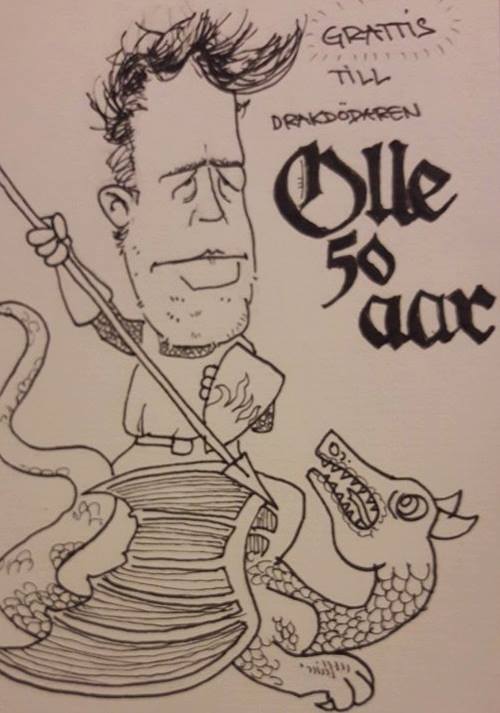
1) Jag tar tillfället i akt att visa den kärleksfulla nidbild av mig som Thore, med anspelning på min bok Here Be Dragons, ritade i samband med min bemärkelsedag förra året.

2) Det är inte ofta som schacksverige uppmärksammar mina framträdanden, så att båda dessa sajter kom att göra det denna gång får mig att höja på ögonbrynet. En tillfällighet? Eller räcker den schackrelaterade bild som arrangörerna i Lund använt sig av i annonseringen som förklaring? Jag tror inte att redaktörerna på Inte bara schack och schack.se samarbetar, men det skulle kunna finnas en tredje part - någon AI-intresserad schackspelare någonstans i landet - som tipsat båda, och som därmed utgör den gemensamma nämnaren. Kan det rentav vara så att någon läsare av denna blogg sitter på information som kan stilla min nyfikenhet?

3) Vad gäller den sistnämnda vill jag en gnutta skamset framhålla att den inte är den bästa intervju jag givit. Jag svarade på frågorna via epost och hade ont om tid, och antog lite förhastat att det skulle komma följdfrågor. Jag borde åtminstone ha utvecklat att par av de mer korthuggna svaren. "Den potential AI har att berika samhällsekonomin och våra liv är enorm, men det gäller även riskerna" hade helt klart varit ett bättre och mer balanserat svar än "Riskerna är enorma" på frågan om huruvida vi bör vara rädda för AI.4 Och vad gäller jämförelsen mellan ett schackprogram och en robotiserad kassörska kunde jag exempelvis ha farmhållit att medan schackprogrammet har en välavgränsad spelplan, väldefinierade regler och en klockrent specificerad målfunktion så är allt detta ofantligt mycket mer komplicerat och oklart för en snabbköpskassörska, som behöver vara kapabel att hantera inte bara standardsituationer som att kvittorullen tar slut eller att kundens kreditkort visar sig ogiltigt, utan även en miljard andra situationer, som 6-åringen som gråter över att ha tappat bort sin förälder någonstans i den stora affären, pensionären som insisterar på att det stått i tidningen att grönkålen kostar 19:90, och fyllot som vomerar på varubandet eller som ställd inför upplysningen att endast personaltoalett finns svarar med att hota att urinera i lösgodiset.

4) Strängt taget tillför väl inte det längre svaret någon information som läsaren inte kan väntas redan känna till, men det handlar här mer om social signalering än om informationsöverföring i snäv mening. Det är viktigt för mig att framstå som en klok och balanserad tänkare snarare än som en extremist och en domedagspredikant.

onsdag 31 oktober 2018

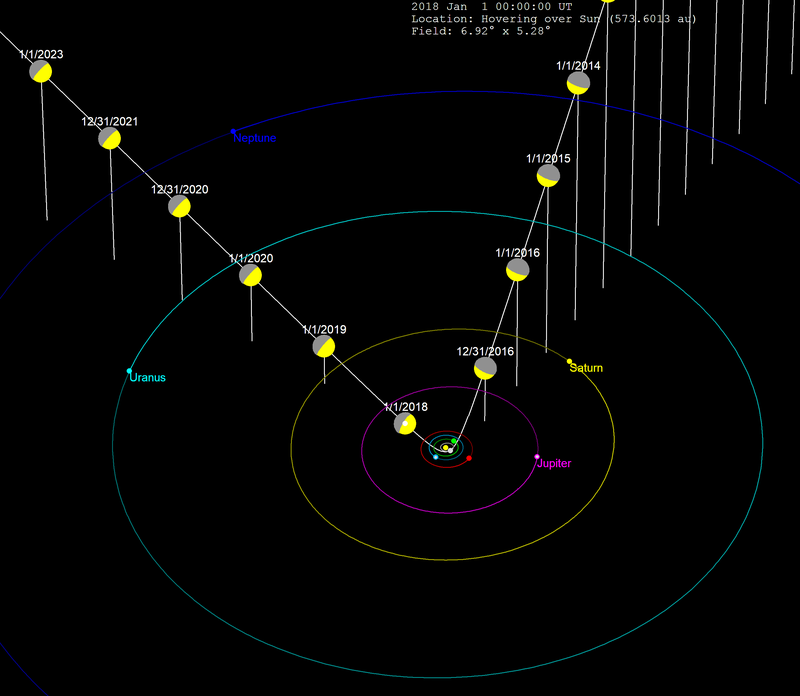
'Oumuamua-mysteriet

Är vi ensamma, eller finns det andra civilisationer där ute bland stjärnorna? Den frågan hör till de största vi kan ställa oss, och som om den inte vore spännande nog i sig har den en praktisk sida, då svaret kan ha stora konsekvenser för mänsklighetens framtidsutsikter. Detta sista tydliggörs med den så kallade The Great Filter-formalismen, som i korthet utgår från observationen att från kanske 1022 (ge eller ta en tiopotens eller två) potentiellt livgivande planeter i det synliga universum så verkar det som om inte en enda har utvecklat en teknologisk supercivilisation av sådana dimensioner att den är synlig för astronomer var som helst i sagda universum, och konstaterar att någonstans på vägen från potentiellt livgivande planet till supercivilisation finns en flaskhals (eller flera) som är extremt svår att passera. Har vi (mänskligheten) passerat denna flaskhals, eller ligger den ännu framför oss? Om detta har jag skrivit här på bloggen, i Kapitel 9 i min senaste bok Here Be Dragons, och i en artikel i International Journal of Astrobiology tillsammans med Chalmerskollegan Vilhelm Verendel häromåret.

Ett problem för den som vill göra framsteg på det här området är bristen på direkta data, utöver den ensamma datapunkt som den stora tystnaden därute utgör, och det ständigt ökande antalet upptäckta exoplaneter som backar upp uppskattningar som den ovan om antalet potentiellt livgivande planeter därute. (Indirekta data om hur allmänt gästvänligt vårt universum är för härbärgerande av liv finns det mer gott om, och skall inte fnysas åt. Ämnet astrobiologi sysslar med sådant.)

Men när det plötsligt dyker upp något som är en helt ny och möjligen relevant datatpunkt, så förtjänar det vårt intresse. Som stenbumlingen (eller vad det nu är) 'Oumuamua.

'Oumuamua upptäcktes den 19 oktober 2017, och det kunde snabbt rekonstrueras att den 40 dagar tidigare passerat sitt preihelium i närheten av Merkurius omloppsbana (och några äldre fotografier där 'Oumuamua dittills obemärkt figurerat kunde rotas fram till stöd för det). Det väntade hade varit att notera den som ännu en asteroid eller komet. Sådana rör sig (med vanligtvis god precision) i elliptiska banor runt solen. Hur avlång ellipsen är beskrivs matematiskt av dess excentricitet e mellan 0 och 1, där e=0 svarar mot en perfekt cirkel, och banan blir alltmer avlång ju mer e närmar sig 1. Problemet med 'Oumuamua är att dess e-värde uppmättes till cirka 1.2, vilket innebär att banan inte är elliptisk utan hyperbolisk, vilket i sin tur tyder på att 'Oumuamua blott är en gäst (den första och hittills enda vi observerat) i vårt solsystem, alltså ett objekt som kommit inramlandes från den interstellära rymden.

Allt detta är spännande nog, men det finns mer att säga om 'Oumuamua med potential att kittla vår fantasi:
  • Den är ovanligt avlång. Dess dimensioner är behäftade med osäkerhet, men den bästa uppskattningen pekar på en längd på 230 meter och bredd resepektive tjocklek på 35 meter vardera. Även om den ovanliga formen kan få den fantasifulle att associera till Clarkeska monoliter, så är det inte i sig tillräckligt för att vi på allvar skall börja fundera på om 'Oumuamua är ett artificiellt föremål från en utomjordisk civilisation, men det kommer mer:
  • Robin Hanson (mannen bakom The Great Filter) påpekade samma höst att av interstellära objekt av 'Oumuamuas storlek som når tillräckligt långt in i vårt solsystem för att vi skall väntas observera dem, så träffar 'Oumuamua närmare Solen än 99% kan väntas göra, förutsatt att det inte suttit någon därute och avsiktligt siktat nära Solen. Källhänvisningen för denna sifferuppgift är inte klockren, men om vi ändå antar att den är riktig så har vi alltså ett p-värde på 0.01. Jag har i andra sammanhang framhållit att p-värden i den storleksordningen inte är fullt så imponerande som många tycks tro, och det gäller givetvis i än högre grad då nollhypotesen som i detta fall formulerats efter att man sett data. När alternativhypotesen är av så spektakulär natur som i detta fall - att någon avsiktligt skickat 'Oumuamua till vårt solsystem - är anledningen till skepsis ännu större, men jag kan inte se att det skulle vara något allvarligt fel att låta siffran inspirera oss att fundera vidare över den hypotesen. Och det kommer ännu mer:
  • I en artikel i Nature tidigare i år påvisades att 'Oumuamua bana uppvisat avvikelser (med överväldigande statistisk signifikans) från vad gravitationsteorin förutsäger. En naturlig förklaring till en sådan avvikelse vore om 'Oumuamua likt en komet uppvisade avdunstning från ytan till följd av den infallande solstrålningen. Ett rykande (no pun intended) aktuellt preprint av astrofysikerna Shmuel Bialy och Abraham Loeb, och en kommentar till denna av Paul Gilster, hävdar dock att kometteorin inte håller. Istället föreslås solvind som en förklaring, vilket dock kräver att 'Oumuamua har så liten massa att den blott kan vara ett lövtunt skal (högst cirka 0.3 mm). Vad som kan skapa ett sådant objekt vet vi inte, men Bialy och Loeb föreslår att "one possibility is a lightsail floating in interstellar space as debris from an advanced technological equipment".
Och Gilster bjuder på andra överslagsräkningar som ytterligare förstärker intrycket att det är något skumt med 'Oumuamua.

Givet sin blygsamma storlek är 'Oumuamua nu bortom räckhåll för våra teleskop, men jag anser att gåtan om dess beskaffenhet och ursprung är tillräckligt angelägen för att vi inte skall låta en sådan detalj knäcka oss. Gilster hävdar visserligen att "it’s too late to get a mission off to chase it with chemical rockets", men det torde i så fall finnas andra tekniska lösningar. Till vilken kostnad det går att göra vet jag inte, men om det skulle gå att rymma inom en budget på säg 100 miljarder kronor (som två Large Hadron Colliders, typ) så tycker jag utan tvekan att vi skall försöka. Jag håller fortfarande för troligast att 'Oumuamua har naturligt ursprung, men tillräckligt mycket fog finns idag för spekulationer om motsatsen för att en närmare undersökning skall ha väldigt hög prioritet.

Edit: Knappt har jag tryckt på knappen för att publicera denna bloggpost förrän jag nås av tips om ett preprint av Andreas Hein et al med detaljer om hur den rymdexpedition jag efterfrågar i sista stycket skulle kunna genomföras.

tisdag 18 september 2018

An essential collection on AI safety and security

The xxix+443-page book Artificial Intelligence Safety and Security, edited by Roman Yampolskiy, has been out for a month or two. Among its 28 independent chapters (plus Yamploskiy's introduction), which have a total of 47 different authors, the first 11 (under the joint heading Concerns of Luminaries) have previously been published, with publication years ranging from 2000 to 2017, while the remaining 17 (dubbed Responses of Scholars) are new. As will be clear below, I have a vested interest in the book, so the reader may want to take my words with a grain of salt when I predict that it will quickly become widely accepted as essential reading in the rapidly expanding and increasingly important fields of AI futurology, AI risk and AI safety; nevertheless, that is what I think. I haven't yet read every single chapter in detail, but have seen enough to confidently assert that while the quality of the chapters is admittedly uneven, the book still offers an amazing amount of key insights and high-quality expositions. For a more systematic account by someone who has read all the chapters, see Michaël Trazzi's book review at Less Wrong.

Most of the texts in the Concerns of Luminaries part of the book are modern classics, and six of them were in fact closely familiar to me even before I had opened the book: Bill Joy's early alarm call Why the future doesn't need us, Ray Kurzweil's The deeply intertwined promise and peril of GNR (from his 2005 book The Singularity is Near), Steve Omohundro's The basic AI drives, Nick Bostrom's and Eliezer Yudkowsky's The ethics of artificial intelligence, Max Tegmark's Friendly artificial intelligence: the physics challenge, and Nick Bostrom's Strategic implications of openness in AI development. (Moreover, the papers by Omohundro and Tegmark provided two of the cornerstones for the arguments in Section 4.5 (The goals of a superintelligent machine) of my 2016 book Here Be Dragons.) Among those that I hadn't previously read, I was struck most of all by the urgent need to handle the near-term nexus of risks connecting AI, chatbots and fake news, outlined in Matt Chessen's The MADCOM future: how artificial intelligence will enhance computational propaganda, reprogram human cultrure, and threaten democracy... and what can be done about it.

The contributions in Responses of Scholars offer an even broader range of perspectives. Somewhat self-centeredly, let me just mention that three of the most interesting chapters were discussed in detail by the authors at the GoCAS guest researcher program on existential risk to humanity organized by Anders Sandberg and myself at Chalmers and the University of Gothenburg in September-October last year: James Miller's A rationally addicted artificial superintelligence, Kaj Sotala's Disjunctive scenarios of catastrophic AI risk, and Phil Torres' provocative and challenging Superintelligence and the future of governance: on prioritizing the control problem at the end of history. Also, there's my own chapter on Strategies for an unfriendly oracle AI with reset button. And much more.

fredag 24 augusti 2018

On the ethics of emerging technologies and future scientific advances

My essay Vetenskap på gott och ont, which I announced in a blog post in April this year, is now available in English translation: Science for good and science for bad. From the introduction:
    My aim in this text is to explain and defend my viewpoint concerning the role of science in society and research ethics which permeates the ethical arguments in my recent book Here Be Dragons: Science, Technology and the Future of Humanity (Häggström, 2016). To clarify my view, I will contrast it with two more widespread points of view which I will call the academic-romantic and the economic-vulgar. These will be sketched in Section 2. In Section 3 I explain what is missing in these approaches, namely, the insight that scientific progress may not only make the world better but may also make it worse, whence we need to act with considerably more foresight than is customary today. As a concrete illustration, I will in Section 4 discuss what this might mean for a specific area of research, namely artificial intelligence. In the concluding Section 5 I return to some general considerations about what I think ought to be done.
Read the entire text here.

onsdag 15 augusti 2018

Singularities

Just today, I came across the 2017 paper Singularities and Cognitive Computing. It deals with AI futurology, a topic I am very much interested in. Author of the paper is Devdatt Dubhashi. Here are four things that struck me, from a mostly rather personal perspective, about the paper:
    (1) The name Häggström appears four times in the short paper, and in all four cases it is me that the name refers to. I am flattered by being considered worthy of such attention.
So far so good, but my feelings about the remaining points (2)-(4) are not quite as unambiguously positive. I'll refrain from passing moral judgement on them - better to let them speak for themselves and let the reader be the judge.
    (2) The paper was published in the summer of 2017, a large fraction of it is devoted to countering arguments by me, and the author is a Chalmers University of Technology colleague of mine with whom I've previously had fruitful collaborations (resulting in several joint papers). These observations in combination make it slightly noteworthy that the paper comes to my attention only now (and mostly by accident), a full year after publication.

    (3) The reference list contains 10 items, but strikingly omits the one text that almost the entire Section 2 of the paper attempts to engage with, namely my February 2017 blog post Vulgopopperianism. That was probably not by mistake, because at the first point in Section 2 in which it is mentioned, its URL address is provided. So why the omission? I cannot think of a reason other than that, perhaps due to some grudge against me, the author wishes to avoid giving me the bibliometric credit that mentioning it in the reference list would yield. (But then why mention my book Here Be Dragons in the reference list? Puzzling.)

    (4) In my Vulgopopperianism blog post I discuss two complementary hypotheses (H1) and (H2) regarding whether superintelligence is achievable by the year 2100. Early in Section 2 of his paper, Dubhashi quotes me correctly as saying in my blog post that "it is not a priori obvious which of hypotheses (H1) and (H2) is more plausible than the other, and as far as burden of proof is concerned, I think the reasonable thing is to treat them symmetrically", but in the very next sentence he goes overboard by claiming that "Häggström suggests [...] that one can assign a prior belief of 50% to both [(H1) and (H2)]". I suggest no such thing in my blog post, and certainly do not advocate such a position (unless one reads the word "can" in Dubhashi's claim absurdly literally, meaning "it is possible for a Bayesian to set up a model in which each of the hypotheses has probability 50%"). If the sentence that he quoted from my blog post had contained the passage "as far as a priori probabilities are concerned" rather then "as far as burden of proof is concerned", then his claim would have been warranted. But the fact is that I talked about "burden of proof", not "a priori probabilities", and it is clear from this and from the surrounding context that what I was discussing was Popperian theory of science rather than Bayesianism.1 It is still possible that the mistake was done in good faith. Perhaps, despite being a highly qualified university professor, Dubhashi does not understand the distinction (and tension) between Popperian and Bayesian theory of science.2

Footnotes

1) It is very much possible to treat two or more hypotheses symmetrically without attaching them the same prior probability (or any probability at all). As a standard example, consider a frequentist statistician faced with a sample from a Gaussian distribution with unknown mean μ and unknown variance σ2, making a 95% symmetric confidence interval for μ. Her procedure treats the hypotheses μ<0 and μ>0 symmetrically, while not assigning them any prior probabilities at all.

2) If this last speculation is correct, then one can make a case that I am partly to blame. In Chapter 6 of Here Be Dragons - which Dubhashi had read and liked - I treated Popperianism vs Bayesianism at some length, but perhaps I didn't explain things sufficiently clearly.

tisdag 31 juli 2018

On dual-use technologies

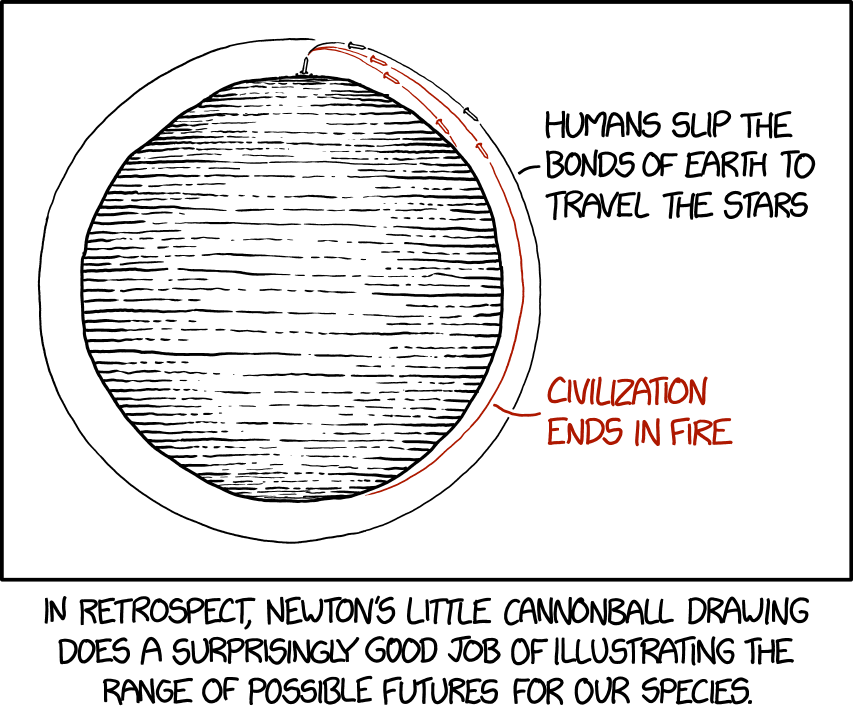
Dual-use technologies are technologies that can be applied both for causing death and destruction and for more benign purposes. An xkcd strip last month illustrates the concept beautifully by recycling Isaac Newton's cannonball thought experiment:

In my 2016 book Here Be Dragons: Science, Technology and the Future of Humanity, I point out at some length the troublesome fact that many emerging technologies have this dual-use feature, and that the dangers are in some cases of such a magnitude that they can mean the end of civilization and humanity. How should we react to this fact? I often encounter the attitude that since there are no inherently good or evil technologies but only good or even uses of them, engineers need not worry about ethical concerns when deciding what to develop. In my recent manuscript Vetenskap på gott och ont (in Swedish) I wholeheartedly condemn that attitude, and view it as an attempt to fall back on a simple one-liner in order to grant oneself the luxury of not having to think inconvenient thoughts ("ett simpelt slagord avsett för att slippa tänka obekväma tankar") or take responsibility for the consequences of one's work.

What to do instead? In Here Be Dragons I admit not having any easy answers to that, but suggest that an improved understanding of the landscape of possible future technologies and their consequences for humanity would improve the odds of a happy outcome, and that it might be a good idea to launch some IPCC-like international body with the task of summerizing our (sparse, but improving) knowledge in this field and making that knowledge available to decision makers on all levels (IPCC is short for Intergovernmental Panel on Climate Change). I was pleased to learn, quite recently, that Daniel Bressler at Columbia University and Jeff Alstott at MIT have developed, in some detail, a similar idea for the highly overlapping field of global catastrophic risk. Do have a look at their report The Intergovernmental Panel on Global Catastrophic Risks (IPGCR): A Proposal for a New International Organization.

måndag 14 maj 2018

Two well-known arguments why an AI breakthrough is not imminent

Much of my recent writing has concerned future scenarios where an artificial intelligence (AI) breakthrough leads to a situation where we humans are no longer the smartest agents on the planet in terms of general intelligence, in which case we cannot (I argue) count on automatically remaining in control; see, e.g., Chapter 4 in my book Here Be Dragons: Science, Technology and the Future of Humanity, or my paper Remarks on artificial intelligence and rational optimism. I am aware of many popular arguments for why such a breakthrough is not around the corner but can only be expected in the far future or not at all, and while I remain open to the conclusion possibly being right, I typically find the arguments themselves at most moderately convincing.1 In this blog post I will briefly consider two such arguments, and give pointers to related and important recent developments. The first such argument is one that I've considered silly for as long as I've given any thought at all to these matters; this goes back at least to my early twenties. The second argument is perhaps more interesting, and in fact one that I've mostly been taking very seriously.

1. A computer program can never do anything creative, as all it does is to blindly execute what it has been programmed to do.

This argument is hard to take seriously, because if we do, we must also accept that a human being such as myself cannot be creative, as all I can do is to blindly execute what my genes and my environment have programmed me to do (this touches on the tedious old free will debate). Or we might actually bite that bullet and accept that humans cannot be creative, but with such a restrictive view of creativity the argument no longer works, as creativity will not be needed to outsmart us in terms of general intelligence. Anyway, the recent and intellectually crowd-sourced paper The Surprising Creativity of Digital Evolution: A Collection of Anecdotes from the Evolutionary Computation and Artificial Life Research Communities offers a fascinating collection of counterexamples to the claim that computer programs cannot be creative.

2. We should distinguish between narrow AI and artificial general intelligence (AGI). Therefore, as far as a future AGI breakthrough is concerned, we should not be taken in by the current AI hype, because it is all just a bunch of narrow AI applications, irrelevant to AGI.

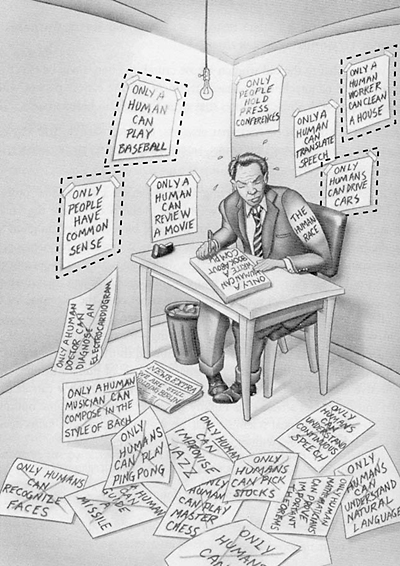
The dichotomy between narrow AI and AGI is worth emphasizing, as UC Berkeley computer scientist Michael Jordan does in his interesting recent essay Artificial Intelligence  - The Revolution Hasn’t Happened Yet. That discourse offers a healthy dose of skepticism concerning the imminence of AGI. And while the claim that progress in narrow AI is not automatically a stepping stone towards AGI seems right, the oft-repeated stronger claim that no progress in narrow AI can serve as such a stepping stone seems unwarranted. Can we be sure that the poor guy in the cartoon on the right (borrowed from Ray Kurzweil's 2005 book; click here for a larger image) can carry on much longer in his desperate production of examples of what only humans can do? Do we really know that AGI will not eventually emerge from a sufficiently broad range of specialized AI capabilities? Can we really trust Thore Husfeldt's image suggesting that Machine Learning Hill is just an isolated hill rather than a slope leading up towards Mount Improbable where real AGI can be found? I must admit that my certainty about such a topography in the landscape of computer programs is somewhat eroded by recent dramatic advances in AI applications. I've previously mentioned as an example AlphaZero's extraordinary and self-taught way of playing chess, made public in December last year. Even more striking is last week's demonstration of the Google Duplex personal assistant's ability to make intelligent phone conversations. Have a look:3

Footnotes

1) See Eliezer Yudkowsky's recent There’s No Fire Alarm for Artificial General Intelligence for a very interesting comment on the lack of convincing arguments for the non-imminence of an AI breakthrough.

2) The image appears some 22:30 into the video, but I really recommend watching Thore's entire talk, which is both instructive and entertaining, and which I had the privilege of hosting in Gothenburg last year.

3) See also the accompanying video exhibiting a wider range of Google AI products. I am a bit dismayed by its evangelical tone: we are told what wonderful enhancements of our lives these products offer, and there is no mention at all of possible social downsides or risks. Of course I realize that this is the way of the commercial sector, but I also think a company of Google's unique and stupendous power has a duty to rise above that narrow-minded logic. Don't be evil, goddamnit!

måndag 16 april 2018

Till storms mot de akademisk-romantiska och ekonomistisk-vulgära synsätten

I oktober förra året bidrog jag till ett symposium rubricerat Vetenskaplig redlighet och oredlighet arrangerat av Kungliga Vetenskaps- och Vitterhets-Samhället i Göteborg, och ombads efteråt stöpa om mitt föredrag till skriftligt format för publicering i en samlingsvolym ägnad symposiet. Jag är nu färdig med min uppsats, vilken (liksom mitt föredrag) fick rubriken... Uppsatsen kan beskrivas som ett 10-sidigt destillat av den forskaretiska ståndpunkt som präglar min bok Here Be Dragons: Science, Technology and the Future of Humanity från 2016 - en ståndpunkt som jag definierar i kontrast mot de vanligt förekommande synsätt jag valt att kalla de akademisk-romantiska och ekonomistisk-vulgära (varav jag själv bär på en dragning mot det förstnämnda, fast jag här tar avstånd från det). Om någon tycker att uppsatsen känns som en enda lång moralkaka så... javisst, lite så är det nog. Men läs den ändå!

fredag 30 mars 2018

A spectacularly uneven AI report

Earlier this week, the EU Parliament's STOA (Science and Technology Options Assessment) committee released the report "Should we fear artificial intelligence?", whose quality is so spectacularly uneven that I don't think I've ever seen anything quite like it. It builds on a seminar in Brussels in October last year, which I've reported on before on this blog. Four authors have contributed one chapter each. Of the four chapters, three are very good two are of very high quality, one is of a quality level that my modesty forbids me to comment on, and one is abysmally bad. Let me list them here, not in the order they appear in the report, but in one that gives a slightly better dramatic effect.
  • Miles Brundage: Scaling Up Humanity: The Case for Conditional Optimism about Artificial Intelligence.

    In this chapter, Brundage (a research fellow at the Future of Humanity Institute) is very clear about the distinction between conditional optimism and just plain old optimism. He's not saying that an AI breakthrough will have good consequences (that would be plain old optimism). Rather, he's saying that if it has good consequences, i.e., if it doesn't cause humanity's extinction or throw us permanently into the jaws of Moloch, then there's a chance the outcome will be very, very good (this is conditional optimism).

  • Thomas Metzinger: Towards a Global Artificial Intelligence Charter.

    Here the well-know German philosopher Thomas Metzinger lists a number of risks that come with future AI development, ranging from well-known ones concerning technological unemployment or autonomous weapons to more exotic ones arising from the possibility of constructing machines with the capacity to suffer. He emphasizes the urgent need for legislation and other government action.

  • Olle Häggström: Remarks on Artificial Intelligence and Rational Optimism.

    This text is already familiar to readers of this blog. It is my humble attempt to sketch, in a balanced way, some of the main arguments for why the wrong kind of AI breakthrough might well be an existential risk to humanity.

  • Peter Bentley: The Three Laws of Artificial Intelligence: Dispelling Common Myths.

    Bentley assigns great significance to the fact that he is an AI developer. Thus, he says, he is (unlike us co-contributors to the report) among "the people who understand AI the most: the computer scientists and engineers who spend their days building the smart solutions, applying them to new products, and testing them". Why exactly expertise in developing AI and expertise in AI futurology necessarily coincide in this way (after all, it is rarely claimed that farmers are in a privileged position to make predictions about the future of agriculture) is not explained. In any case, he claims to debunk a number of myths, in order to arrive at the position which is perhaps best expressed in the words he chose to utter at the seminar in October: superhumanly intelligent AI "is not going to emerge, that’s the point! It’s entirely irrational to even conceive that it will emerge" [video from the event, at 12:08:45]. He relies more on naked unsupported claims than on actual arguments, however. In fact, there is hardly any end to the inanity of his chapter. It is very hard to comment on at all without falling into a condescending tone, but let me nevertheless risk listing a few of its very many very weak points:

    1. Bentley pretends to speak on behalf of AI experts - in his narrow sense of what such expertise entails. But it is easy to give examples of leading AI experts who, unlike him, take AI safety and apocalyptic AI scenarios seriously, such as Stuart Russell and Murray Shanahan. AI experts are in fact highly divided in this issue, as demonstrated in surveys. Bentley really should know this, as in his chapter he actually cites one of these surveys (but quotes it in shamelessly misleading fashion).

    2. In his desperate search for arguments to back up his central claim about the impossibility of building a superintelligent AI, Bentley waves at the so-called No Free Lunch theorem. As I explained in my paper Intelligent design and the NFL theorems a decade ago, this result is an utter triviality, which basically says that in a world with no structure at all, no better way than brute force exists if you want to find something. Fortunately, in a world such as ours which has structure, the result does not apply. Basically the only thing that the result has going for it is its cool name, something that creationist charlatan William Dembski exploited energetically to try to give the impression that biological evolution is impossible, and now Peter Bentley is attempting the analogous trick for superintelligent AI.

    3. At one point in his chapter, Bentley proclaims that "even if we could create a super-intelligence, there is no evidence that such a super-intelligent AI would ever wish to harm us". What the hell? Bentley knows about Omohundro-Bostrom theory for instrumental vs final AI goals (see my chapter in the report for a brief introduction) and how it predicts catastrophic consequences in case we fail to equip the superintelligent AI with goals that are well-aligned with human values. He knows it by virtue of having read my book Here Be Dragons (or at least he cites it and quotes it), on top of which he actually heard me present the topic at the Brussels seminar in October. Perhaps he has reasons to believe Omohundro-Bostrom theory to be flawed, in which case he should explain why. Simply stating out of the blue, as he does, that no reason exists for believing that a superintelligent AI might turn agianst us is deeply dishonest.

    4. Bentley spends a large part of his chapter attacking the silly straw man that the mere progress of Moore's law, giving increasing access to computer power, will somehow spontaneously create superintelligent AI. Many serious thinkers speculate about an AI breakthrough, but none of them (not even Ray Kurzweil) think computer power on its own will be enough.

    5. The more advanced an AI gets, the more involved will the testing step of its development be, claims Bentley, and goes on to argue that the amount of testing needed grows exponentially with the complexity of the situation, essentially preventing rapid development of advanced AI. His premise for this is that "partial testing is not sufficient - the intelligence must be tested on all likely permutations of the problem for its designed lifetime otherwise its capabilities may not be trustable", and to illustrate the immensity of this task he points out that if the machine's input consists of a mere 100 variables that each can take 10 values, then there are 10100 cases to test. And for readers for whom it is not evident that 10100 is a very large number, he writes it in decimal. Oh please. If Bentley doesn't know that "partial testing" is what all engineering projects need to resort to, then I'm beginning to wonder what planet he comes from. Here's a piece of homework for him: calculate how many cases the developers of the latest version of Microsoft Word would have needed to test, in order not to fall back on "partial testing", and how many pages would be needed for writing that number in decimal.

    6. Among the four contributors to the report, Bentley is alone in claiming to be able to predict the future. He just knows that superintelligent AI will not happen. Funny, then, that not even his claim that "we are terrible at predicting the future, and almost without exception the predictions (even by world experts) are completely wrong" doesn't seem to induce as much as a iota of empistemic humility into his prophecy.

    7. In the final paragraph of his chapter, Bentley reveals his motivation for writing it: "Do not be fearful of AI - marvel at the persistence and skill of those human specialists who are dedicating their lives to help create it. And appreciate that AI is helping to improve our lives every day." He is simply offended! He and his colleagues work so hard on AI, they just want to make the world a better place, and along comes a bunch of other people who have the insolence to come and talk about AI risks. How dare they! Well, I've got news for Bentley: The future development of AI comes with big risks, and to see that we do not even need to invoke the kind of superintelligence breakthrough that is the topic of the present discussion. There are plenty of more down-to-earth reasons to be "fearful" of what may come out of AI. One such example, which I touch upon in my own chapter in the report, is the development of AI technology for autonomous weapons, and how to keep this technology away from the hands of terrorists.

A few days after the report came out, Steven Pinker tweeted that he "especially recommend[s] AI expert Peter Bentley's 'The Three Laws of Artificial Intelligence: Dispelling Common Myths' (I make similar arguments in Enlightenment Now)". I find this astonishing. Is it really possible that Pinker is that blind to the errors and shortcomings in Bentley's chapter? Is there a name for the fallacy "I like the conclusion, therefore I am willing to accept any sort of crap as arguments"?

tisdag 20 februari 2018

Existentiell risk i Stockholm

På onsdag kväll i nästa vecka, den 28 februari, håller jag föredrag i Stockholm med rubriken Existential risks to humanity. Tidpunkt 17.30-18.30, plats Stockholms uiversitet, Universitetsvägen 10A, Södra huset, sal D7. Arrangör är föreningen Effektiv Altruism Sverige, och i deras inbjudan till föredraget finns följande sammanfattning:
    During the 21st century, extraordinary and perhaps disruptive advances can be expected within biotechnology, nanotechnology, and machine intelligence. The potential benefits of all these technologies are enormous, but so are the risks, including the possibility of human extinction.

    In this lecture, Olle Häggström will discuss some of the major existential risks facing humanity in the coming century or so, and explain why he thinks that the currently predominant attitude towards research and development - tantamount to running blindfolded at full speed through a minefield - ought to be revised in favor of more foresight and more caution.

    [...]

    Olle Häggström is a professor of mathematical statistics at Chalmers University of Technology. His most noted research achievements are in probability theory, but his cross-disciplinary research interests are wide-ranging and include climate science, artificial intelligence, and philosophy. The talk will be partly based on his 2016 book Here Be Dragons: Science, Technology and the Future of Humanity.

fredag 15 december 2017

Litet efterspel till panelen i Bryssel

Sent i lördags eftermiddag (den 9 december) ökade plötsligt trafiken hit till bloggen kraftigt. Den kom mestadels från USA, och landade till större delen på min bloggpost The AI meeting in Brussels last week från förrförra månaden, så till den grad att bloggposten inom loppet av 24 timmar klättrade från typ ingenstans till tredje plats på all-time-high-listan över denna bloggs mest lästa inlägg (slagen endast av de gamla bloggposterna Quickologisk sannolikhetskalkyl och Om statistisk signifikans, epigenetik och de norrbottniska farmödrarna). Givetvis blev jag nyfiken på vad som kunde ha orsakat denna trafikökning, och fann snabbt en Facebookupdatering av den framstående AI-forskaren Yann LeCun vid New York University. LeCun länkar till min Bryssel-bloggpost, och har ett imponerande antal Facebook-följare, vilket förklarar trafikökningen.

Precis som sin AI-forskarkollega Peter Bentley och kognitionsforskaren Steven Pinker - vilka båda deltog i Bryssel-panelen - anser LeCun att alla farhågor om en eventuell framtida AI-apokalyps är obefogade. Hans imponerande meriter som AI-forskare väcker såklart förhoppningar (hos den som läser hans Facebookuppdatering) om att han skall presentera väsentligt bättre argument för denna ståndpunkt än dem som Pinker och Bentley levererade i Bryssel - förhoppningar som dock genast kommer på skam. LeCuns retoriska huvudnummer är följande bisarra jämförelse:
    [F]ear mongering now about possible Terminator scenarios is a bit like saying in the mid 19th century that the automobile will destroy humanity because, although we might someday figure out how to build internal combustion engines, we have no idea how to build brakes and safety belts, and we should be very, very worried.
Vad som gör jämförelsen bisarr är att (åtminstone 1900-talets och dagens) bilar totalt saknar de självreproducerande och rekursivt självförbättrande egenskaper som en tillräckligt intelligent framtida AI enligt många bedömare kan väntas få, vilka är grunden för de potentiellt katstrofala intelligensexplosionsscenarier som diskuteras av bland andra Yudkowsky, Bostrom och Tegmark (liksom i min egen bok Here Be Dragons). Till skillnad mot i AI-scenarierna finns inget rimligt bilscenario där vår oförmåga att bygga fungerande bromsar skulle ta kål på mänskligheten (allt som skulle hända om det inte gick att få till en fungerande bromsteknologi vore att ingen skulle vilja köra bil och att biltillverkningen upphörde). Vad som krävs för att LeCuns jämförelse skall få minsta relevans är att han påvisar att fenomenet med en rekursivt självförbättrande AI inte kan bli verklighet, men han redovisar inte tillstymmelse till sådant argument.

LeCuns Facebookuppdatering bjuder också på en direkt självmotsägelse: han hävdar dels att "we have no idea of the basic principles of a purported human-level AI", dels att...
    [t]he emergence of human-level AI will not be a singular event (as in many Hollywood scenarios). It will be progressive over many many years. I'd love to believe that there is a single principle and recipe for human-level AI (it would make my research program a lot easier). But the reality is always more complicated. Even if there is a small number of simple principles, it will take decades of work to actually reduce it to practice.
Här frågar sig naturligtvis den vakne läsaren: om nu LeCun har rätt i sitt första påstående, hur i hela glödheta h-e kan han då ha den kunskap han gör anspråk på i det andra? Det kan naturligtvis hända att han har rätt i att utvecklingen kommer att gå långsamt, men hans dogmatiska tvärsäkerhet är (i avsaknad av solida argument för att backa upp ståndpunkten) direkt omdömeslös.

Vad som gör LeCuns Facebookuppdatering den 9 december ännu mer beklämmande är att dess text är kopierad från en kommentar han skrev i en annan Facebooktråd redan den 30 oktober. Uppenbarligen tyckte han, trots att han haft mer än en månad på sig att begrunda saken, att hans slagfärdigheter var av tillräckligt värde för att förtjäna ytterligare spridning.