Visar inlägg med etikett Isaac Newton. Visa alla inlägg

tisdag 31 juli 2018

On dual-use technologies

Dual-use technologies are technologies that can be applied both for causing death and destruction and for more benign purposes. An xkcd strip last month illustrates the concept beautifully by recycling Isaac Newton's cannonball thought experiment:
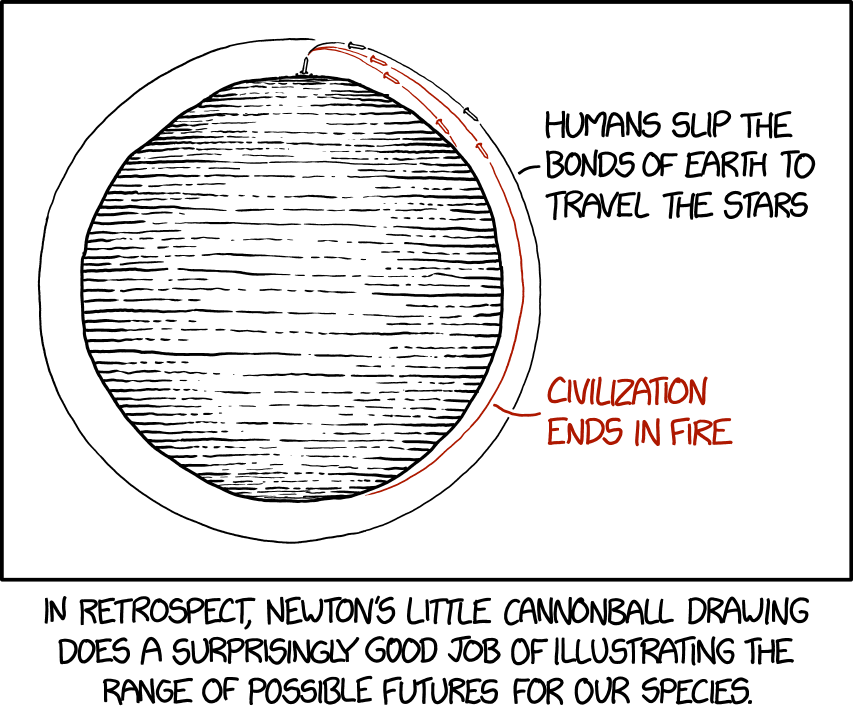
In my 2016 book Here Be Dragons: Science, Technology and the Future of Humanity, I point out at some length the troublesome fact that many emerging technologies have this dual-use feature, and that the dangers are in some cases of such a magnitude that they can mean the end of civilization and humanity. How should we react to this fact? I often encounter the attitude that since there are no inherently good or evil technologies but only good or even uses of them, engineers need not worry about ethical concerns when deciding what to develop. In my recent manuscript Vetenskap på gott och ont (in Swedish) I wholeheartedly condemn that attitude, and view it as an attempt to fall back on a simple one-liner in order to grant oneself the luxury of not having to think inconvenient thoughts ("ett simpelt slagord avsett för att slippa tänka obekväma tankar") or take responsibility for the consequences of one's work.

What to do instead? In Here Be Dragons I admit not having any easy answers to that, but suggest that an improved understanding of the landscape of possible future technologies and their consequences for humanity would improve the odds of a happy outcome, and that it might be a good idea to launch some IPCC-like international body with the task of summerizing our (sparse, but improving) knowledge in this field and making that knowledge available to decision makers on all levels (IPCC is short for Intergovernmental Panel on Climate Change). I was pleased to learn, quite recently, that Daniel Bressler at Columbia University and Jeff Alstott at MIT have developed, in some detail, a similar idea for the highly overlapping field of global catastrophic risk. Do have a look at their report The Intergovernmental Panel on Global Catastrophic Risks (IPGCR): A Proposal for a New International Organization.

onsdag 11 februari 2015

Douglas Adams - några favoritcitat

En av de slagfärdigaste och roligaste personer som världen skådat är den på tok för tidigt bortgångne engelske författaren Douglas Adams (1951-2001), mest känd för den underbara Liftarens guide-trilogin.1 Här är några av mina favoriter bland hans yttranden, hämtade från Wikiquotes Douglas Adams-sida:
  • I takt med att Liftarens guide-trilogin utökades till både fyra och fem delar hade Adams vissa svårigheter att hålla uppe den briljanta nivån på prosan, men när han började på nytt med Dirk Gentlys holistiska detektivbyrå (1987) blev det en nytändning och ett mästerverk. Följande passage ur boken behandlar den så kallade kattdörren, som en halsbrytande illustration till distinktionen mellan upptäckt och uppfinning:
      "Sir Isaac Newton, renowned inventor of the milled-edge coin and the catflap!"

      "The what?" said Richard.

      "The catflap! A device of the utmost cunning, perspicuity and invention. It is a door within a door, you see, a ..."

      "Yes," said Richard, "there was also the small matter of gravity."

      "Gravity," said Dirk with a slightly dismissed shrug, "yes, there was that as well, I suppose. Though that, of course, was merely a discovery. It was there to be discovered." ... "You see?" he said dropping his cigarette butt, "They even keep it on at weekends. Someone was bound to notice sooner or later. But the catflap ... ah, there is a very different matter. Invention, pure creative invention. It is a door within a door, you see."

  • En fråga inom kosmologin som jag då och då haft anledning att snudda vid här på bloggen är det så kallade finjusteringsproblemet - hur kommer det sig att naturlagarnas konstanter antar värden som på ett vad det verkar närmast mirakuöst vis passar för uppkomsten av liv? Vanliga försök till svar inbegriper existensen av antingen en Gud eller ett mutiversum. En helt annan förklaring går ut på att finjusteringsproblemet är ett missförstånd grundat i våra alltför snäva idéer om hur liv, intelligens och medvetande kan te sig, och formulerades på följande vis av Adams i ett föredrag i Cambridge 1998:
      Imagine a puddle waking up one morning and thinking, "This is an interesting world I find myself in — an interesting hole I find myself in — fits me rather neatly, doesn't it? In fact it fits me staggeringly well, must have been made to have me in it!"
    Adams fortsätter sedan vattenpölsanalogin för att inskärpa ännu en viktig poäng, nära släkt med Russells kalkon:
      This is such a powerful idea that as the sun rises in the sky and the air heats up and as, gradually, the puddle gets smaller and smaller, it's still frantically hanging on to the notion that everything's going to be alright, because this world was meant to have him in it, was built to have him in it; so the moment he disappears catches him rather by surprise. I think this may be something we need to be on the watch out for. We all know that at some point in the future the Universe will come to an end and at some other point, considerably in advance from that but still not immediately pressing, the sun will explode. We feel there's plenty of time to worry about that, but on the other hand that's a very dangerous thing to say.
  • Det talas mycket om jordens undergång, men det mesta som sägs är strängt taget ovederhäftigt, genom att det förbiser följande viktiga distinktion, som Adams föredömligt besserwisseraktigt framhöll i ett föredrag på UC Santa Barbara kort före sin död:
      We don't have to save the world. The world is big enough to look after itself. What we have to be concerned about is whether or not the world we live in will be capable of sustaining us in it.
  • Jag har inte läst Adams postumt publicerade The Salmon of Doubt, men följande ofta citerade observation ur boken synes mig insktsfull och väsentligen korrekt:
      I've come up with a set of rules that describe our reactions to technologies:

      1. Anything that is in the world when you’re born is normal and ordinary and is just a natural part of the way the world works.

      2. Anything that's invented between when you’re fifteen and thirty-five is new and exciting and revolutionary and you can probably get a career in it.

      3. Anything invented after you're thirty-five is against the natural order of things.

Fotnot

1) För mer om Douglas Adams, se t.ex. Richard Dawkins vackra minnesord i The Guardian.