- Miles Brundage: Scaling Up Humanity: The Case for Conditional Optimism about Artificial Intelligence.
In this chapter, Brundage (a research fellow at the Future of Humanity Institute) is very clear about the distinction between conditional optimism and just plain old optimism. He's not saying that an AI breakthrough will have good consequences (that would be plain old optimism). Rather, he's saying that if it has good consequences, i.e., if it doesn't cause humanity's extinction or throw us permanently into the jaws of Moloch, then there's a chance the outcome will be very, very good (this is conditional optimism).
- Thomas Metzinger: Towards a Global Artificial Intelligence Charter.
Here the well-know German philosopher Thomas Metzinger lists a number of risks that come with future AI development, ranging from well-known ones concerning technological unemployment or autonomous weapons to more exotic ones arising from the possibility of constructing machines with the capacity to suffer. He emphasizes the urgent need for legislation and other government action.
- Olle Häggström: Remarks on Artificial Intelligence and Rational Optimism.
This text is already familiar to readers of this blog. It is my humble attempt to sketch, in a balanced way, some of the main arguments for why the wrong kind of AI breakthrough might well be an existential risk to humanity.
- Peter Bentley: The Three Laws of Artificial Intelligence: Dispelling Common Myths.
Bentley assigns great significance to the fact that he is an AI developer. Thus, he says, he is (unlike us co-contributors to the report) among "the people who understand AI the most: the computer scientists and engineers who spend their days building the smart solutions, applying them to new products, and testing them". Why exactly expertise in developing AI and expertise in AI futurology necessarily coincide in this way (after all, it is rarely claimed that farmers are in a privileged position to make predictions about the future of agriculture) is not explained. In any case, he claims to debunk a number of myths, in order to arrive at the position which is perhaps best expressed in the words he chose to utter at the seminar in October: superhumanly intelligent AI "is not going to emerge, that’s the point! It’s entirely irrational to even conceive that it will emerge" [video from the event, at 12:08:45]. He relies more on naked unsupported claims than on actual arguments, however. In fact, there is hardly any end to the inanity of his chapter. It is very hard to comment on at all without falling into a condescending tone, but let me nevertheless risk listing a few of its very many very weak points:
1. Bentley pretends to speak on behalf of AI experts - in his narrow sense of what such expertise entails. But it is easy to give examples of leading AI experts who, unlike him, take AI safety and apocalyptic AI scenarios seriously, such as Stuart Russell and Murray Shanahan. AI experts are in fact highly divided in this issue, as demonstrated in surveys. Bentley really should know this, as in his chapter he actually cites one of these surveys (but quotes it in shamelessly misleading fashion).
2. In his desperate search for arguments to back up his central claim about the impossibility of building a superintelligent AI, Bentley waves at the so-called No Free Lunch theorem. As I explained in my paper Intelligent design and the NFL theorems a decade ago, this result is an utter triviality, which basically says that in a world with no structure at all, no better way than brute force exists if you want to find something. Fortunately, in a world such as ours which has structure, the result does not apply. Basically the only thing that the result has going for it is its cool name, something that creationist charlatan William Dembski exploited energetically to try to give the impression that biological evolution is impossible, and now Peter Bentley is attempting the analogous trick for superintelligent AI.
3. At one point in his chapter, Bentley proclaims that "even if we could create a super-intelligence, there is no evidence that such a super-intelligent AI would ever wish to harm us". What the hell? Bentley knows about Omohundro-Bostrom theory for instrumental vs final AI goals (see my chapter in the report for a brief introduction) and how it predicts catastrophic consequences in case we fail to equip the superintelligent AI with goals that are well-aligned with human values. He knows it by virtue of having read my book Here Be Dragons (or at least he cites it and quotes it), on top of which he actually heard me present the topic at the Brussels seminar in October. Perhaps he has reasons to believe Omohundro-Bostrom theory to be flawed, in which case he should explain why. Simply stating out of the blue, as he does, that no reason exists for believing that a superintelligent AI might turn agianst us is deeply dishonest.
4. Bentley spends a large part of his chapter attacking the silly straw man that the mere progress of Moore's law, giving increasing access to computer power, will somehow spontaneously create superintelligent AI. Many serious thinkers speculate about an AI breakthrough, but none of them (not even Ray Kurzweil) think computer power on its own will be enough.
5. The more advanced an AI gets, the more involved will the testing step of its development be, claims Bentley, and goes on to argue that the amount of testing needed grows exponentially with the complexity of the situation, essentially preventing rapid development of advanced AI. His premise for this is that "partial testing is not sufficient - the intelligence must be tested on all likely permutations of the problem for its designed lifetime otherwise its capabilities may not be trustable", and to illustrate the immensity of this task he points out that if the machine's input consists of a mere 100 variables that each can take 10 values, then there are 10100 cases to test. And for readers for whom it is not evident that 10100 is a very large number, he writes it in decimal. Oh please. If Bentley doesn't know that "partial testing" is what all engineering projects need to resort to, then I'm beginning to wonder what planet he comes from. Here's a piece of homework for him: calculate how many cases the developers of the latest version of Microsoft Word would have needed to test, in order not to fall back on "partial testing", and how many pages would be needed for writing that number in decimal.
6. Among the four contributors to the report, Bentley is alone in claiming to be able to predict the future. He just knows that superintelligent AI will not happen. Funny, then, that not even his claim that "we are terrible at predicting the future, and almost without exception the predictions (even by world experts) are completely wrong" doesn't seem to induce as much as a iota of empistemic humility into his prophecy.
7. In the final paragraph of his chapter, Bentley reveals his motivation for writing it: "Do not be fearful of AI - marvel at the persistence and skill of those human specialists who are dedicating their lives to help create it. And appreciate that AI is helping to improve our lives every day." He is simply offended! He and his colleagues work so hard on AI, they just want to make the world a better place, and along comes a bunch of other people who have the insolence to come and talk about AI risks. How dare they! Well, I've got news for Bentley: The future development of AI comes with big risks, and to see that we do not even need to invoke the kind of superintelligence breakthrough that is the topic of the present discussion. There are plenty of more down-to-earth reasons to be "fearful" of what may come out of AI. One such example, which I touch upon in my own chapter in the report, is the development of AI technology for autonomous weapons, and how to keep this technology away from the hands of terrorists.
fredag 30 mars 2018
A spectacularly uneven AI report

fredag 15 december 2017
Litet efterspel till panelen i Bryssel
- [F]ear mongering now about possible Terminator scenarios is a bit like saying in the mid 19th century that the automobile will destroy humanity because, although we might someday figure out how to build internal combustion engines, we have no idea how to build brakes and safety belts, and we should be very, very worried.
- [t]he emergence of human-level AI will not be a singular event (as in many Hollywood scenarios). It will be progressive over many many years. I'd love to believe that there is a single principle and recipe for human-level AI (it would make my research program a lot easier). But the reality is always more complicated. Even if there is a small number of simple principles, it will take decades of work to actually reduce it to practice.
måndag 23 oktober 2017
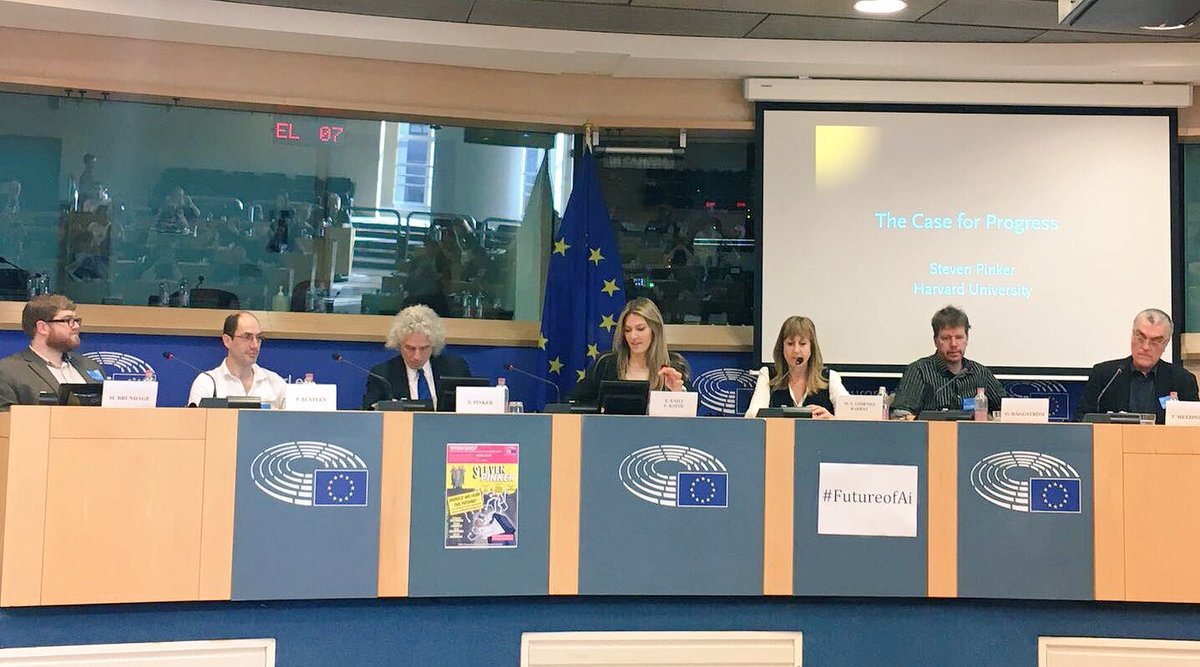
The AI meeting in Brussels last week
-
1. The general public already has the nuclear threat and the climate threat to worry about, and bringing up yet another global risk may overwhelm people and cause them to simply give up on the future. There may be something to this speculation, but to evaluate the argument's merit we need to consider separately the two possibilities of
-
(a) apocalyptic AI risk being real, and
(b) apocalyptic AI risk being spurious.
2. Pinker held forth a bunch of concerns that seemed more or less copy-and-pasted from the standard climate denialism discourse. These included the observation that the Millennium bug did not cause global catastrophe, whence (or so the argument goes) a global catastrophe cannot be expected from a superintelligent AGI (analogously to the oft-repeated claim that the old Greek's fear that the skies would fall down turing out to be unfounded shows that greenhouse gas emissions cannot accelerate global warming in any dangerous way), and speculations about the hidden motives of those who discuss AI risk - they are probably just competing for status and research grants. This is not impressive. See also yesterday's blog post by my friend Björn Bengtsson for more on this; it is to him that I owe the (in retrospect obvious) parallel to climate denialism.
-
3. All the apocalyptic AI scenarios involve the AI having bad goals, which leads Pinker to reflect on why in the world would anyone program the machine with bad goals - let's just not do that! This is essentially the idea of the so-called Friendly AI project (see Yudkowsky, 2008, or Bostrom, 2014), but what Pinker does not seem to appreciate is that the project is extremely difficult. He went on to ask why in the world anyone would be so stupid as to program self-preservation at all costs into the machine, and this in fact annoyed me slightly, because it happened just 20 or so minutes after I had sketched the Omohundro-Bostrom theory for how self-preservation and various other instrumental goals are likely to emerge spontaneously (i.e., without having them explicitly put into it by human programmers) in any sufficiently intelligent AGI.
4. In the debate, Pinker described (as he had done several times before) the superintelligent AGI in apocalyptic scenarios as having a typically male psychology, but pointed out that it can equally well turn out to have more female characteristics (things like compassion and motherhood), in which case everything will be all right. This is just another indication of how utterly unfamiliar he is with the literature on possible superintelligent psychologies. His male-female distinction in the general context of AGIs is just barely more relevant than the question of whether the next exoplanet we discover will turn out to be male or female.
- Why do we know that AGI is decades away? In popular articles penned by heads of AI research labs and the like, there are typically three prominent reasons given:
(A) The author does not know how to build AGI using present technology. The author does not know where to start.
(B) The author thinks it is really very hard to do the impressive things that modern AI technology does, they have to slave long hours over a hot GPU farm tweaking hyperparameters to get it done. They think that the public does not appreciate how hard it is to get anything done right now, and is panicking prematurely because the public thinks anyone can just fire up Tensorflow and build a robotic car.
(C) The author spends a lot of time interacting with AI systems and therefore is able to personally appreciate all the ways in which they are still stupid and lack common sense.